
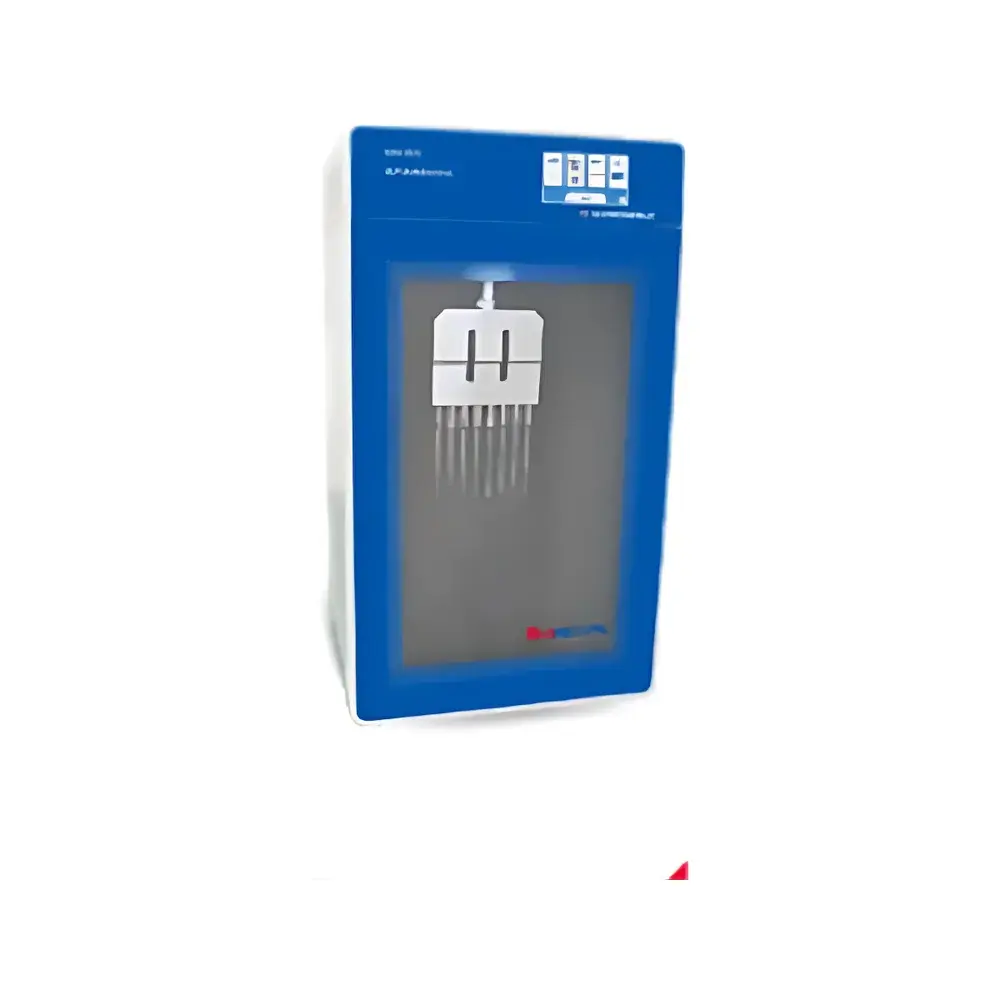
SHUMEI KBC-6TD Multi-Channel Ultrasonic Cell Disruptor
| Brand | SHUMEI |
|---|---|
| Origin | Jiangsu, China |
| Manufacturer Type | Direct Manufacturer |
| Product Category | Domestic |
| Model | KBC-6TD |
| Instrument Type | General-Purpose |
| Ultrasonic Frequency | 20 ± 0.5 kHz |
| Ultrasonic Power | 600 W |
| Power Adjustment Range | 0–100% |
| Time Adjustment Range | 1 min – 99 h 59 min |
Overview
The SHUMEI KBC-6TD Multi-Channel Ultrasonic Cell Disruptor is an engineered solution for high-throughput, reproducible sample lysis and homogenization in life science laboratories. Unlike conventional single-probe sonicators, this system employs parallel ultrasonic energy delivery via six independently controllable titanium alloy (Ti-6Al-4V) probes operating at a stable resonant frequency of 20 ± 0.5 kHz. The device utilizes piezoelectric transduction to generate intense cavitation fields within liquid media—inducing controlled microbubble formation, growth, and implosive collapse. This physical mechanism enables efficient disruption of cellular membranes, organelles, and extracellular matrices without significant thermal degradation when operated under pulsed or temperature-monitored conditions. Designed for consistency across replicates, the KBC-6TD is particularly suited for applications requiring strict inter-sample comparability—such as transcriptomic sample preparation, microbial lysis prior to DNA extraction, or nanoparticle dispersion protocols where batch uniformity is critical.
Key Features
- Six-channel synchronized ultrasonic output with individual amplitude control per probe
- Ti-6Al-4V titanium alloy sonotrodes (Φ6 mm standard; optional Φ3 mm variants available)
- High-efficiency piezoelectric transducer architecture delivering 600 W nominal output power
- Full-range power modulation (0–100%) and programmable time control (1 minute to 99 hours 59 minutes)
- Motorized vertical lift platform with integrated LED illumination for precise probe immersion depth adjustment
- Real-time temperature monitoring interface (optional external Pt100 sensor support) with over-temperature alarm threshold
- Touchscreen LCD control panel supporting up to nine user-defined protocol presets
- Integrated overload protection circuitry and acoustic isolation housing compliant with IEC 61000-6-3 EMC standards
- Modular stacking design enabling scalable integration into automated lab workflows
Sample Compatibility & Compliance
The KBC-6TD accommodates a wide range of biological and material science samples—including mammalian and plant tissues, bacterial and yeast cultures, viral suspensions, and synthetic nanomaterial dispersions. Sample volumes per channel range from 0.5 mL to 30 mL, compatible with standard microcentrifuge tubes, Eppendorf-style vials, and custom multi-well configurations. While not classified as a medical device, the instrument meets general laboratory safety requirements per EN 61010-1:2010 for electrical equipment used in measurement, control, and laboratory use. Its operational parameters align with common method validation frameworks referenced in ISO/IEC 17025-accredited labs—for example, consistent probe geometry and fixed frequency enable repeatable energy input calibration traceable to acoustic power meter measurements. Optional temperature feedback supports adherence to cold lysis protocols required by RNA integrity preservation guidelines (e.g., RIN > 8.0).
Software & Data Management
The embedded firmware provides non-volatile storage for nine full-parameter protocol templates, each including power setpoint, duration, pulse-on/off intervals (1 s–59 min 59 s), and probe selection mask. All executed runs are timestamped and logged locally with operator ID entry capability. While no proprietary PC software is bundled, the system exports run logs via USB-C port in CSV format for integration into LIMS or ELN platforms. Audit trail functionality satisfies basic GLP documentation needs; however, full 21 CFR Part 11 compliance requires third-party electronic signature middleware and networked server deployment—neither of which are natively supported. For regulated environments, users should validate the instrument’s repeatability using reference standards such as NIST-traceable acoustic power calibrators before routine deployment.
Applications
- High-yield genomic DNA and total RNA isolation from diverse tissue types
- Preparation of subcellular fractions (e.g., nuclear extracts, mitochondrial lysates)
- Disruption of biofilm-embedded bacteria for antimicrobial susceptibility testing
- Emulsification of oil-in-water formulations for pharmaceutical nanocarrier development
- Accelerated solvent extraction of phytochemicals from botanical matrices
- Deagglomeration and stabilization of carbon nanotubes, graphene oxide, and metal oxide nanoparticles
- Cleaning and surface activation of microfluidic chips and quartz crystal microbalance (QCM) sensors
FAQ
Is the KBC-6TD suitable for RNA extraction protocols requiring low-temperature operation?
Yes—when paired with the optional temperature sensor and configured with short pulse cycles (e.g., 5 s on / 10 s off), it maintains sample temperatures below 15 °C in ice-water baths, preserving RNA integrity.
Can I use different probe diameters simultaneously across the six channels?
No—the standard configuration uses identical Φ6 mm probes for uniform energy distribution. Mixed-diameter operation is not supported due to impedance mismatch risks and inconsistent cavitation thresholds.
What maintenance is required for long-term reliability?
Annual recalibration of transducer resonance frequency and visual inspection of sonotrode tip erosion are recommended. Avoid prolonged operation above 80% amplitude in viscous media to prevent premature fatigue cracking.
Does the system support remote triggering via TTL or Ethernet?
No native digital I/O interface is provided; external relay-based automation requires third-party hardware integration.
How does the KBC-6TD compare to cup-horn systems for cell lysis?
Unlike cup-horn designs that distribute energy indirectly through bath fluid, the KBC-6TD delivers focused, direct-contact ultrasonic energy—yielding higher lysis efficiency per watt and reduced cross-contamination risk between samples.



