
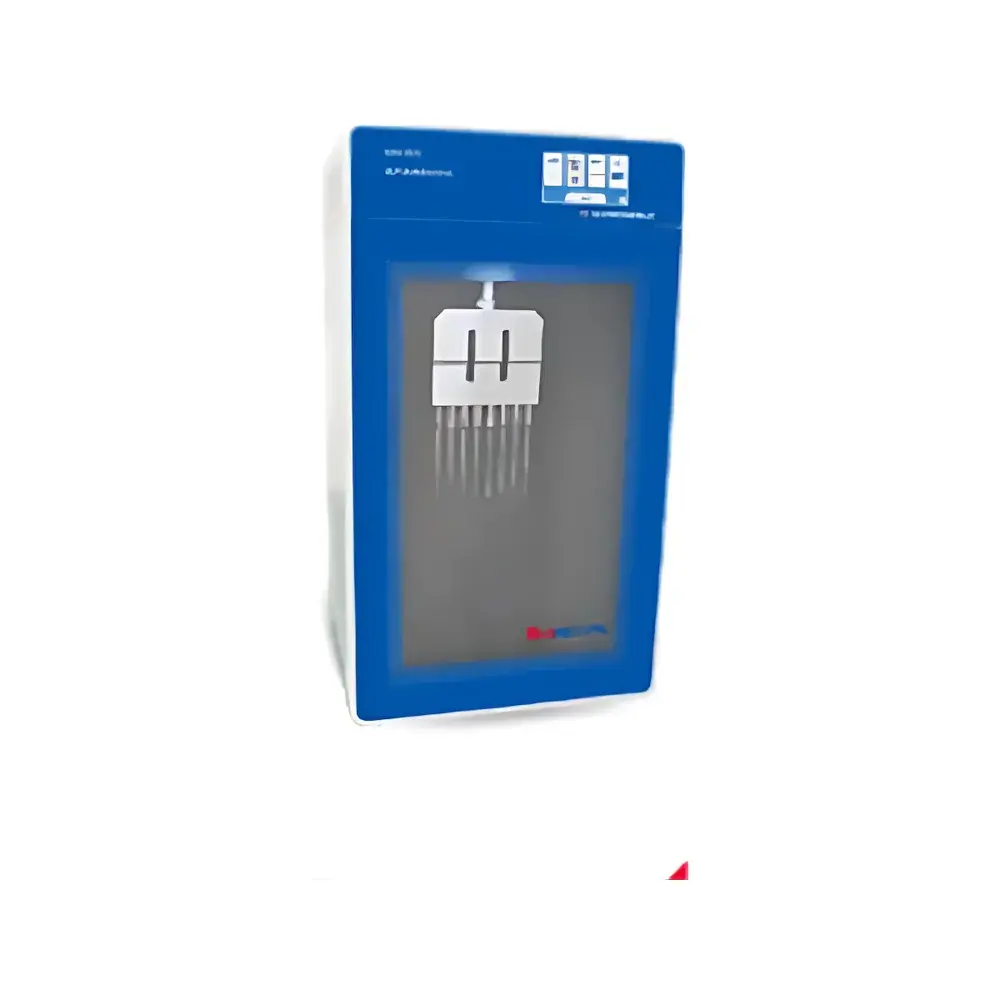
SHUMEI KBC-96TD Multi-Channel Ultrasonic Cell Disruptor
| Brand | SHUMEI |
|---|---|
| Origin | Jiangsu, China |
| Manufacturer Type | Direct Manufacturer |
| Product Category | Domestic |
| Model | KBC-96TD |
| Instrument Type | General-Purpose |
| Ultrasonic Frequency | 20 ± 0.5 kHz |
| Ultrasonic Power Output | 3000 W |
| Power Adjustment Range | 0–100% |
| Time Adjustment Range | 1 min – 99 h 59 min |
| Sample Capacity | 96-well deep-well plate compatibility |
| Transducer Material | Ti-6Al-4V titanium alloy |
| Probe Options | Φ3 mm (standard), Φ6 mm (optional) |
| User Program Storage | 9 presets |
Overview
The SHUMEI KBC-96TD Multi-Channel Ultrasonic Cell Disruptor is an engineered high-throughput sonication platform designed for parallel lysis of biological samples under tightly controlled acoustic conditions. It operates on the principle of high-intensity ultrasonic cavitation—where rapid pressure oscillations generate transient microbubbles in liquid media that collapse violently, producing localized shear forces, shockwaves, and thermal transients sufficient to disrupt cellular membranes and subcellular structures. Unlike single-probe sonicators or bath-type ultrasonic cleaners, the KBC-96TD integrates 96 individually coupled titanium alloy (Ti-6Al-4V) probes aligned precisely with standard 96-well deep-well plates, enabling simultaneous, uniform energy delivery across all wells without cross-contamination or positional bias. This architecture ensures high reproducibility in nucleic acid extraction, protein solubilization, organelle isolation, and nanoparticle dispersion—critical for applications requiring inter-sample comparability, such as transcriptomic library prep, high-content screening, and QC-controlled bioprocessing.
Key Features
- 96-channel synchronized ultrasonic output with independent amplitude consistency across all probes, minimizing well-to-well variability (CV < 5% under standardized load conditions)
- Ti-6Al-4V titanium alloy probes (Φ3 mm standard; Φ6 mm optional) offering superior acoustic impedance matching, corrosion resistance, and fatigue endurance over extended duty cycles
- Motorized vertical stage with precision height adjustment and integrated LED illumination for real-time visual monitoring of sample meniscus and cavitation activity
- Full-touch LCD interface supporting intuitive parameter entry, real-time power feedback, and 9 programmable user protocols with timestamped execution logs
- Comprehensive safety architecture: electronic overload protection, thermal cutoff (with optional PT100 sensor), and automatic shutdown upon lid open or probe misalignment detection
- Pulse-mode operation (1 s – 59 min 59 s intervals) to mitigate thermal accumulation during sensitive biomolecule processing
Sample Compatibility & Compliance
The KBC-96TD accommodates a broad range of biological matrices—including mammalian and insect cell suspensions, bacterial cultures (E. coli, Bacillus spp.), yeast pellets, plant tissue homogenates, viral lysates, and frozen-thawed tissue sections—within volumes of 0.3–0.5 mL per well. Its sealed probe array design prevents aerosol generation and maintains sterility when used in biosafety cabinets. The system complies with IEC 61000-6-3 (EMC emission standards) and IEC 61000-6-2 (immunity requirements). While not certified for ISO 13485 or FDA 21 CFR Part 11 out-of-the-box, its audit-ready digital log export (CSV/Excel), user-access-level password protection, and non-volatile protocol storage support GLP/GMP-aligned documentation practices. Optional temperature monitoring enables validation against USP analytical instrument qualification guidelines.
Software & Data Management
Operation is fully managed via an embedded ARM-based controller with a 7-inch capacitive touchscreen. All parameters—including power %, total duration, pulse sequence, and probe configuration—are stored in non-volatile memory with write-cycle logging. Timestamped execution records (start time, end time, average power, fault codes) are exportable via USB port in comma-separated format for LIMS integration or internal QA review. No external PC or proprietary software is required; however, the system supports RS-485 Modbus RTU communication for centralized lab automation systems (e.g., LabVantage, STARLIMS) when equipped with optional interface module.
Applications
- High-throughput genomic DNA/RNA extraction from cultured cells or clinical specimens prior to NGS library construction
- Preparation of soluble antigen extracts for ELISA and immunoassay development
- Disruption of Gram-positive bacteria and spore-forming strains where enzymatic lysis proves inefficient
- Nanomaterial dispersion in aqueous or organic media for DLS, TEM sample prep, and catalytic formulation
- Accelerated solvent-free extraction of secondary metabolites from botanical matrices (e.g., flavonoids, alkaloids)
- Emulsification of lipid nanoparticles (LNPs) for mRNA delivery system development
FAQ
Can the KBC-96TD be validated for regulated environments (e.g., pharmaceutical QC)?
Yes—when configured with the optional PT100 temperature sensor and used with documented SOPs, it supports IQ/OQ protocols per ASTM E2500 and ISO/IEC 17025 requirements.
Is probe sterilization possible between runs?
Titanium alloy probes tolerate autoclaving (121°C, 20 min, saturated steam); however, repeated sterilization may affect surface finish and require periodic calibration verification.
Does the system support variable amplitude per well?
No—the KBC-96TD delivers uniform amplitude across all 96 channels to ensure inter-well consistency; differential intensity control is not supported.
What maintenance is required for long-term reliability?
Biannual inspection of transducer coupling integrity, annual recalibration of power output (traceable to NIST-certified acoustic power meter), and routine cleaning of the well-plate alignment guide with ethanol.
Can deep-well plates from third-party vendors be used?
Yes—provided they conform to ANSI/SBS standard footprint (127.76 × 85.48 mm) and well depth ≥40 mm; SHUMEI provides dimensional tolerance specifications for compatibility verification.



