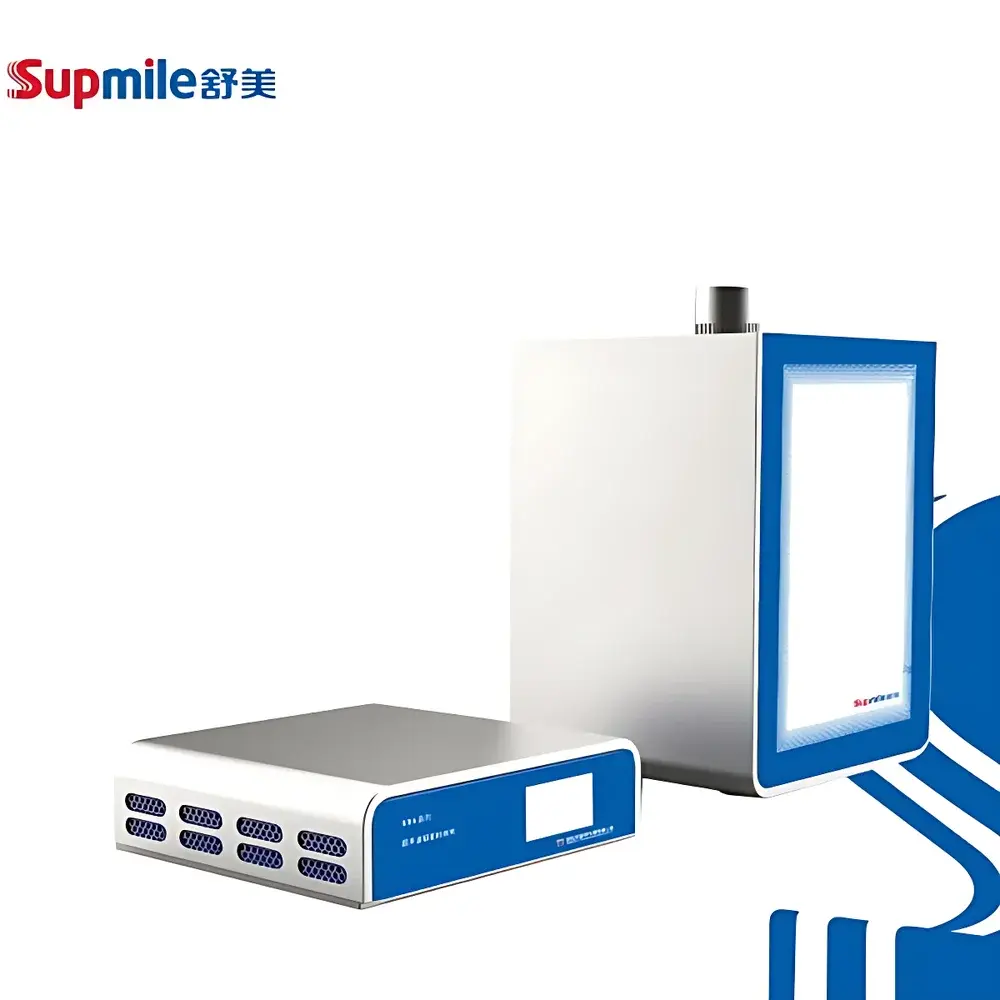
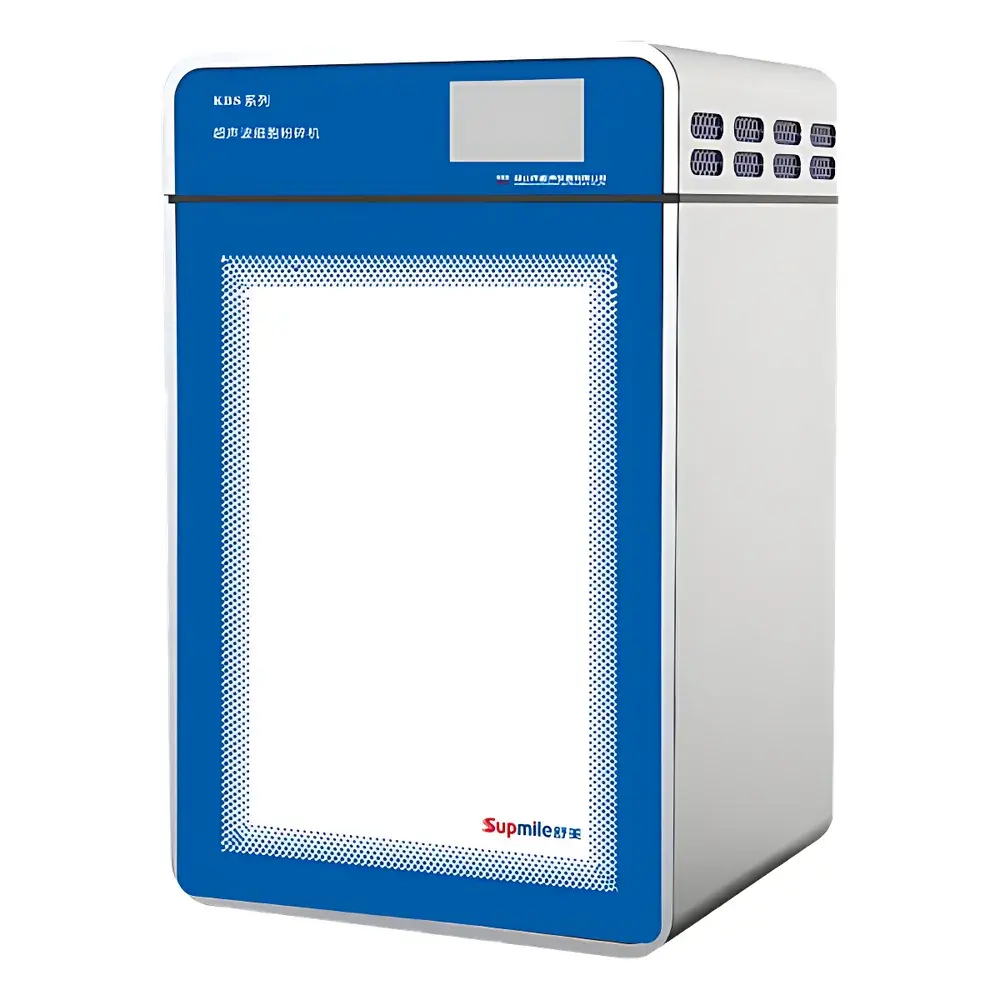
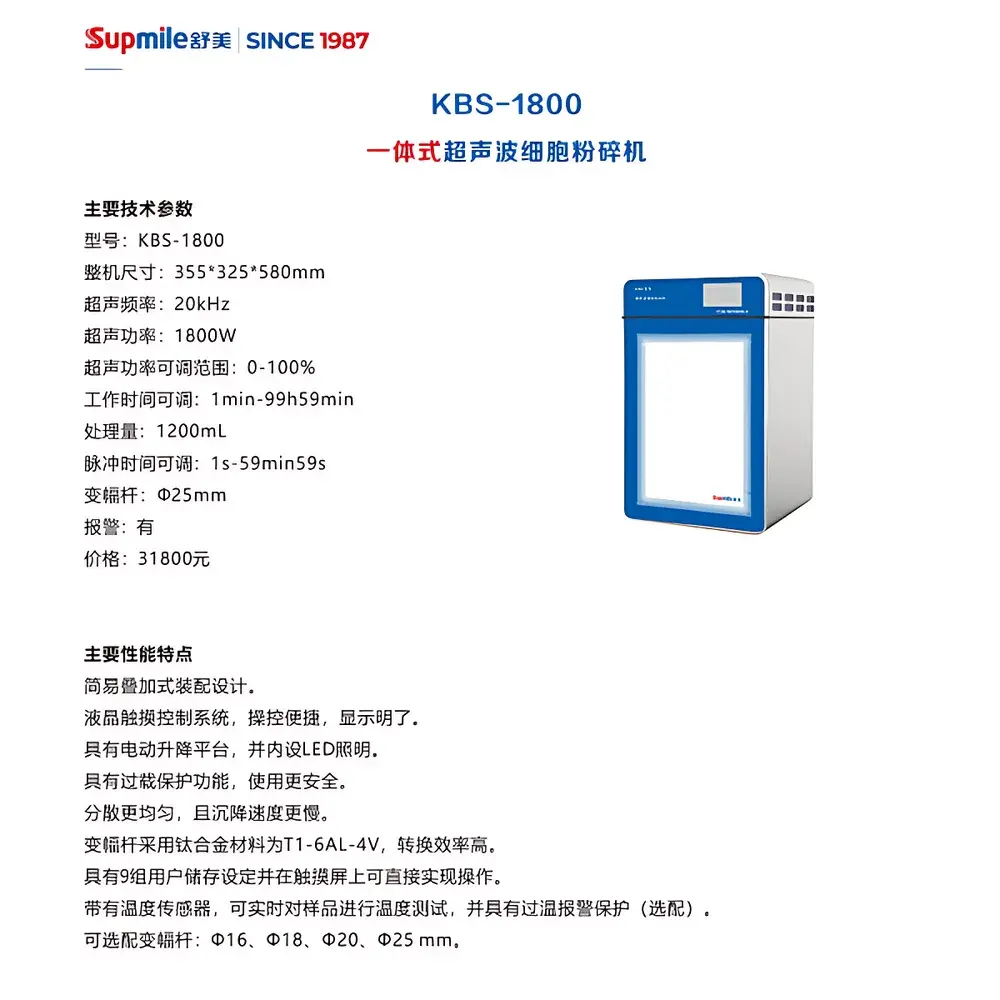
SHUMEI KBS-1800 Integrated High-Power Ultrasonic Cell Disruptor
| Brand | SHUMEI |
|---|---|
| Origin | Jiangsu, China |
| Manufacturer Type | Direct Manufacturer |
| Instrument Category | Domestic |
| Model | KBS-1800 |
| Quotation | USD 4,450 (FOB) |
| Instrument Type | Ultrasonic Cell Disruptor |
| Operating Frequency | 20 kHz |
| Ultrasonic Power Output | 1800 W |
| Adjustable Power Range | 0–100% |
| Time Setting Range | 1 min – 99 h 59 min |
| Pulse Duration Adjustment | 1 s – 59 min 59 s |
| Maximum Sample Volume | 1200 mL |
| Horn Diameter Options | Φ16, Φ18, Φ20, Φ25 mm (standard: Φ25 mm Ti-6Al-4V alloy) |
| Safety Features | Overload protection, overtemperature alarm (optional), LED illumination, motorized vertical lift stage |
| Control Interface | LCD touchscreen with 9 user-programmable memory slots |
| Dimensions (W×D×H) | 355 × 325 × 580 mm |
| Temperature Monitoring | Integrated PT100 sensor (optional) |
Overview
The SHUMEI KBS-1800 Integrated High-Power Ultrasonic Cell Disruptor is engineered for reproducible, scalable mechanical lysis of biological cells, tissues, and subcellular structures via high-intensity ultrasonic cavitation. Operating at a fundamental frequency of 20 kHz, the system generates controlled acoustic energy that induces transient microcavitation in liquid media—leading to localized shockwaves, microstreaming, and shear forces sufficient to disrupt membranes, solubilize inclusion bodies, and homogenize viscous or particulate suspensions. Designed as a self-contained benchtop unit, it integrates transducer, generator, and adjustable horn assembly within a single rigid chassis—eliminating alignment drift, minimizing energy loss at coupling interfaces, and ensuring consistent amplitude delivery across repeated runs. Its 1800 W nominal output power supports high-throughput processing of volumes up to 1200 mL per cycle, making it suitable for preparative-scale applications in protein purification, nucleic acid extraction, nanoparticle dispersion, and microbial lysate preparation.
Key Features
- Integrated motorized vertical lift stage with precision height adjustment—enabling repeatable immersion depth control and reducing operator variability.
- LCD touchscreen interface with intuitive icon-based navigation and nine programmable method slots for rapid recall of validated protocols.
- Titanium alloy (Ti-6Al-4V) sonotrode standard (Φ25 mm), offering superior acoustic impedance matching, corrosion resistance, and fatigue strength under continuous high-amplitude operation.
- Real-time digital power regulation (0–100%) with closed-loop feedback—maintaining stable amplitude despite load fluctuations or temperature-induced impedance shifts.
- Dual safety architecture: hardware-based overload cutoff plus optional PT100 temperature monitoring with configurable thermal threshold and audible/visual overtemperature alarm.
- Programmable pulse mode (1 s – 59 min 59 s on/off cycles) to mitigate sample heating and preserve thermolabile biomolecules during extended processing.
- Integrated LED illumination beneath the horn mount—facilitating visual confirmation of sample level, foam formation, and suspension homogeneity during operation.
Sample Compatibility & Compliance
The KBS-1800 accommodates a broad range of biological matrices including bacterial cultures (E. coli, Bacillus spp.), yeast (S. cerevisiae), mammalian cell lines (HEK293, CHO), plant tissue homogenates, and soft animal tissues. Compatible with aqueous buffers, low-conductivity solvents (e.g., ethanol/water mixtures), and viscous media (e.g., lysates containing genomic DNA or polysaccharides). All wetted components comply with ISO 10993-5 cytotoxicity requirements. The instrument’s electrical design conforms to IEC 61010-1:2010 for laboratory equipment safety. Optional data logging functionality supports audit-ready records aligned with GLP and GMP documentation practices; when paired with validated software, timestamped parameter logs—including power, duration, pulse settings, and (if equipped) temperature traces—meet FDA 21 CFR Part 11 requirements for electronic records.
Software & Data Management
While the base KBS-1800 operates via embedded firmware without external PC dependency, an optional USB-C data export module enables CSV-formatted session logs (start time, set parameters, actual power delivered, elapsed duration, temperature readings). These files are compatible with LIMS integration and statistical process control (SPC) platforms. Firmware updates are performed via secure USB flash drive—retaining all user-defined methods and calibration offsets. No proprietary runtime environments or subscription licenses are required; configuration remains fully accessible through the onboard interface.
Applications
- Preparative lysis of recombinant E. coli for inclusion body recovery prior to refolding.
- Chromatin shearing in ChIP-seq workflows requiring narrow fragment size distribution (200–500 bp).
- Dispersion of graphene oxide, metal-organic frameworks (MOFs), and polymeric nanoparticles in aqueous suspensions.
- Extraction of intracellular metabolites from filamentous fungi under cryo-cooled conditions.
- Homogenization of fibrous plant tissues (e.g., Arabidopsis root or lignified stem sections) for transcriptomic analysis.
- Disaggregation of amyloid fibrils and protein aggregates in neurodegenerative disease research.
FAQ
What is the recommended maintenance interval for the Ti-6Al-4V sonotrode?
Inspect the horn tip for pitting or erosion every 200 operating hours; replace if surface roughness exceeds Ra 0.8 µm or if amplitude deviation exceeds ±5% at rated power.
Can the KBS-1800 be used in cold rooms or under refrigerated conditions?
Yes—ambient operating range is 5–40 °C; however, condensation on electronics must be prevented. Use only with dry, non-corrosive cooling jackets for sub-10 °C sample handling.
Is third-party validation support available for IQ/OQ/PQ protocols?
SHUMEI provides factory test reports (including frequency sweep verification and power linearity calibration) and assists with protocol development per ASTM E2873-22 guidelines for ultrasonic processor qualification.
How does pulse mode affect cavitation efficiency compared to continuous operation?
Pulsing reduces net thermal load while preserving peak cavitation intensity during “on” cycles—yielding comparable disruption efficiency at lower average power, particularly beneficial for heat-sensitive enzymes or RNA integrity preservation.
Are replacement horns traceable to NIST-traceable calibration standards?
Each Ti-6Al-4V horn is supplied with a certificate of conformance referencing ISO 17025-accredited acoustic output verification at 20 kHz ± 0.5%, conducted using calibrated hydrophone and oscilloscope measurement systems.