
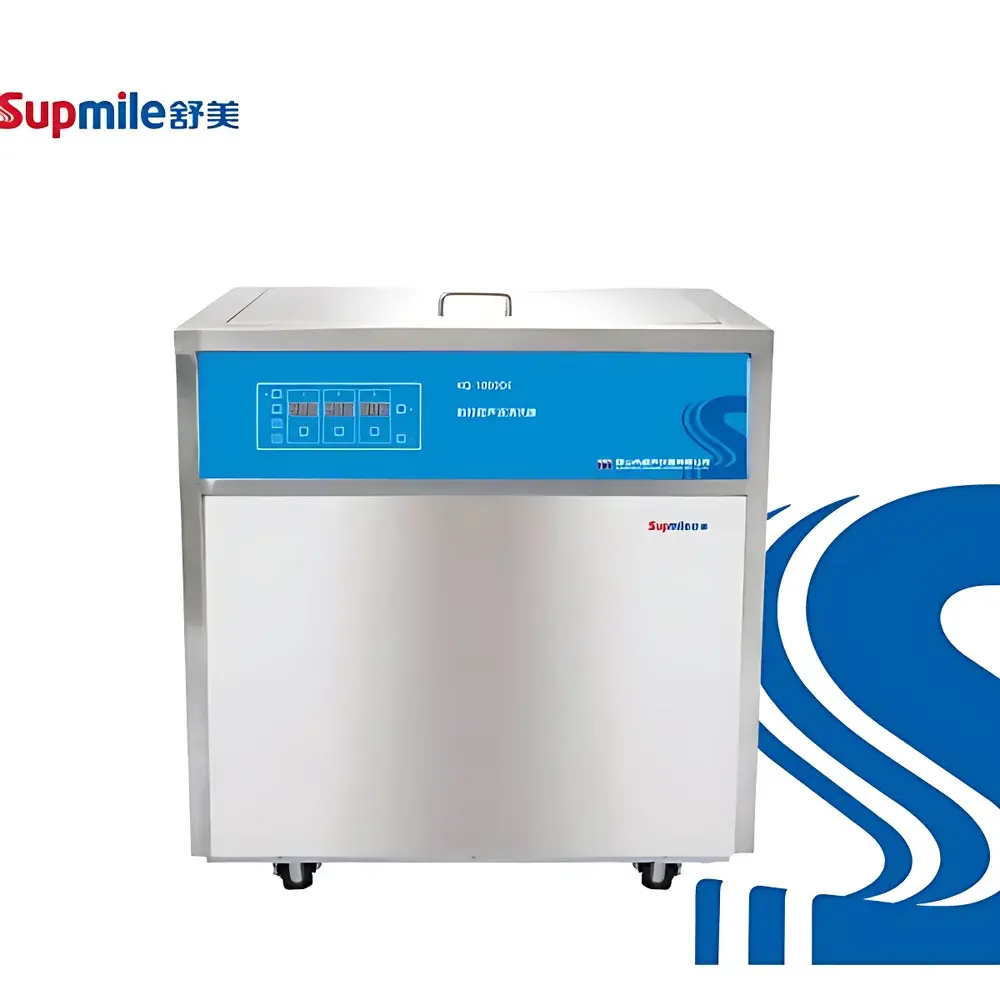
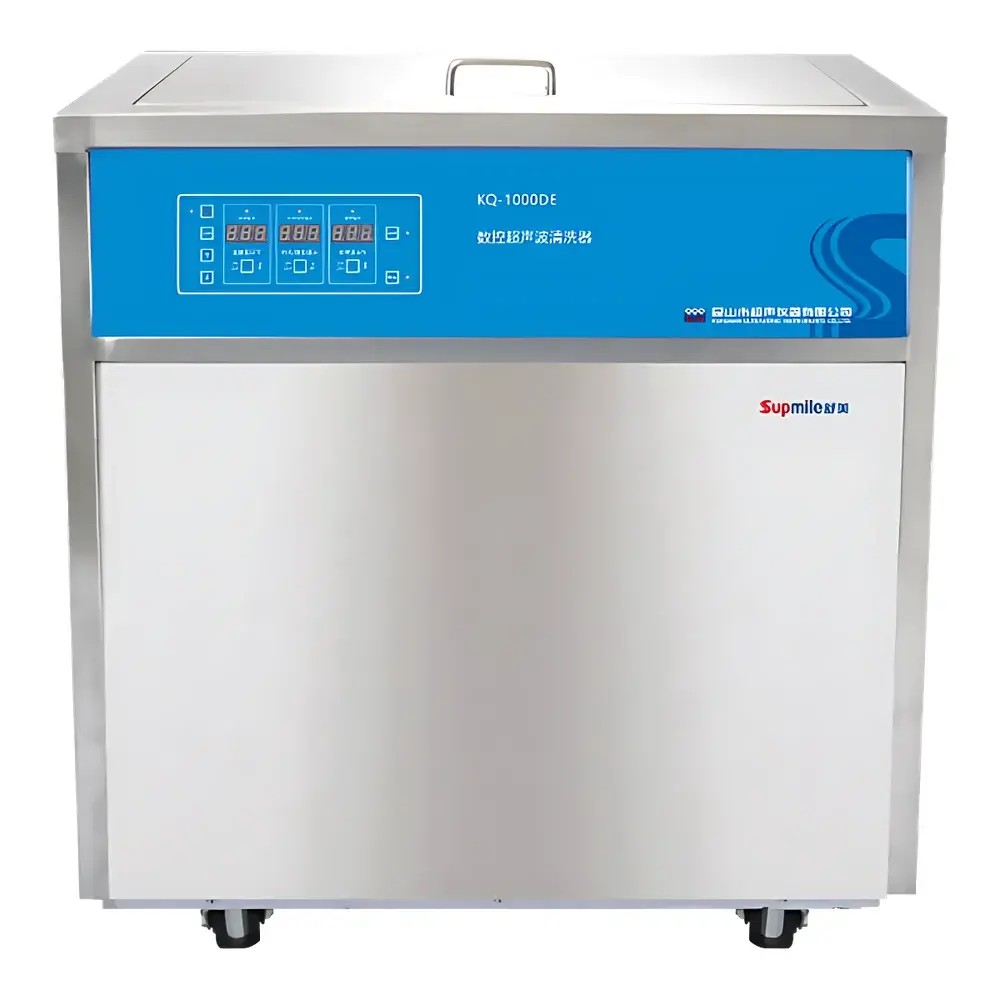
SHUMEI KQ-1000DE Digital Ultrasonic Cleaner
| Brand | SHUMEI |
|---|---|
| Origin | Jiangsu, China |
| Manufacturer Type | Direct Manufacturer |
| Product Category | Domestic |
| Model | KQ-1000DE |
| Instrument Type | General-Purpose |
| Tank Capacity | 72 L |
| Ultrasonic Frequency | 40 kHz |
| Ultrasonic Power Output | 1000 W |
| Adjustable Ultrasonic Power | 40–100% |
| Heating Temperature Range | Ambient to 80 °C |
| Heating Power | 3000 W |
| Timer Range | 1–480 min |
| Sound-Dampening Lid | Yes |
| Automatic Fill/Drain Control | Electrically Actuated |
| Power Supply | AC 220 V / 50 Hz or AC 380 V / 50 Hz |
| Tank Dimensions (L×W×H) | 600 × 300 × 400 mm |
| External Dimensions (L×W×H) | 800 × 550 × 780 mm |
| Construction Material | 304 Stainless Steel |
| Liquid Level Monitoring & Protection | Yes |
| Standard Accessories | Stainless Steel Mesh Basket, Sound-Dampening Lid, Electric Inlet/Outlet Valves |
Overview
The SHUMEI KQ-1000DE Digital Ultrasonic Cleaner is a general-purpose laboratory cleaning system engineered for precision, repeatability, and operational safety in demanding analytical, quality control, and research environments. It operates on the principle of ultrasonic cavitation—where high-frequency mechanical vibrations (40 kHz) generate microscopic implosive bubbles in aqueous or compatible solvent-based cleaning media. These transient cavities collapse with localized energy release, dislodging particulate contaminants, organic residues, biofilms, and microscale debris from complex geometries—including narrow lumens, threaded components, optical surfaces, and porous substrates. Designed for consistent performance across batch processing workflows, the KQ-1000DE integrates digital microcontroller-based operation with real-time parameter feedback, enabling precise replication of validated cleaning protocols under GLP- and GMP-aligned laboratory practices.
Key Features
- Digital microprocessor control with intuitive interface for independent adjustment of ultrasonic power (40–100% of 1000 W nominal output), heating temperature (ambient to 80 °C), and cycle duration (1–480 minutes).
- Robust 304 stainless steel tank (600 × 300 × 400 mm internal dimensions) and housing ensure long-term corrosion resistance, structural integrity, and compatibility with common laboratory cleaning agents including alkaline, acidic, and enzymatic formulations.
- Integrated thermal management system featuring 3000 W heating capacity, real-time temperature sensing, and dual-stage over-temperature protection to maintain process stability and prevent solvent degradation or sample damage.
- Comprehensive safety architecture: automatic low-level fluid detection, over-current and over-voltage monitoring, audible/visual fault alerts, and fail-safe shutdown during abnormal operating conditions.
- Acoustically optimized design incorporating a hinged sound-dampening lid and insulated chamber walls to reduce ambient noise emissions (<65 dB(A) at 1 m) and minimize thermal loss during heated cycles.
- Electrically actuated inlet and drain valves enable programmable fill-and-drain sequences—supporting unattended operation and integration into multi-step cleaning validation routines.
Sample Compatibility & Compliance
The KQ-1000DE accommodates a broad range of sample types—including glassware (vials, pipettes, cuvettes), metal components (syringe needles, surgical instruments), ceramic substrates, and polymer-based labware—provided compatibility with aqueous or low-volatility solvents is confirmed. Its sealed 304 stainless steel construction meets ISO 13485-informed material requirements for medical device reprocessing equipment. While not certified as a Class II medical device per FDA 21 CFR Part 820, the unit supports cleaning validation activities aligned with ASTM F3127 (Standard Guide for Ultrasonic Cleaning Process Validation) and ISO 15883-1 (Washer-disinfectors for thermolabile medical devices). All electrical components comply with IEC 61010-1 for laboratory equipment safety.
Software & Data Management
The embedded controller provides non-volatile memory for up to 10 user-defined cleaning programs, each storing target parameters (power %, temperature setpoint, duration) and real-time operational logs (actual temperature, elapsed time, power delivery status). While the system does not feature Ethernet or USB data export, all displayed values—including instantaneous temperature, remaining time, and active power level—are traceable via front-panel LED readouts. The digital interface supports audit-ready documentation when paired with external loggers or laboratory information management systems (LIMS) via manual entry or barcode-scanned protocol referencing. Configuration changes are timestamped and retained across power cycles, supporting basic 21 CFR Part 11–aligned procedural accountability where electronic records are manually transcribed.
Applications
- Pretreatment of HPLC, GC, and ICP-MS sample vials and autosampler components to eliminate carryover and adsorbed organics.
- Cleaning of optical elements (lenses, mirrors, fiber optic connectors) without surface abrasion or coating damage.
- Removal of flux residues and particulates from PCBs and microelectromechanical systems (MEMS) prior to inspection or packaging.
- Decontamination of reusable laboratory tools—including forceps, tweezers, and tissue culture inserts—prior to sterilization or reuse.
- Supporting ASTM D2240 (Shore hardness testing) sample preparation by removing mold release agents from elastomeric test specimens.
- Pre-analytical processing in environmental labs: extraction vessel cleaning between soil/water digestions to prevent cross-contamination.
FAQ
What is the maximum recommended cleaning temperature for aqueous solutions?
The unit supports heating up to 80 °C; however, for standard aqueous detergents, optimal cleaning efficiency is typically achieved between 40–60 °C. Temperatures above 70 °C may accelerate evaporation and reduce cavitation intensity.
Can this cleaner be used with flammable solvents?
No. The KQ-1000DE is designed exclusively for aqueous or water-miscible, non-flammable cleaning solutions. Use of volatile organic solvents (e.g., acetone, ethanol, chlorinated hydrocarbons) poses fire, explosion, and health hazards and voids warranty and safety certification.
Is the ultrasonic transducer array serviceable in-field?
Transducers are permanently bonded to the tank base and are not user-replaceable. Field service requires authorized SHUMEI technical support and adherence to factory calibration protocols to maintain acoustic uniformity and power delivery accuracy.
Does the unit include validation documentation for IQ/OQ/PQ procedures?
The KQ-1000DE ships with a Factory Acceptance Test (FAT) report and electrical safety certificate. Full installation qualification (IQ), operational qualification (OQ), and performance qualification (PQ) documentation must be developed internally or with third-party validation partners using standardized test methods such as ASTM E1757 or ISO 13485 Annex A.
What maintenance intervals are recommended for routine operation?
Daily visual inspection of tank integrity and lid seal; weekly descaling using 5% citric acid solution if hard water is used; biannual verification of temperature sensor accuracy and timer calibration using NIST-traceable references.



