
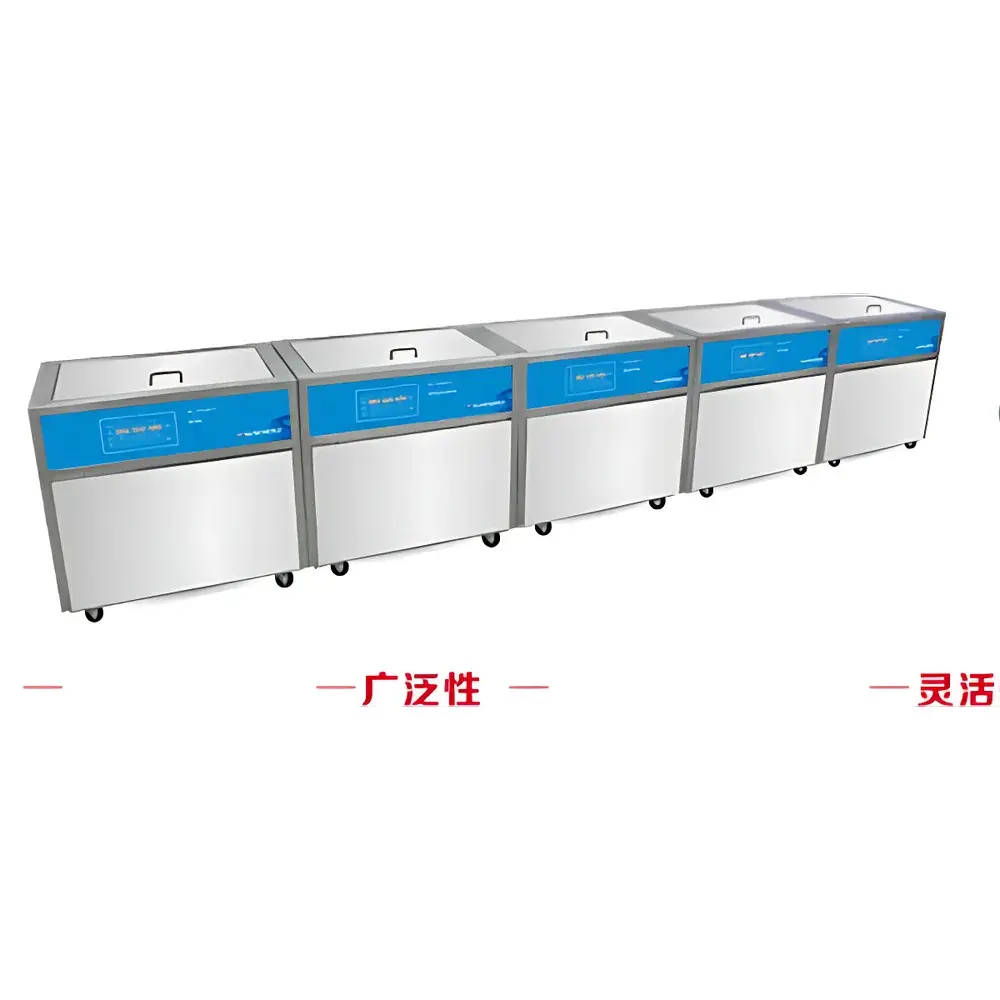
SHUMEI KQ-1000DE-P Multi-Tank Digital Ultrasonic Cleaner
| Brand | SHUMEI |
|---|---|
| Origin | Jiangsu, China |
| Manufacturer Type | Direct Manufacturer |
| Product Category | Domestic |
| Model | KQ-1000DE-P |
| Instrument Type | General-Purpose |
| Capacity | 72 L |
| Ultrasonic Frequency | 40 kHz |
| Ultrasonic Power | 1000 W |
| Power Adjustment Range | 40–100% |
| Temperature Control Range | Ambient to 45 °C |
| Timer Range | 1–480 min |
Overview
The SHUMEI KQ-1000DE-P Multi-Tank Digital Ultrasonic Cleaner is an industrial-grade, modular ultrasonic cleaning system engineered for precision laboratory and quality control environments requiring sequential cleaning, rinsing, and conditioning steps. It operates on the principle of high-frequency acoustic cavitation—where 40 kHz ultrasonic energy induces controlled microbubble formation and implosion in aqueous or solvent-based cleaning media—generating localized shear forces sufficient to dislodge particulate contaminants, organic residues, and thin oxide layers from complex geometries, including blind holes, crevices, and microstructured surfaces. Designed as a multi-station platform, the KQ-1000DE-P supports independent operation of up to five functionally distinct tanks (e.g., pre-clean, ultrasonic clean, rinse, passivation, drying), each configurable with identical or differentiated process parameters. Its stainless-steel construction (AISI 304), integrated thermal insulation, and acoustic damping minimize energy loss and ambient noise—ensuring stable cavitation performance and operator safety during extended duty cycles.
Key Features
- Modular tank architecture: All individual tanks are self-contained units—mechanically isolated, electrically independent, and position-flexible—enabling custom layout configurations (linear, U-shaped, or clustered) to match workflow ergonomics and facility footprint.
- Digital microcontroller interface: Real-time display and programmable memory for ultrasonic power (40–100% of 1000 W nominal), bath temperature (ambient to 45 °C ±2 °C accuracy), and timer duration (1–480 minutes); all settings retained after power cycling.
- Comprehensive safety protection: Automatic shutdown triggered by low liquid level, over-temperature (>45 °C), over-voltage, over-current, or dry-run conditions; visual alarm indicators for each fault mode.
- High-efficiency transducer array: Factory-matched 40 kHz piezoelectric transducers mounted on the tank bottom deliver uniform energy distribution across the full 600 × 300 × 400 mm internal volume (72 L capacity).
- Integrated fluid management: Standard automatic fill/drain solenoid valves support unattended batch processing; optional external pump coupling enables closed-loop recirculation or inline filtration integration.
- Robust mechanical design: Reinforced 304 stainless steel tank body, insulated lid with vapor containment, and vibration-dampened mounting feet ensure long-term dimensional stability and corrosion resistance under repeated thermal and acoustic stress.
Sample Compatibility & Compliance
The KQ-1000DE-P accommodates a broad range of sample types—including metal components (stainless steel, aluminum, titanium), glassware (vials, cuvettes, optical lenses), ceramic substrates, printed circuit boards (PCBs), and medical device assemblies—provided compatibility with aqueous or mild solvent-based cleaning chemistries (e.g., alkaline, neutral, or citric acid formulations). While not certified for sterile processing per ISO 13485 or FDA 21 CFR Part 820, the system’s repeatable parameter control, digital audit trail (via optional RS-232/USB data logging), and GMP-aligned operational safeguards (e.g., password-protected parameter lockout, event-triggered error logging) support use in GLP-compliant analytical laboratories and manufacturing QC labs. It meets CE electromagnetic compatibility (EMC) Directive 2014/30/EU and Low Voltage Directive 2014/35/EU requirements when operated within specified environmental conditions (5–40 °C ambient, <80% RH non-condensing).
Software & Data Management
The embedded firmware provides local parameter storage for up to 99 user-defined cleaning protocols, each with independent settings for power, temperature, and time. Optional PC connectivity via RS-232 or USB enables remote monitoring, protocol upload/download, and real-time data capture—including timestamped temperature/power profiles and fault-event logs—for inclusion in electronic lab notebooks (ELN) or LIMS integration. Though no proprietary software suite is bundled, the device supports standard ASCII serial communication protocols compatible with LabVIEW, Python (PySerial), or MATLAB-based automation frameworks. Audit-trail functionality satisfies basic ALCOA+ principles (Attributable, Legible, Contemporaneous, Original, Accurate) for routine cleaning validation documentation.
Applications
- Precision parts cleaning prior to metrology, coating, or bonding operations in R&D and pilot-scale manufacturing.
- Removal of polishing compounds, flux residues, and machining oils from aerospace turbine blades and hydraulic components.
- Pre-analytical preparation of HPLC vials, ICP-MS sample containers, and electron microscopy grids to eliminate trace metal contamination.
- Reprocessing of reusable surgical instruments and dental handpieces in hospital central sterile supply departments (CSSD), when validated with appropriate disinfectant chemistries.
- Batch cleaning of MEMS devices, semiconductor wafers (pre-photolithography), and fiber optic connectors where particle counts <100 nm must be reduced to ISO Class 5 cleanroom levels.
FAQ
Can the KQ-1000DE-P operate continuously for extended periods?
Yes—the system is rated for continuous duty at 100% power output, provided ambient cooling is maintained and liquid level remains within operational limits.
Is it possible to retrofit additional tanks or upgrade transducers post-purchase?
No—tank modules are factory-assembled and calibrated as fixed units; expansion requires purchasing additional KQ-1000DE-P base units configured as standalone stations.
Does the unit support external temperature probes for bath calibration verification?
No—temperature sensing is internal only (PT100 sensor embedded in tank wall); external probe input is not supported in current firmware.
What maintenance intervals are recommended for optimal cavitation performance?
Transducer performance should be verified quarterly using a calibrated hydrophone or calorimetric power meter; stainless steel tank surfaces require periodic passivation with nitric acid solution if exposed to chloride-containing solutions.
Can this system be integrated into a fully automated production line?
Yes—dry-contact relay outputs (standard) and optional PLC-compatible I/O modules enable synchronization with conveyor systems, robotic arms, and centralized SCADA platforms.



