
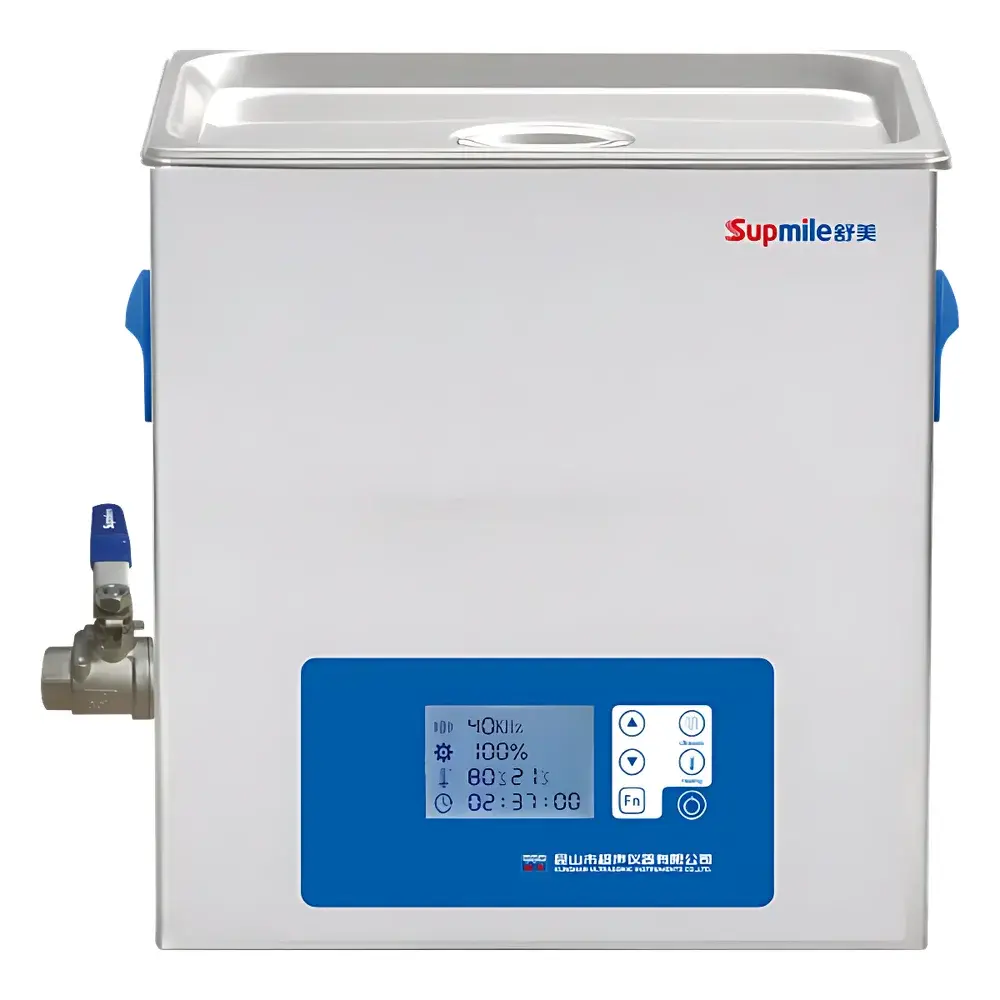
Shumei KQ-250DM Quiet-Operation Ultrasonic Cleaner
| Brand | Shumei |
|---|---|
| Origin | Jiangsu, China |
| Manufacturer Type | Direct Manufacturer |
| Equipment Type | Domestic |
| Model | KQ-250DM |
| Instrument Category | General-Purpose |
| Tank Capacity | 10 L |
| Ultrasonic Frequency | 40 kHz |
| Ultrasonic Power Output | 250 W |
| Power Adjustment Range | 0–100% (stepless) |
| Heating Power | 400 W |
| Temperature Control Range | Ambient to 80 °C |
| Timer Range | 0–24 h |
| Noise Level | <60 dB(A) |
| Lid | Acoustic-Dampening Cover Included |
| Drain/Inlet | Manual Valve Control |
| Tank Dimensions (L×W×H) | 300 × 240 × 150 mm |
| External Dimensions (L×W×H) | 325 × 265 × 375 mm |
| Construction Material | 304 Stainless Steel (tank and chassis) |
| Safety Features | Liquid-Level Protection, Over-Temperature & Over-Current Protection |
| Standard Accessories | Stainless Steel Mesh Basket, Stainless Steel Rack, Acoustic Lid |
Overview
The Shumei KQ-250DM Quiet-Operation Ultrasonic Cleaner is an engineered solution for precision cleaning of laboratory glassware, optical components, precision instruments, surgical tools, and small mechanical parts. It operates on the principle of ultrasonic cavitation—generating high-frequency pressure waves (40 kHz) in aqueous or solvent-based cleaning media to produce microscopic implosions that dislodge particulate contaminants, organic residues, and biofilms from surfaces without mechanical abrasion. Designed for routine use in QC laboratories, research facilities, and clinical support environments, the KQ-250DM balances acoustic efficiency with operational discretion: its noise emission remains below 60 dB(A) during full-power operation, making it suitable for shared lab spaces where acoustic disturbance must be minimized. The unit features a robust 304 stainless steel tank (300 × 240 × 150 mm internal volume), formed via single-stage deep-drawing to eliminate weld seams and crevices—enhancing corrosion resistance and simplifying decontamination validation.
Key Features
- Stepless ultrasonic power control (0–100%) enables precise energy modulation for delicate substrates—including coated optics, microfluidic devices, and MEMS components—without risk of surface erosion or pitting.
- Integrated heating system (400 W) supports temperature-controlled cleaning protocols from ambient up to 80 °C, facilitating dissolution of waxy, greasy, or thermally sensitive residues in accordance with ASTM D4292 and ISO 15883-5 guidelines.
- Programmable timer (0–24 h) with auto-shutdown ensures process repeatability and unattended operation, critical for batch processing under GLP-compliant workflows.
- Acoustic-dampening lid reduces airborne noise transmission and minimizes solvent evaporation during heated cycles—contributing to both operator comfort and reagent conservation.
- Dual safety architecture includes liquid-level sensing (prevents dry-run damage) and real-time monitoring of thermal and current loads to prevent component stress or thermal runaway.
- All-wetted surfaces constructed from AISI 304 stainless steel meet USP material compatibility requirements for non-sterile compounding environments and align with FDA-recommended construction practices for reusable cleaning equipment.
Sample Compatibility & Compliance
The KQ-250DM accommodates a broad range of sample geometries and materials, including borosilicate glass vials, quartz cuvettes, stainless steel forceps, titanium implants, ceramic substrates, and polymer-based microplates. Its 10 L capacity and adjustable basket/rack configuration allow simultaneous processing of heterogeneous loads while maintaining consistent acoustic field distribution. The device complies with IEC 61000-6-3 (EMC emission limits) and IEC 61000-6-2 (immunity standards), and its electrical insulation meets Class I protection requirements per IEC 61010-1. Though not certified as a medical device under MDR 2017/745, its design supports validation protocols required for ISO 13485-certified cleanroom support equipment when used in conjunction with documented cleaning SOPs and periodic performance qualification (PQ).
Software & Data Management
The KQ-250DM utilizes a standalone embedded control system with a backlit LCD touch interface—requiring no external PC or proprietary software. All operational parameters (power %, temperature setpoint, duration, and start time) are stored in non-volatile memory and retain settings after power cycling. While the unit does not feature network connectivity or electronic audit trail functionality, its manual parameter logging capability supports paper-based or LIMS-integrated recordkeeping. For labs operating under 21 CFR Part 11 requirements, users may implement procedural controls—such as dual-operator verification of settings and timestamped logbook entries—to satisfy data integrity expectations during routine cleaning validation.
Applications
- Cleaning of HPLC/GC sample vials, syringe filters, and column frits prior to analytical reuse.
- Removal of polishing compounds and metal fines from precision-machined calibration standards.
- Pre-sterilization preparation of surgical instruments in hospital central supply departments (CSDs).
- Decontamination of electron microscopy grids and TEM specimen holders.
- Residue removal from semiconductor wafer handling fixtures and photomask carriers.
- Supporting ASTM E1711-20 (ultrasonic cleaning of metallic test specimens) and ISO 14971 risk management frameworks through configurable process parameters.
FAQ
Does the KQ-250DM support continuous operation beyond 24 hours?
No—the maximum timer setting is 24 hours. For extended cleaning cycles, manual reset is required.
Can the unit be operated without the acoustic lid?
Yes, but doing so increases audible noise output above 60 dB(A) and accelerates solvent evaporation; lid use is strongly recommended for all heated or prolonged cycles.
Is the heating function independent of ultrasonic activation?
Yes—temperature can be set and maintained without concurrent ultrasonic output, enabling gentle pre-warming of cleaning solutions.
What maintenance is required for long-term reliability?
Routine inspection of the transducer mounting integrity, periodic descaling of the tank interior using dilute citric acid, and verification of liquid-level sensor responsiveness every 6 months.
Does the KQ-250DM comply with CE marking requirements?
It meets applicable EMC and Low Voltage Directive harmonized standards; however, formal CE marking requires end-user responsibility for conformity assessment under EU regulatory frameworks.



