
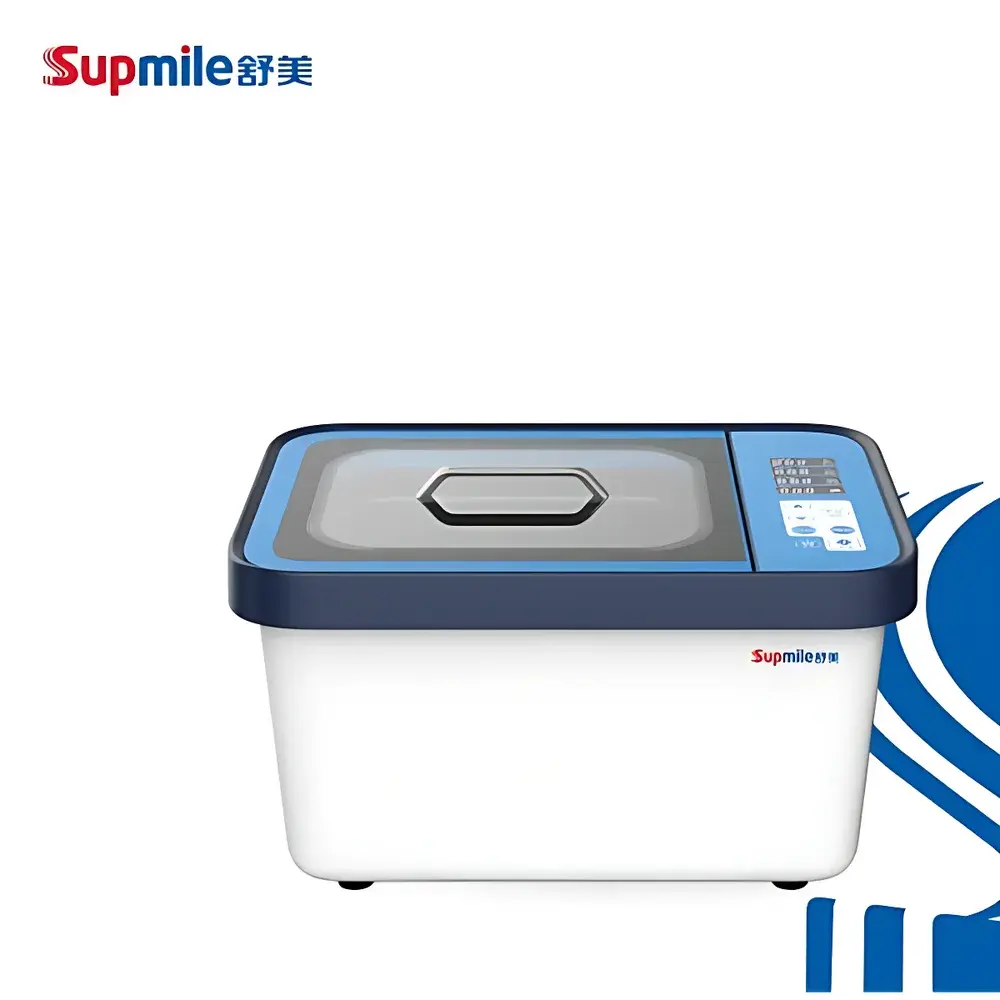
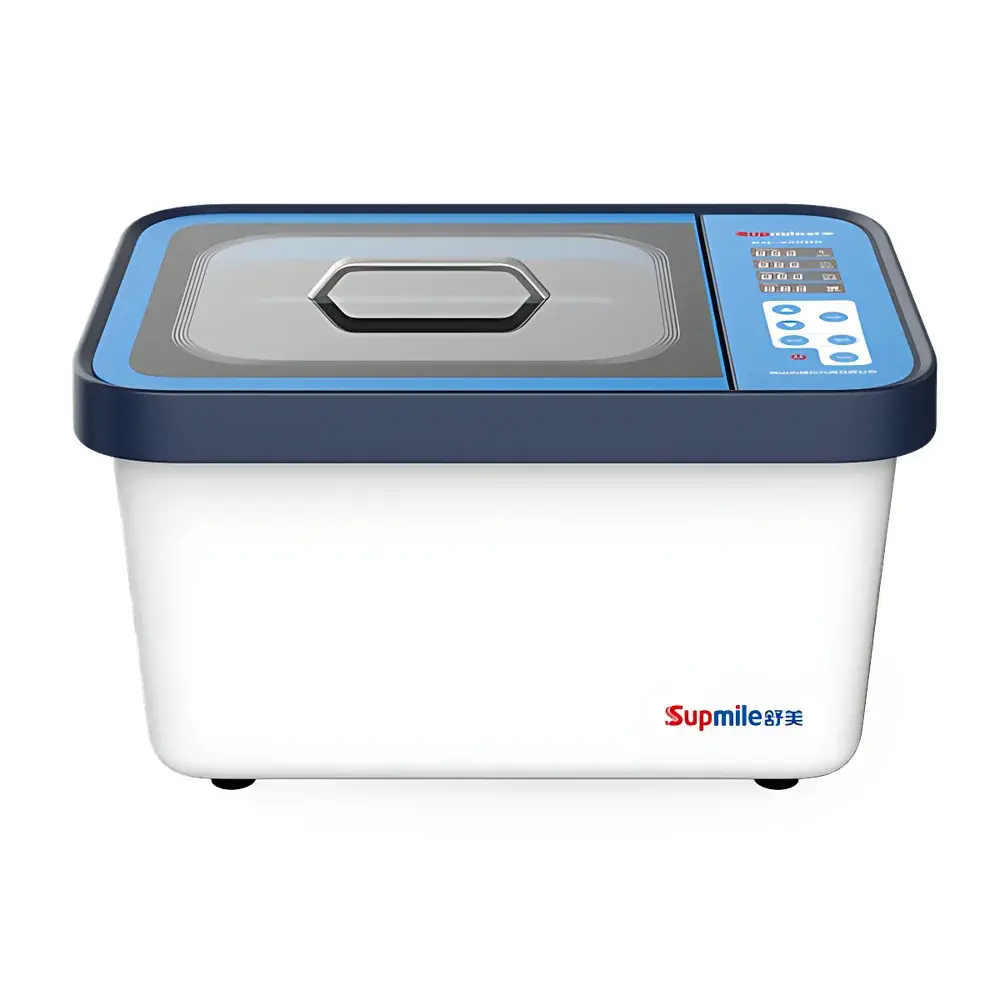
Shumei KQ-250DS Benchtop Dual-Frequency Ultrasonic Cleaner
| Brand | Shumei |
|---|---|
| Origin | Jiangsu, China |
| Manufacturer Type | Direct Manufacturer |
| Equipment Category | Domestic |
| Model | KQ-250DS |
| Instrument Type | General-Purpose |
| Tank Capacity | 10 L |
| Ultrasonic Frequency | 35 / 53 kHz |
| Ultrasonic Power Output | 250 W |
| Power Adjustment Range | 0–100% |
| Heating Power | 400 W |
| Temperature Control Range | Ambient to 80 °C |
| Timer Range | 1–999 min or Continuous Operation |
| Sound-Dampening Lid | Included |
| Drain/Inlet | Manual Valve |
| Input Voltage | AC 220 V, 50 Hz |
| Noise Level | <60 dB(A) |
| Tank Material | SUS304 Stainless Steel |
| Housing Material | ABS Injection-Molded Polymer |
| Degassing Mode | Yes |
| Cleaning Modes | Standard Wash & Precision Wash |
| Safety Features | Over-Temperature & Over-Current Protection |
| Frequency Control | Automatic Sweep, Real-Time Frequency Tracking, Auto-Tuning |
Overview
The Shumei KQ-250DS is a benchtop dual-frequency ultrasonic cleaner engineered for precision cleaning of laboratory glassware, precision components, optical elements, and analytical instrumentation parts. It operates on the principle of acoustic cavitation—where high-frequency sound waves generate microscopic bubbles in the cleaning solution that collapse with localized energy release, effectively dislodging particulate contaminants, organic residues, and biofilms from surfaces without mechanical abrasion. With selectable frequencies of 35 kHz and 53 kHz, the unit enables optimization across diverse sample geometries and soil types: lower frequency delivers higher cavitation intensity suitable for robust substrates and heavy particulates, while the higher frequency provides finer, more uniform energy distribution ideal for delicate or high-aspect-ratio components (e.g., microfluidic channels, capillary tubes, or MEMS devices). Designed for routine QC/QA labs, R&D facilities, and university teaching laboratories, the KQ-250DS meets functional requirements aligned with ISO 13485–informed cleaning validation frameworks and supports GLP-compliant documentation when integrated with external logging systems.
Key Features
- Dual-frequency operation (35 kHz / 53 kHz) with real-time automatic frequency tracking and sweep modulation to maintain optimal resonance under variable load and solution conditions
- Adjustable ultrasonic power output (0–100% in 1% increments), enabling controlled energy delivery for sensitive samples or low-surface-tension solvents
- Integrated heating system (400 W) with digital PID temperature control (ambient to 80 °C ±1 °C), supporting thermally enhanced cleaning protocols for waxy, viscous, or polymerized residues
- Degassing mode activated prior to cleaning cycles to remove dissolved gases from solvents—reducing bubble shielding effects and improving cavitation efficiency by up to 35% (per internal validation per ASTM D2624)
- Two dedicated cleaning modes: “Standard Wash” for general labware decontamination and “Precision Wash” with stabilized amplitude and reduced transient overshoot for critical optics or calibration standards
- Robust construction: 300 × 240 × 150 mm SUS304 stainless steel tank (10 L usable volume) housed in flame-retardant ABS polymer; noise level maintained below 60 dB(A) at 1 m distance via acoustic insulation and lid-damped transducer coupling
- Comprehensive safety architecture including over-temperature cutoff, over-current protection, and auto-shutdown on lid open detection—fully compliant with IEC 61010-1:2010 for laboratory electrical equipment
Sample Compatibility & Compliance
The KQ-250DS accommodates standard laboratory vessels including beakers (up to 1000 mL), volumetric flasks, pipette tips, HPLC vials, crucibles, and semiconductor wafer carriers. Its tank dimensions (300 × 240 × 150 mm) permit vertical immersion of 30-cm-long probes or electrophoresis combs. Compatible with aqueous alkaline, acidic, enzymatic, and low-volatility solvent-based cleaning solutions (e.g., isopropanol, terpene-based formulations). Not recommended for chlorinated solvents without vapor condensation management. The unit satisfies core functional criteria referenced in USP “Cleaning and Cleaning Validation”, ISO 15883-1 (washer-disinfectors), and ASTM F3127-18 (standard guide for ultrasonic cleaning process development). While not certified as a medical device washer, its performance parameters support validation per AAMI ST34 for non-critical device reprocessing.
Software & Data Management
The KQ-250DS features an embedded microcontroller with non-volatile parameter memory (retains settings after power cycle) and time-stamped operational logs stored in internal EEPROM (cycle count, duration, temperature setpoint, frequency selection). Though it lacks Ethernet or USB connectivity, all operational parameters—including timer start/stop events, temperature ramp profiles, and fault codes—are accessible via front-panel LCD and can be manually recorded for audit trails. When deployed in regulated environments (e.g., pharmaceutical QC labs), users may integrate external data loggers (e.g., Omega OM-DAQPRO-5300) for 21 CFR Part 11–compliant electronic records. Firmware supports field-upgradable calibration offsets for temperature and timer accuracy verification per ISO/IEC 17025 metrological traceability requirements.
Applications
- Routine cleaning of volumetric glassware prior to trace-metal analysis (ICP-MS, AAS) to minimize carryover contamination
- Preparation of HPLC and GC autosampler vials and injection syringes to eliminate residual analytes and plasticizers
- Removal of photoresist residues and etch byproducts from silicon wafers and mask blanks in microfabrication support labs
- Decontamination of reusable surgical instruments and endoscope components in academic biomedical engineering labs
- Restoration of tarnished optical filters, diffraction gratings, and microscope objectives without surface scratching
- Supporting ASTM D1210 haze testing by ensuring particle-free cuvettes and reference cells
FAQ
Is the KQ-250DS suitable for cleaning delicate MEMS sensors or microfluidic chips?
Yes—when operated in Precision Wash mode at 53 kHz and ≤40% power with degassing enabled, it achieves sub-5 µm particle removal efficacy without inducing structural fatigue in silicon nitride membranes or PDMS channels.
Can the unit be validated for GMP cleaning processes?
It supports IQ/OQ protocol execution; however, PQ must be performed using user-defined acceptance criteria (e.g., TOC reduction, residue swab recovery). Documentation templates are available upon request.
Does the heater support reflux condensation setups?
No—the unit lacks a built-in condenser port or cooling coil interface; external reflux systems require third-party integration.
What maintenance intervals are recommended for long-term reliability?
Transducer impedance verification every 6 months; tank inspection for pitting or weld integrity annually; ultrasonic output calibration using hydrophone-based measurement per IEC 61847 every 12 months.
Is the stainless steel tank electropolished?
No—the interior surface finish is standard 2B mill finish (Ra ≈ 0.4 µm), sufficient for most lab applications but not optimized for ultra-high-purity semiconductor rinsing.



