
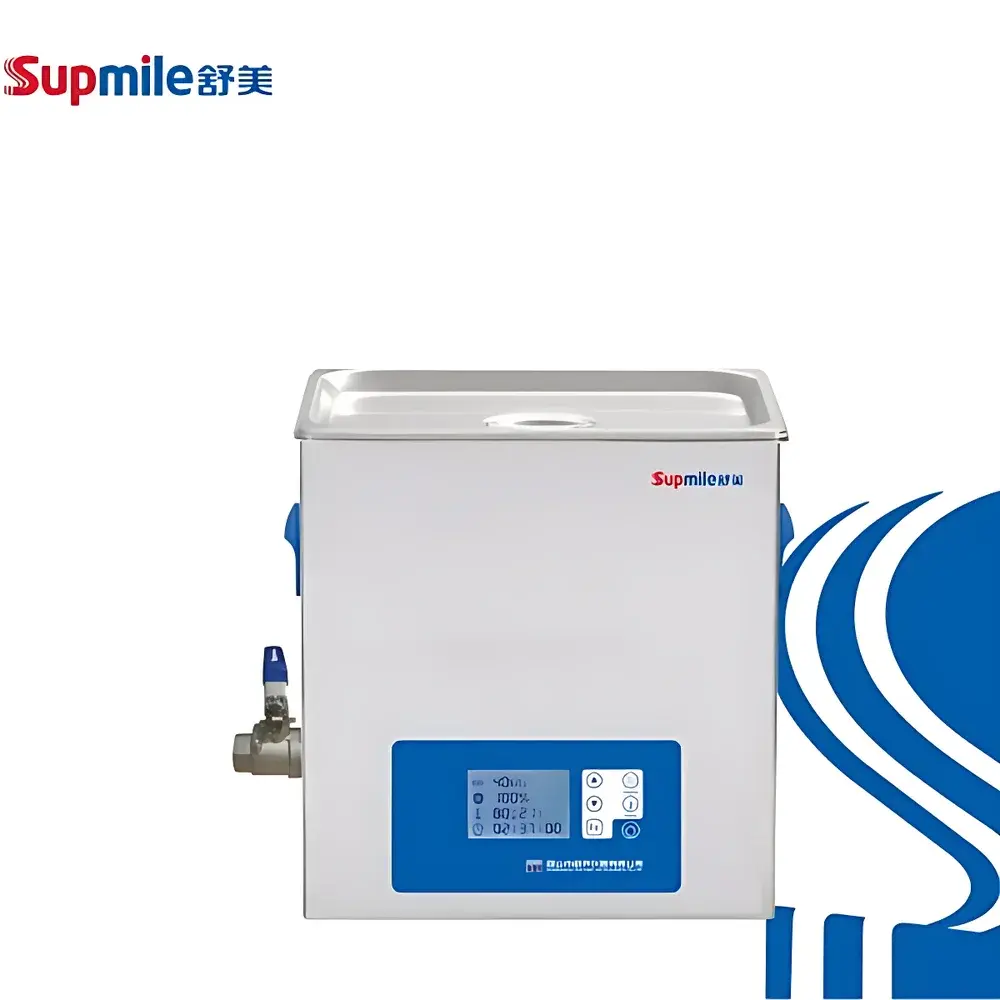
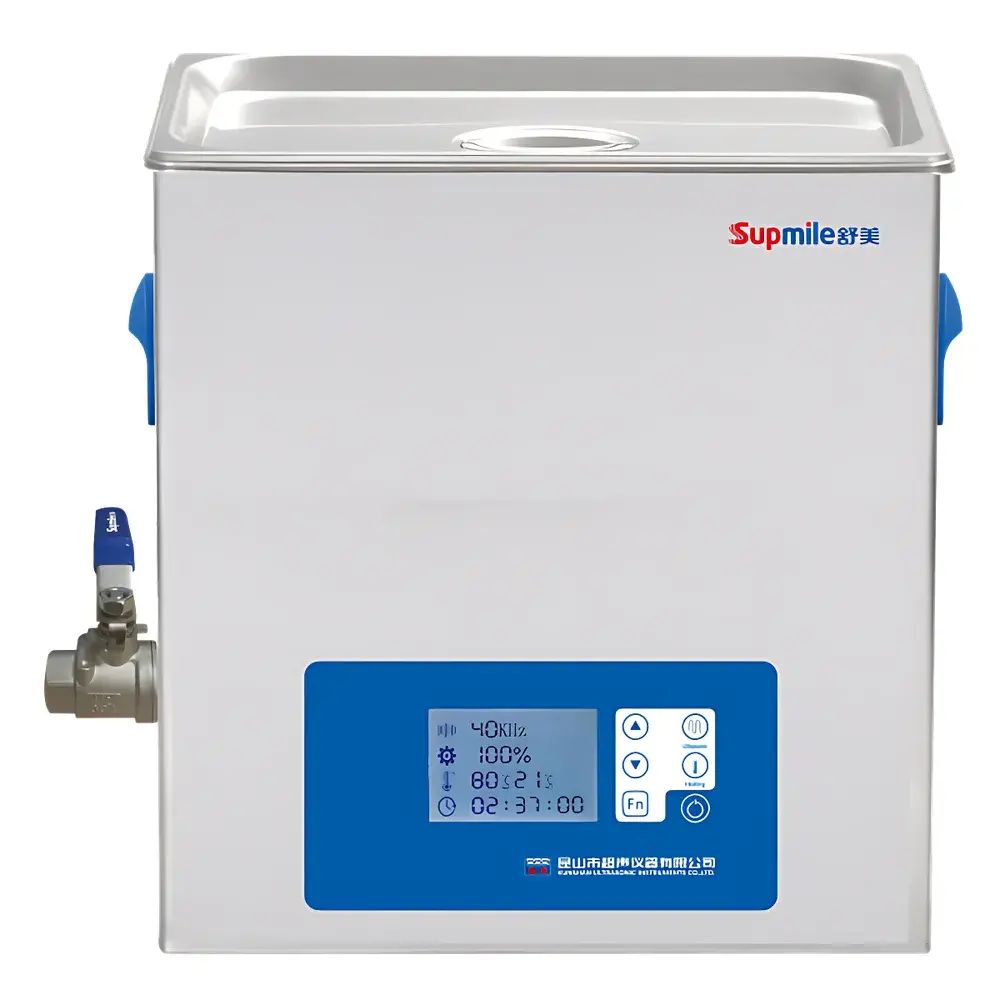
Shumei KQ-300DM Quiet-Operation Ultrasonic Cleaner
| Brand | Shumei |
|---|---|
| Origin | Jiangsu, China |
| Manufacturer Type | Direct Manufacturer |
| Instrument Type | General-Purpose Ultrasonic Cleaner |
| Tank Capacity | 10 L |
| Ultrasonic Frequency | 40 kHz |
| Ultrasonic Power Output | 300 W (0–100% continuously adjustable) |
| Heating Power | 400 W |
| Temperature Range | Ambient to 80 °C (adjustable) |
| Timer Range | 0–24 h (adjustable) |
| Noise Level | <60 dB(A) |
| Tank Dimensions (L×W×H) | 300 × 240 × 150 mm |
| External Dimensions (L×W×H) | 325 × 265 × 375 mm |
| Construction | 304 Stainless Steel (tank and chassis) |
| Lid | Acoustic-dampening cover included |
| Drain/Inlet | Manual valve control |
| Safety Features | Automatic liquid-level protection, over-temperature and over-current protection |
| Standard Accessories | Stainless steel mesh basket, support rack, touch-screen controller |
Overview
The Shumei KQ-300DM Quiet-Operation Ultrasonic Cleaner is an engineered solution for precision cleaning of delicate laboratory components—including glassware, pipette tips, filtration membranes, optical lenses, microfluidic devices, and analytical sample preparation vessels—where consistent cavitation energy delivery and low acoustic emission are critical. It operates on the principle of piezoelectrically generated ultrasonic waves at a fixed frequency of 40 kHz, inducing controlled cavitation in aqueous or mild solvent-based cleaning baths. The transducer array is acoustically coupled to a monolithic 304 stainless steel tank formed via deep-draw stamping, ensuring structural integrity, corrosion resistance, and minimal harmonic distortion. With a nominal tank volume of 10 L and a working depth of 150 mm, the unit supports immersion of medium-format labware while maintaining uniform energy distribution across the active cleaning zone. Its integrated thermal management system enables temperature-controlled cleaning protocols compliant with ASTM D2616 and ISO 13847 methodologies for residue removal validation.
Key Features
- Low-noise operation (<60 dB[A] at 1 m distance), achieved through optimized transducer mounting, vibration-damping chassis design, and an integrated acoustic lid that attenuates airborne sound transmission without impeding vapor release.
- Full-range ultrasonic power modulation (0–100% in fine increments), allowing users to match cavitation intensity to substrate sensitivity—e.g., reduced power for soft polymers or coated optics, higher output for metal parts with adherent particulates.
- Precision digital temperature control (ambient to 80 °C ±1.5 °C), supported by a 400 W heating element and PID-regulated feedback loop, enabling thermally assisted cleaning protocols aligned with USP <1051> and pharmacopeial cleaning validation requirements.
- Extended programmable timer (0–24 hours), with auto-shutdown and hold-at-temperature functionality for unattended overnight processing under GLP-compliant conditions.
- Robust 304 stainless steel construction throughout—tank, housing, basket, and rack—ensuring long-term resistance to chlorinated, alkaline, and mildly acidic cleaning solutions used in QC/QA laboratories.
- Comprehensive safety architecture including liquid-level sensing, real-time current monitoring, thermal cut-off switches, and short-circuit protected power electronics.
Sample Compatibility & Compliance
The KQ-300DM accommodates a broad range of sample geometries and materials: standard volumetric flasks (up to 1 L), chromatography vials, crucibles, sintered filters, surgical instruments, and printed circuit boards. Its non-aggressive 40 kHz frequency minimizes surface pitting on aluminum, brass, and anodized coatings while maintaining efficacy on organic residues, dried salts, and biofilm matrices. The unit meets CE marking requirements for electromagnetic compatibility (EN 61326-1) and electrical safety (EN 61010-1). While not certified for sterile processing per ISO 13485, its design supports integration into validated cleaning SOPs referenced in FDA 21 CFR Part 211 (for pharmaceutical manufacturing) and ISO 15883 (for washer-disinfectors used in reprocessing reusable medical devices).
Software & Data Management
The KQ-300DM features a capacitive touch-screen interface with intuitive icon-driven navigation and persistent parameter memory (up to 10 user-defined programs). All operational events—including start/stop timestamps, setpoint deviations, fault codes, and manual override actions—are logged internally with time/date stamps. Though it does not include Ethernet or USB data export, the event log can be reviewed on-device for audit readiness and root-cause analysis during equipment qualification (IQ/OQ/PQ). The firmware architecture supports traceable calibration verification per ISO/IEC 17025 Clause 6.5, and all displayed values (temperature, time, power %) are directly traceable to internal NIST-traceable references embedded in the controller’s ADC subsystem.
Applications
- Routine cleaning of HPLC/GC autosampler vials, syringe filters, and column frits prior to reuse.
- Removal of proteinaceous or lipid residues from electrophoresis tanks and electrode assemblies.
- Preparation of substrates for XRD, SEM, and AFM imaging—where particle-free surfaces are mandatory.
- Decontamination of reusable PPE components (e.g., face shields, goggle frames) in biosafety labs following CDC-recommended detergent protocols.
- Supporting ASTM E2972-14 (Standard Practice for Ultrasonic Cleaning Validation) through repeatable, documented parameter control.
FAQ
Is the KQ-300DM suitable for cleaning delicate optical components?
Yes—its 40 kHz frequency and continuous 0–100% power adjustment allow gentle yet effective removal of dust, fingerprints, and thin organic films from lenses, mirrors, and laser windows without micro-scratching.
Can the unit operate continuously for 24 hours?
Yes—the timer supports full 24-hour cycles, and thermal overload protection ensures safe extended operation when paired with appropriate cooling and bath replenishment intervals.
Does it comply with FDA 21 CFR Part 11 for electronic records?
No—the device lacks electronic signature capability, audit trail export, or user-access controls required under Part 11; however, its internal event log satisfies basic ALCOA+ principles for paper-based or hybrid documentation workflows.
What cleaning solutions are compatible with the stainless steel tank?
Aqueous alkaline detergents (pH 9–11), ethanol/water mixtures, and isopropanol are routinely used; avoid halogenated solvents (e.g., chloroform, carbon tetrachloride) and strong oxidizers (e.g., undiluted nitric acid) to preserve transducer longevity and tank passivation.
Is external drainage plumbing possible?
No—the unit uses manual valve-controlled drain and fill only; no threaded ports or pump interfaces are provided for automated fluid handling integration.



