
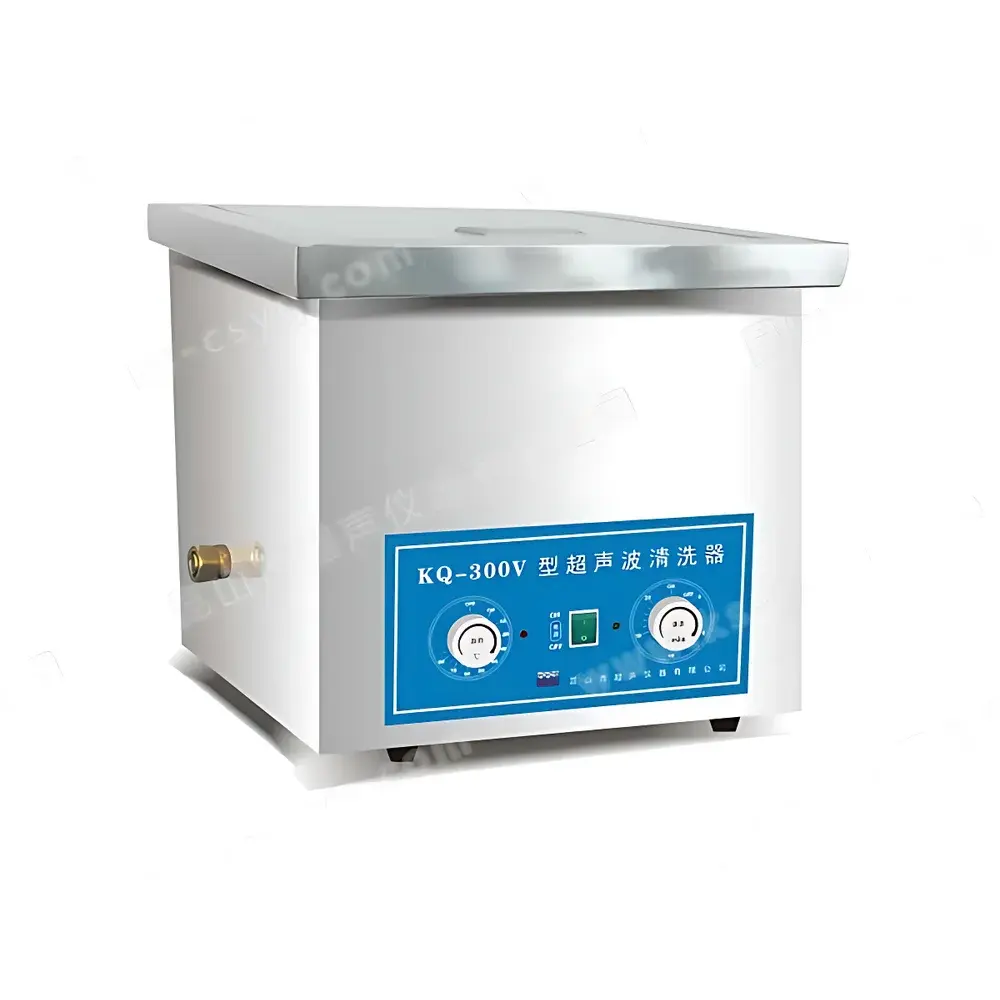
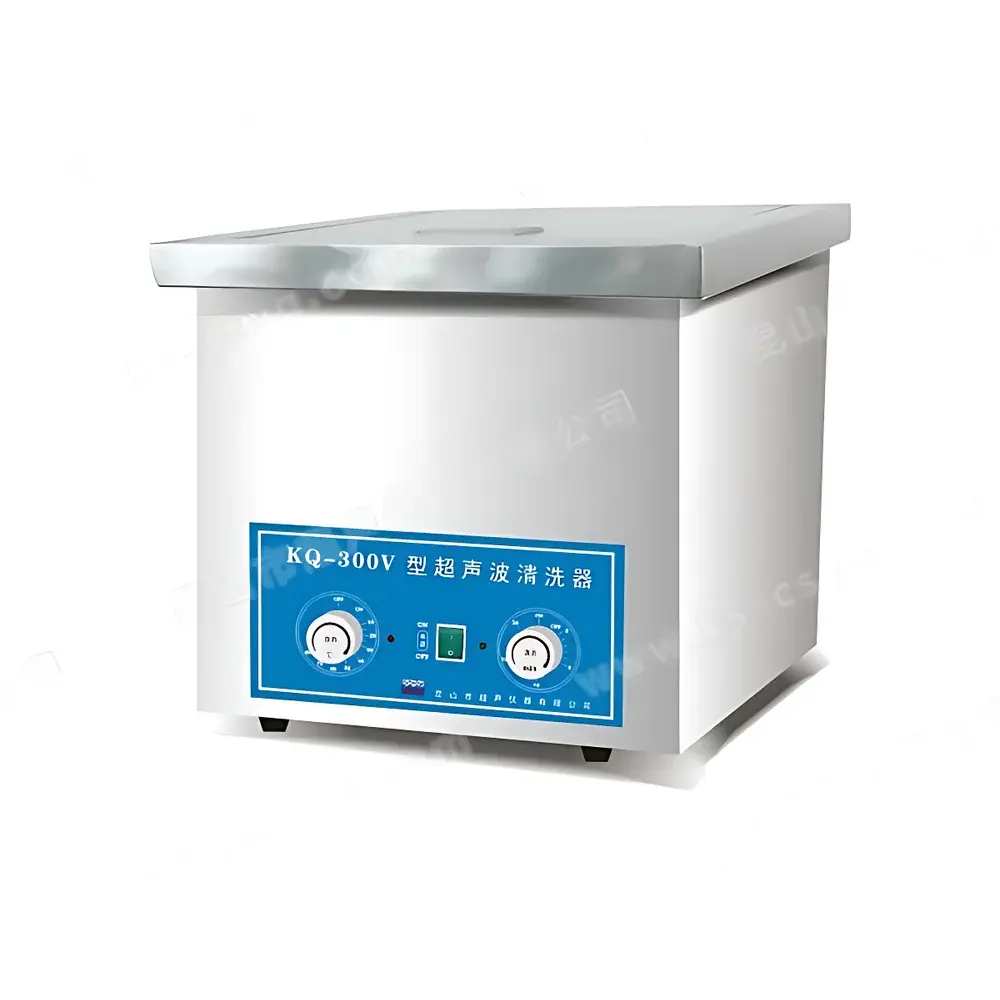
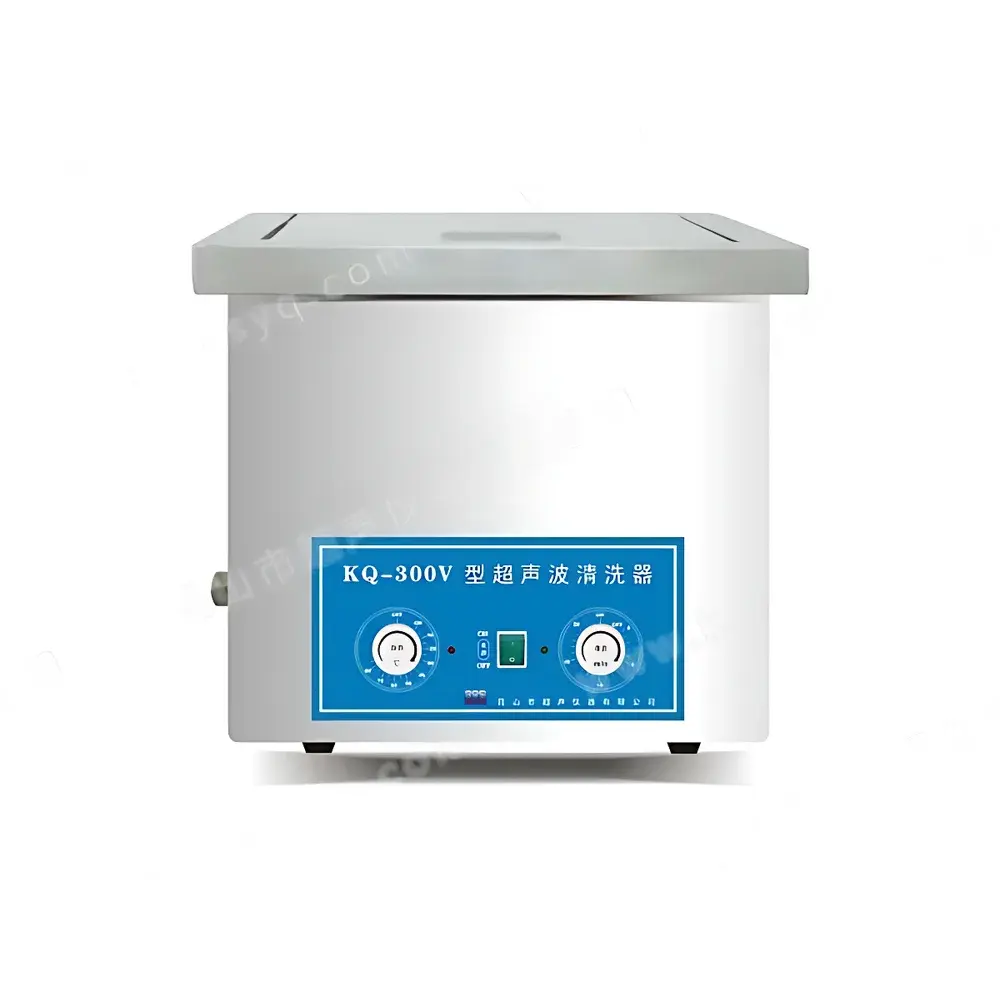
Shumei KQ-300V Benchtop Ultrasonic Cleaner
| Brand | Shumei |
|---|---|
| Origin | Jiangsu, China |
| Manufacturer Type | Direct Manufacturer |
| Equipment Type | General-Purpose Ultrasonic Cleaner |
| Model | KQ-300V |
| Capacity | 13 L |
| Ultrasonic Frequency | 40 kHz |
| Ultrasonic Power | 300 W |
| Adjustable Power | No |
| Temperature Range | 0–80 °C |
| Timer Range | 1–20 min |
| Sound-Dampening Lid | Yes |
| Drain/Inlet | Manual Control |
| Heating Power | 600 W |
| Input Voltage | 220 V / 50 Hz |
| Tank Material | 304 Stainless Steel |
| Internal Dimensions | 300 × 240 × 180 mm |
| External Dimensions | 445 × 347 × 390 mm |
| Standard Accessories | Stainless steel mesh basket, sound-dampening lid, manual drain valve |
Overview
The Shumei KQ-300V is a general-purpose benchtop ultrasonic cleaner engineered for routine laboratory cleaning, degreasing, and particle removal from precision components, glassware, surgical instruments, and analytical sample preparation tools. It operates on the principle of acoustic cavitation—generating high-frequency mechanical vibrations (40 kHz) via piezoelectric transducers bonded to the stainless steel tank base. These vibrations induce microbubble formation and implosive collapse within the cleaning solution, producing localized high-pressure and high-temperature transient zones that effectively dislodge contaminants without mechanical abrasion. Designed for stable, repeatable performance in QC labs, research facilities, and maintenance workshops, the KQ-300V integrates PTC (Positive Temperature Coefficient) heating elements for uniform thermal control and features an auto-sweep frequency circuit to maintain consistent energy transfer across varying load conditions and solution compositions.
Key Features
- Built with a seamless 304 stainless steel tank (internal dimensions: 300 × 240 × 180 mm; total capacity: 13 L), ensuring corrosion resistance and long-term structural integrity under repeated exposure to aqueous and mild solvent-based cleaning media.
- Fixed-frequency 40 kHz ultrasonic generation using standard 50 W transducers—optimized for broad-spectrum contaminant removal including particulates, oxides, oils, and biological residues.
- PTC-based heating system (600 W nominal power) enables precise temperature regulation from ambient up to 80 °C, supporting thermally enhanced cleaning protocols such as enzymatic residue dissolution or low-viscosity solvent activation.
- Mechanical timer with 1–20 minute adjustable intervals provides deterministic process repeatability—critical for SOP-driven environments where dwell time must be strictly controlled per ASTM D2605 or ISO 13485-aligned cleaning validation procedures.
- Included sound-dampening lid reduces airborne noise to ≤55 dB(A) at 1 m distance and minimizes solution evaporation during heated operation—supporting safer, quieter lab workflows and improved thermal efficiency.
- Manual inlet and drain valves allow flexible integration into non-pressurized utility systems; no external plumbing or pump interface required—ideal for temporary setups or space-constrained laboratories.
Sample Compatibility & Compliance
The KQ-300V accommodates a wide range of laboratory substrates, including borosilicate glassware (vials, cuvettes, pipettes), stainless steel tools (tweezers, forceps), ceramic crucibles, and polymer-based fixtures (e.g., polypropylene centrifuge tubes, when verified compatible with ultrasonic exposure). Its sealed 304 stainless steel construction complies with basic hygienic design principles outlined in ISO 14644-1 (cleanroom equipment classification) and supports GLP-compliant documentation of cleaning parameters (time, temperature, cycle count) via operator logbooks. While not certified to IEC 61000-6-3 (EMC) or UL 61010-1 out-of-the-box, its electrical architecture adheres to fundamental safety requirements for Class I laboratory appliances operating at 220 V / 50 Hz. Users performing validated cleaning processes should conduct in-house verification per USP or ISO 15883-1 guidelines when deploying the unit for critical medical device reprocessing.
Software & Data Management
As a mechanically controlled instrument, the KQ-300V does not incorporate digital firmware, touchscreen interfaces, or data logging capabilities. All operational parameters—including timer setting, temperature selection, and power activation—are managed via tactile rotary dials and toggle switches. This analog architecture eliminates cybersecurity risks associated with networked controllers and ensures uninterrupted functionality in electromagnetically noisy environments (e.g., near centrifuges or RF sources). For laboratories requiring audit-ready records, manual entry of operating conditions into electronic lab notebooks (ELNs) or paper-based batch records remains the recommended practice. The absence of software also simplifies qualification activities (IQ/OQ) under FDA 21 CFR Part 11, as no electronic records or signatures are generated.
Applications
- Routine cleaning of HPLC vials, GC autosampler trays, and spectrophotometer cuvettes prior to analysis to prevent carryover contamination.
- Preparation of electron microscopy grids and TEM sample holders by removing adsorbed hydrocarbons and dust particles.
- Removal of flux residues from printed circuit boards (PCBs) and soldering jigs in electronics R&D labs.
- Decontamination of reusable surgical instruments in academic teaching hospitals and veterinary clinics—when used in conjunction with EPA-registered disinfectants and validated rinse protocols.
- Supporting ASTM E1997-22 test methods for evaluating cleaning efficacy of medical devices through gravimetric residue analysis.
FAQ
Is the ultrasonic frequency adjustable?
No. The KQ-300V operates exclusively at 40 kHz, a frequency selected for optimal balance between penetration depth and cavitation intensity in aqueous solutions.
Can this unit be used with solvents other than water?
Yes—provided the solvent is non-flammable, non-corrosive to 304 stainless steel, and compatible with ultrasonic energy transmission (e.g., isopropyl alcohol, ethanol, or terpene-based cleaners). Flammable solvents require explosion-proof variants not offered in this model.
Does it support continuous operation beyond 20 minutes?
No. The mechanical timer caps at 20 minutes per cycle. For extended cleaning, users must manually restart the unit after each cycle.
What maintenance is required for long-term reliability?
Regular inspection of the transducer bonding layer, periodic descaling of the tank interior using diluted citric acid (if hard water is used), and verification of lid seal integrity are recommended every 6 months or after 500 operating hours.
Is calibration traceable to national standards?
Temperature accuracy is factory-verified against NIST-traceable references; however, no formal calibration certificate is supplied. Users may perform in-house verification using a calibrated RTD probe per ISO/IEC 17025 guidelines.



