
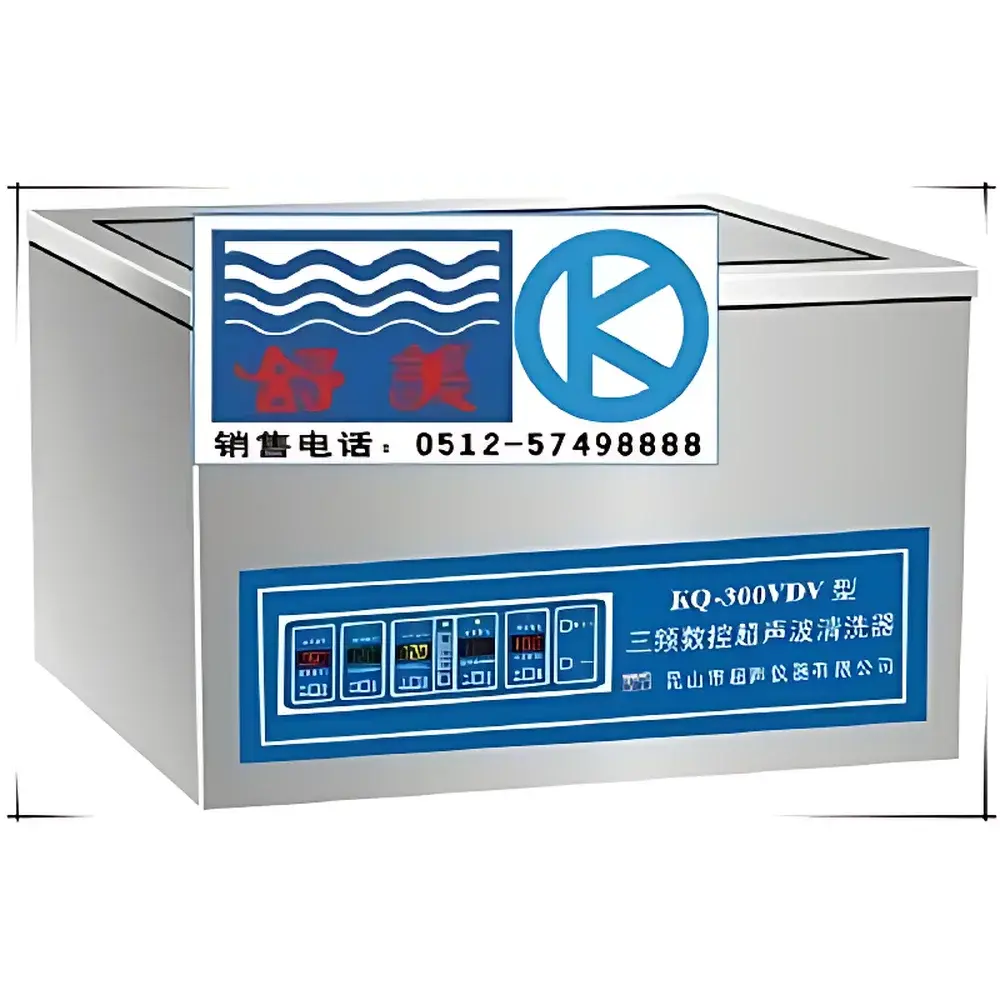
Shumei KQ-300VDV Desktop Tri-Frequency Digital Ultrasonic Cleaner
| Brand | Shumei |
|---|---|
| Origin | Jiangsu, China |
| Manufacturer Type | Direct Manufacturer |
| Product Category | Domestic |
| Model | KQ-300VDV |
| Quotation | Upon Request |
| Dimensions (W×D×H) | 410 × 350 × 380 mm |
| Inner Tank Dimensions | 300 × 240 × 180 mm |
| Capacity | 13 L |
| Ultrasonic Frequencies | 45 kHz, 80 kHz, 100 kHz |
| Frequency Switching Interval | 1–999 s |
| Ultrasonic Power Output | 300 W (Adjustable: 40–100 %) |
| Heating Power | 400 W |
| Temperature Range | 10–80 °C |
| Timer Range | 1–480 min |
| Cumulative Operating Time | Up to 999,999 h |
| Water Level Detection Range | 1–140 mm |
| Tank Material | Stainless Steel (Grade 304) |
| Lid & Housing Material | Stainless Steel |
| Basket Material | Polymer (Chemically Resistant) |
| Integrated Features | Vapor Recovery System, Acoustic Damping & Thermal Insulation Lid, Microcontroller-Based Digital Control System |
Overview
The Shumei KQ-300VDV is a desktop tri-frequency digital ultrasonic cleaner engineered for laboratories requiring high-fidelity, multi-stage cleaning protocols across diverse sample types. Unlike conventional single-frequency ultrasonic systems—whose cavitation field exhibits fixed wavelength-dependent penetration depth and particle displacement characteristics—the KQ-300VDV employs synchronized switching between three discrete ultrasonic frequencies: 45 kHz, 80 kHz, and 100 kHz. This frequency agility enables sequential or interleaved operation modes that leverage the distinct physical mechanisms of each band: lower frequencies (45 kHz) generate larger, higher-energy cavitation bubbles suited for macroscopic contaminant removal (e.g., particulates, oils, machining residues); mid-band frequencies (80 kHz) balance energy density and bubble collapse uniformity for intermediate soiling; while higher frequencies (100 kHz) produce denser, smaller cavitation events ideal for sub-micron debris, biofilm disruption, and delicate surface decontamination without erosion. The system’s microcontroller-based architecture permits programmable dwell time per frequency (1–999 seconds), enabling user-defined cleaning sequences aligned with ISO 13485 cleanroom validation requirements or ASTM F2796 guidelines for medical device cleaning verification.
Key Features
- Tri-frequency digital control with real-time selection and automatic cycling among 45 kHz, 80 kHz, and 100 kHz—no hardware reconfiguration required
- Full digital display interface showing simultaneous parameters: actual liquid level (1–140 mm), bath temperature (10–80 °C), ultrasonic power (% of 300 W), elapsed and cumulative operating time (up to 999,999 hours), and selected frequency mode
- Stainless steel (AISI 304) tank formed via precision deep-drawing, ensuring dimensional stability and resistance to alkaline/acidic cleaning solutions
- Integrated vapor recovery system mitigates solvent evaporation losses and reduces ambient volatile organic compound (VOC) concentrations—critical for chlorinated or alcohol-based cleaning baths
- Acoustically damped, thermally insulated stainless steel lid minimizes airborne noise (<55 dB(A) at 1 m) and suppresses heat loss during heated cycles
- Comprehensive safety monitoring: over-voltage/over-current detection, low-liquid-level cutoff, dry-run prevention, and real-time thermal overload protection
- Microprocessor-driven firmware supporting repeatable protocol storage, parameter recall, and factory calibration traceability
Sample Compatibility & Compliance
The KQ-300VDV accommodates a broad range of laboratory substrates—including glassware (vials, cuvettes, pipette tips), metal components (surgical instruments, optical mounts), silicon wafers, ceramic filters, and polymer-based microfluidic devices—without compromising structural integrity or surface finish. Its triple-frequency capability satisfies cleaning validation needs under ISO 15883-1 (washer-disinfectors), USP (Cleaning Validation of Laboratory Equipment), and FDA 21 CFR Part 11-compliant data logging when interfaced with external audit-trail software. All electronic subsystems conform to IEC 61010-1 safety standards for laboratory electrical equipment. The stainless steel construction meets EN 10088-1 corrosion resistance specifications for aqueous chemical exposure.
Software & Data Management
While the KQ-300VDV operates as a standalone instrument with embedded digital controls, its operational logs—including start/stop timestamps, frequency sequence history, temperature profiles, and power modulation events—are retained in non-volatile memory. Optional RS-232 or USB-to-serial interface modules (sold separately) enable integration into centralized lab management systems for GLP/GMP audit trail generation. Firmware supports user-defined cleaning SOP templates with password-protected parameter locking—ensuring procedural consistency across shifts and operators. Calibration records (frequency output accuracy, temperature sensor drift, liquid level sensor linearity) are stored with date/time stamps and can be exported in CSV format for quality assurance documentation.
Applications
- Precision cleaning of HPLC/GC autosampler vials, syringe filters, and column frits prior to chromatographic analysis
- Removal of photoresist residues and etch byproducts from semiconductor wafers and MEMS devices
- Deagglomeration and dispersion of nanomaterials (e.g., graphene oxide, quantum dots) in aqueous or organic media
- Cell lysis and nucleic acid extraction support in molecular biology workflows
- Pre-sterilization cleaning of reusable surgical tools in hospital central sterile supply departments (CSSD)
- Ultrasonic degassing of solvents prior to vacuum filtration or spectroscopic measurements
- Emulsification of immiscible liquids (e.g., oil-in-water formulations) for pharmaceutical excipient development
FAQ
Can the KQ-300VDV operate continuously for extended durations?
Yes—the system supports uninterrupted operation up to 480 minutes per cycle, with cumulative runtime tracking exceeding 114 years (999,999 hours). Thermal management and duty-cycle monitoring prevent coil saturation or transducer overheating.
Is frequency switching fully automated, or does it require manual intervention?
All frequency transitions are programmable and automatic; users define sequence order, dwell time per frequency, and repetition count via the front-panel interface or optional PC software.
What cleaning solutions are compatible with the stainless steel tank?
Aqueous alkaline, acidic, enzymatic, and mild solvent-based solutions (e.g., isopropanol, ethanol, acetone) may be used—provided they remain within the 10–80 °C operational temperature window and do not exceed pH 2–12 for prolonged exposure.
Does the unit include validation documentation for regulated environments?
Factory calibration certificates (traceable to NIST standards) and IQ/OQ protocol templates are available upon request for GxP-compliant installations.
How is acoustic performance verified across all three frequencies?
Each frequency channel undergoes individual output power verification (±5% tolerance) and cavitation distribution mapping using calibrated hydrophones and aluminum foil erosion testing per ASTM E1769.



