
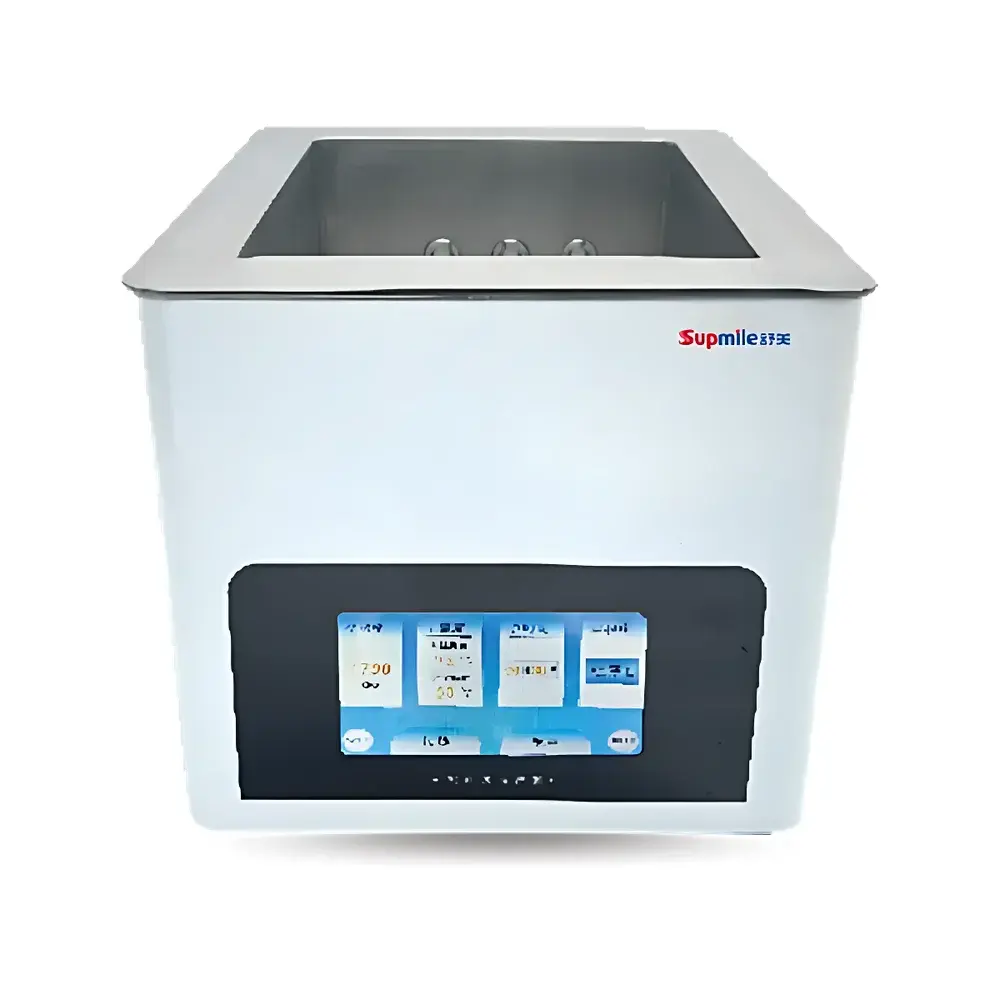
Shumei KQ-400MSE Benchtop Megasonic Cleaner
| Brand | Shumei |
|---|---|
| Origin | Jiangsu, China |
| Manufacturer Type | Direct Manufacturer |
| Product Category | Domestic |
| Model | KQ-400MSE |
| Instrument Type | General-Purpose |
| Tank Capacity | 15 L |
| Megasonic Frequencies | 0.5 MHz, 1.0 MHz, 1.7 MHz |
| Ultrasonic Power Output | 400 W |
| Temperature Control Range | Ambient to 80 °C |
| Timer Range | 1 min – 99 h 59 min |
| Drain Valve | Equipped |
Overview
The Shumei KQ-400MSE Benchtop Megasonic Cleaner is an engineered solution for ultra-precision cleaning of delicate substrates in semiconductor fabrication, MEMS manufacturing, photonics R&D, and advanced materials laboratories. Unlike conventional ultrasonic cleaners that rely on cavitation-induced microjetting and shockwaves—mechanisms inherently associated with surface pitting and erosion—the KQ-400MSE operates in the megasonic frequency range (0.5–1.7 MHz), where acoustic energy induces high-velocity fluid streaming within a nanoscale boundary layer adjacent to the substrate surface. This non-cavitating mechanism generates shear forces sufficient to dislodge sub-micron and nanoscale particulate contaminants—including metallic residues, photoresist residuals, and organic films—without mechanical or thermal damage to sensitive features such as low-k dielectrics, copper interconnects, or lithographically patterned wafers.
Key Features
- Triple-frequency megasonic transducer system (0.5 MHz, 1.0 MHz, 1.7 MHz) enabling process optimization across diverse substrate geometries and contaminant types;
- 7-inch high-resolution TFT capacitive touchscreen interface supporting up to nine user-defined cleaning protocols with independent parameter sets for frequency, power, temperature, and duration;
- Intelligent power regulation architecture delivering >85% electroacoustic conversion efficiency and minimal reactive power loss;
- Stainless steel powder-coated chassis (304-grade) with corrosion-resistant interior tank and integrated drain valve for controlled fluid disposal;
- Dual-stage thermal management: PTC heating element (500 W) with ±0.5 °C stability across 20–80 °C range; real-time overtemperature, overvoltage, and overcurrent monitoring with automatic shutdown;
- Acoustically damped enclosure design achieving <35 dB(A) operational noise level—suitable for open-lab environments and ISO Class 5 cleanroom-adjacent installations.
Sample Compatibility & Compliance
The KQ-400MSE accommodates standard 150 mm and 200 mm wafers, reticles, optical lenses, microfluidic chips, and ceramic substrates up to 320 × 320 mm footprint. Its non-destructive cleaning profile complies with industry-standard wafer handling requirements per SEMI F19-0218 and JEDEC J-STD-033 for moisture-sensitive devices. While not certified to IEC 61000-4 electromagnetic compatibility standards out-of-box, the unit meets CE safety directives (2014/35/EU Low Voltage Directive and 2014/30/EU EMC Directive) when installed per manufacturer-specified grounding and isolation guidelines. For regulated environments requiring auditability, optional firmware upgrade supports timestamped event logging aligned with GLP/GMP documentation practices.
Software & Data Management
No proprietary PC software is required for basic operation; all parameters are configured directly via the embedded HMI. However, the device includes an RS-232 serial port (DB9) and optional USB-to-serial adapter support for integration into centralized lab automation systems. Logged data—including start/stop timestamps, actual temperature/power profiles, and fault codes—is exportable in CSV format for traceability. When deployed in FDA-regulated facilities, the timer and temperature control functions can be validated per USP and guidance for cleaning process verification, though full 21 CFR Part 11 compliance requires third-party electronic signature and audit trail middleware.
Applications
- Semiconductor front-end: Pre-deposition wafer cleaning, post-etch residue removal, and CMP slurry decontamination;
- Advanced packaging: Underfill and mold compound residue mitigation prior to wire bonding;
- MEMS/NEMS: Release etch residue clearance without stiction or structural deformation;
- Optoelectronics: Anti-reflective coating substrate preparation and laser cavity mirror cleaning;
- Life sciences: Microarray slide decontamination and microfluidic channel priming prior to assay loading;
- Research labs: Nanoparticle dispersion stabilization and colloidal sample conditioning for DLS or TEM grid preparation.
FAQ
What distinguishes megasonic from ultrasonic cleaning?
Megasonic cleaning uses frequencies ≥0.5 MHz to generate acoustic streaming rather than transient cavitation—eliminating surface erosion while retaining efficacy against sub-100 nm particles.
Can the KQ-400MSE be used for aqueous and solvent-based chemistries?
Yes; the stainless steel tank and sealed transducer housing are compatible with deionized water, SC1/SC2 solutions, isopropanol, and low-volatility solvents—provided flash point exceeds 60 °C and vapor pressure remains below 10 kPa at operating temperature.
Is calibration certification available?
Factory calibration reports for temperature and timer accuracy are included; NIST-traceable acoustic intensity mapping (per ASTM E1000) may be commissioned separately.
Does the unit support continuous operation?
The thermal management system permits uninterrupted duty cycles up to 72 hours under nominal load (400 W at 1.0 MHz, 45 °C), with automatic cooldown intervals triggered if internal ambient exceeds 55 °C.
How is acoustic uniformity verified across the tank?
Shumei provides a normalized acoustic field map (±15% intensity variation across central 80% of tank area) measured using calibrated hydrophone arrays per IEC 62127-1 Annex B methodology.



