
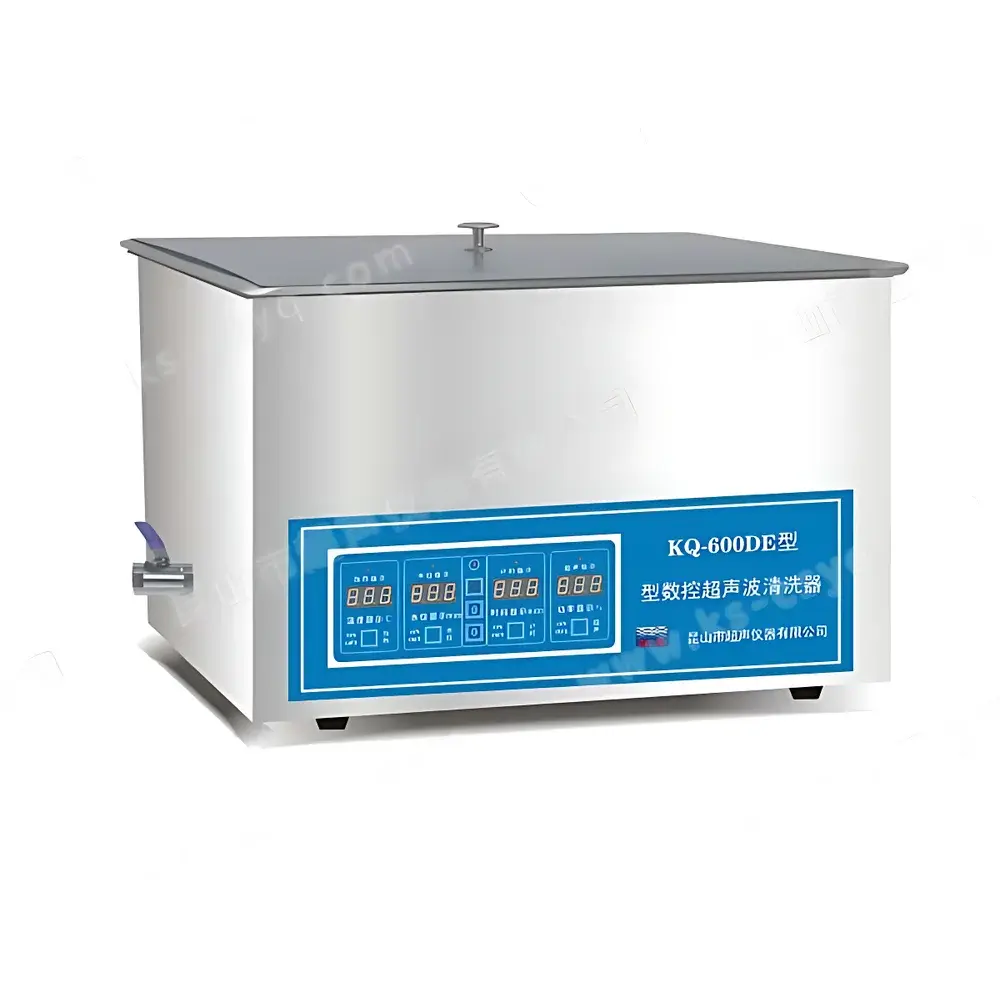
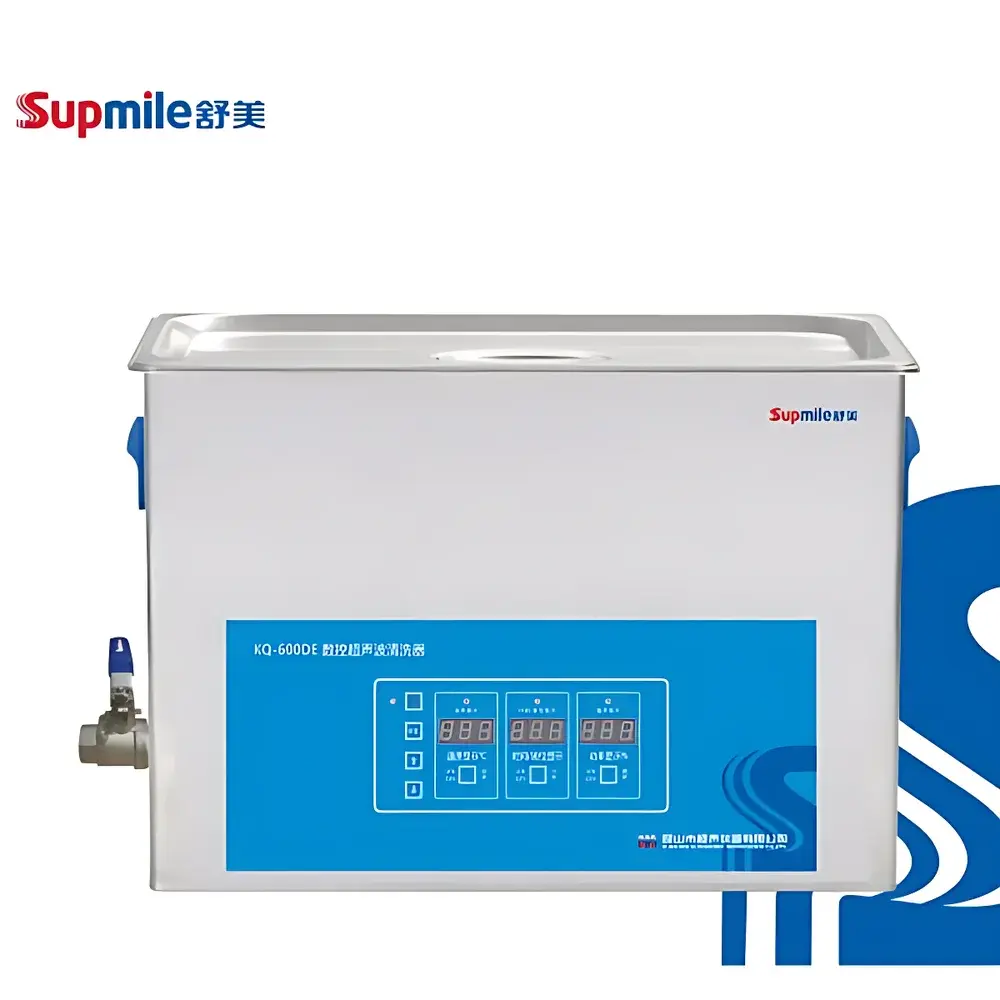
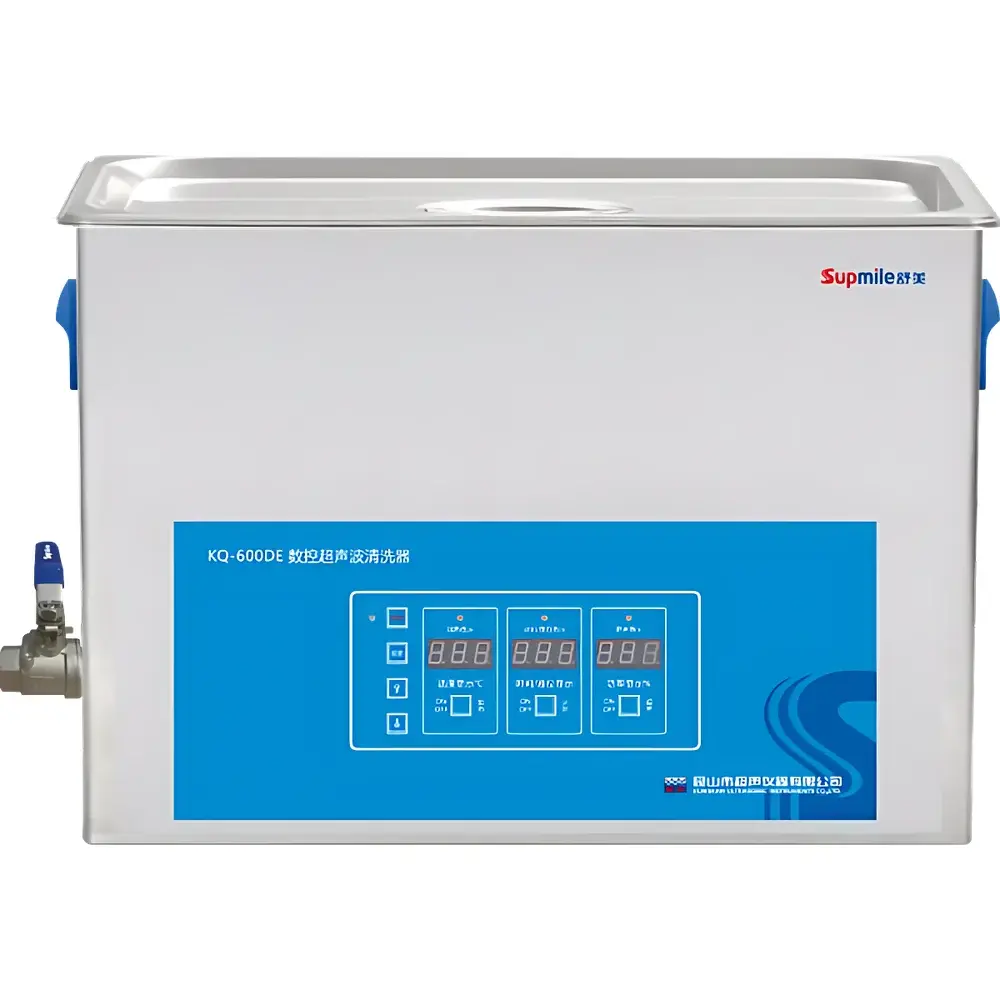
Shumei KQ-600DE Digital Ultrasonic Cleaner
| Brand | Shumei |
|---|---|
| Origin | Jiangsu, China |
| Manufacturer Type | Direct Manufacturer |
| Product Category | Domestic |
| Model | KQ-600DE |
| Instrument Type | General-Purpose |
| Tank Capacity | 22.5 L |
| Ultrasonic Frequency | 40 kHz |
| Ultrasonic Power Output | 600 W |
| Power Adjustment Range | 40–100% |
| Heating Temperature Range | 10–80 °C |
| Timer Range | 1–480 min |
| Sound-Dampening Lid | Included |
| Drain/Inlet | Manual Control |
| Heating Power | 800 W |
| Internal Tank Dimensions | 500 × 300 × 150 mm |
| External Dimensions | 531 × 326 × 375 mm |
| Power Supply | AC 220 V / 50 Hz |
| Construction Material | 304 Stainless Steel |
| Safety Protections | Low-level liquid detection, over-temperature, over-voltage, over-current, and dry-run protection |
| Display | Digital LCD showing real-time temperature, power level, elapsed time, set parameters, and fluid level |
Overview
The Shumei KQ-600DE Digital Ultrasonic Cleaner is a general-purpose laboratory-grade cleaning system engineered for precision, repeatability, and operational safety in routine sample preparation workflows. It operates on the principle of ultrasonic cavitation—generating high-frequency (40 kHz) acoustic pressure waves in aqueous or compatible solvent media to induce controlled microbubble formation and implosion. This physical mechanism effectively dislodges particulate contaminants, organic residues, biofilms, and loosely adhered debris from surfaces of glassware, metal parts, surgical instruments, electronic components, and analytical sample holders. Designed for continuous use in QC labs, research facilities, and clinical support environments, the KQ-600DE integrates robust 304 stainless steel construction with digitally regulated ultrasonic energy delivery, thermal control, and programmable timing—all within a compact footprint (531 × 326 × 375 mm) and 22.5 L working tank volume.
Key Features
- Digital microcontroller-based operation with intuitive LCD interface for real-time monitoring and parameter adjustment.
- Adjustable ultrasonic power output (40–100% of 600 W nominal), enabling optimization across diverse sample types—from delicate optics to heavily soiled industrial parts.
- Precise temperature regulation from 10 °C to 80 °C via integrated 800 W heating element; supports enhanced cleaning efficacy for waxy, viscous, or thermally responsive contaminants.
- Programmable timer spanning 1 to 480 minutes, facilitating both rapid decontamination cycles and extended soak protocols.
- Comprehensive safety architecture including low-fluid-level detection, over-temperature cutoff, over-voltage and over-current protection, and dry-run prevention—ensuring equipment longevity and operator safety.
- Sound-dampening lid minimizes ambient noise emission during operation, meeting typical laboratory acoustic environment requirements.
- Manual inlet and drain valves allow flexible integration into lab utility infrastructure without requiring permanent plumbing.
- Standard accessories include 304 stainless steel mesh basket and support rack for uniform part suspension and consistent exposure to ultrasonic fields.
Sample Compatibility & Compliance
The KQ-600DE accommodates a broad range of laboratory and industrial substrates, including borosilicate glassware (vials, beakers, pipettes), stainless steel tools, aluminum fixtures, ceramic components, and polymer-based carriers—provided compatibility with aqueous or mild solvent-based cleaning solutions is verified. Its design conforms to fundamental electrical safety standards for laboratory equipment (IEC 61010-1). While not certified for sterile processing per ISO 13485 or FDA 21 CFR Part 820, it supports GLP-aligned documentation practices when used as part of validated cleaning SOPs. The digital memory function retains last-used settings, supporting traceability in regulated environments where procedural consistency is required.
Software & Data Management
The unit features embedded firmware with non-volatile parameter memory—retaining user-defined time, temperature, and power settings across power cycles. Though it lacks external connectivity (e.g., USB, Ethernet, or RS-232), its digital display logs real-time operational data (actual temperature, elapsed time, active power %), enabling manual entry into electronic lab notebooks (ELNs) or paper-based batch records. All displayed values are derived from calibrated internal sensors (NTC thermistor, current shunt, and fluid-level float switch), ensuring measurement integrity suitable for internal quality assurance protocols. No proprietary software installation or cloud dependency is required.
Applications
- Routine cleaning and descaling of HPLC vials, GC autosampler trays, and spectrophotometer cuvettes.
- Preparation of electron microscopy specimens by removing surface hydrocarbons and particulates prior to sputter coating.
- Decontamination of reusable surgical and dental instruments in non-sterile pre-wash stages.
- Removal of flux residues from printed circuit boards (PCBs) and microelectronic assemblies.
- Supporting ASTM D2240 (Shore A hardness testing) sample conditioning via solvent-assisted surface cleaning.
- ISO 8573-1 compressed air system component cleaning prior to particle counting analysis.
FAQ
Is the KQ-600DE suitable for cleaning delicate optical lenses or semiconductor wafers?
Yes—when operated at reduced power (40–60%) and with appropriate low-surface-tension, non-ionic cleaning solutions, it provides gentle yet effective contaminant removal without mechanical abrasion.
Does the unit meet FDA 21 CFR Part 11 requirements for electronic records?
No—it does not provide audit trails, electronic signatures, or system access controls; however, its digital display supports manual transcription into compliant ELN systems.
Can the tank be filled with solvents other than water?
Only if fully compatible with 304 stainless steel and confirmed safe at operating temperatures up to 80 °C; flammable or chlorinated solvents are strictly prohibited due to safety and material compatibility constraints.
What maintenance is required to ensure long-term performance?
Regular descaling with diluted citric acid solution (every 2–4 weeks depending on water hardness), visual inspection of transducer bonding integrity, and periodic verification of temperature sensor calibration using a NIST-traceable thermometer.



