
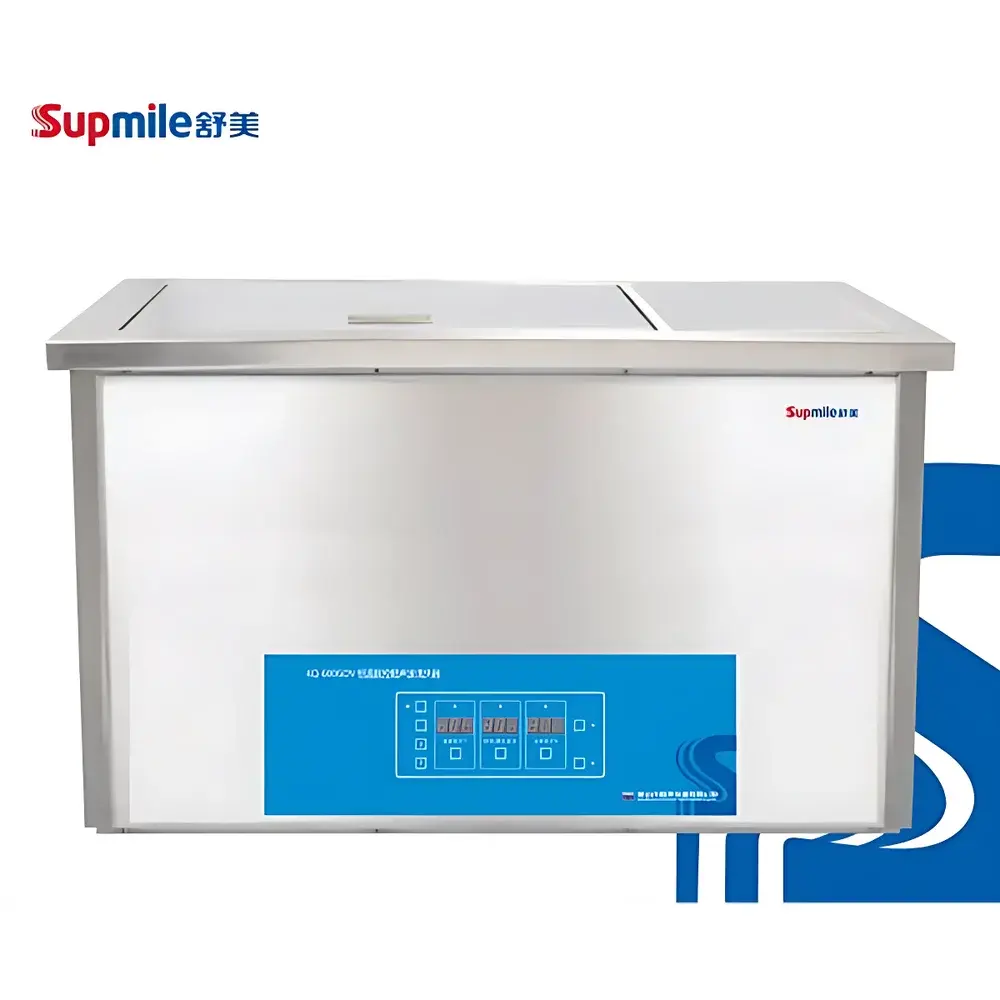
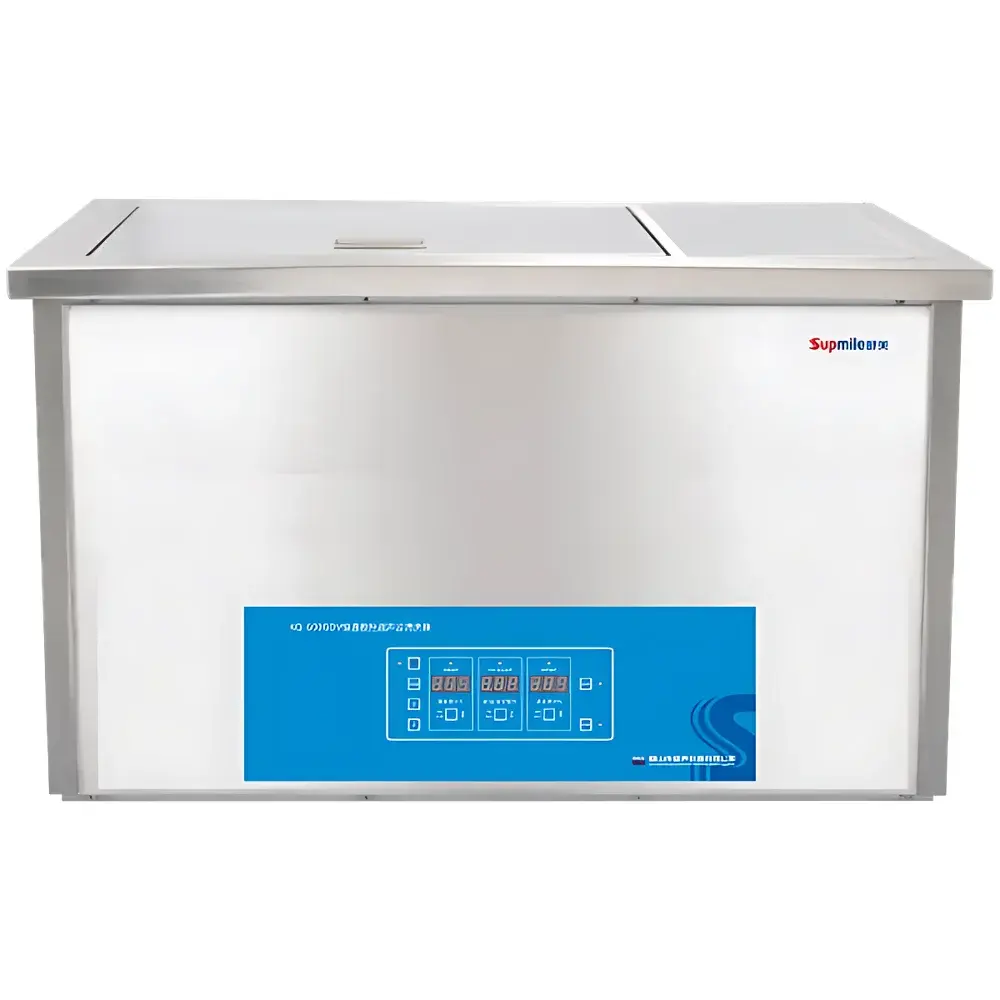
Shumei KQ-600GDV Digital Temperature-Controlled Ultrasonic Cleaner
| Brand | Shumei |
|---|---|
| Origin | Jiangsu, China |
| Manufacturer Type | Direct Manufacturer |
| Product Category | Domestic |
| Model | KQ-600GDV |
| Instrument Type | General-Purpose |
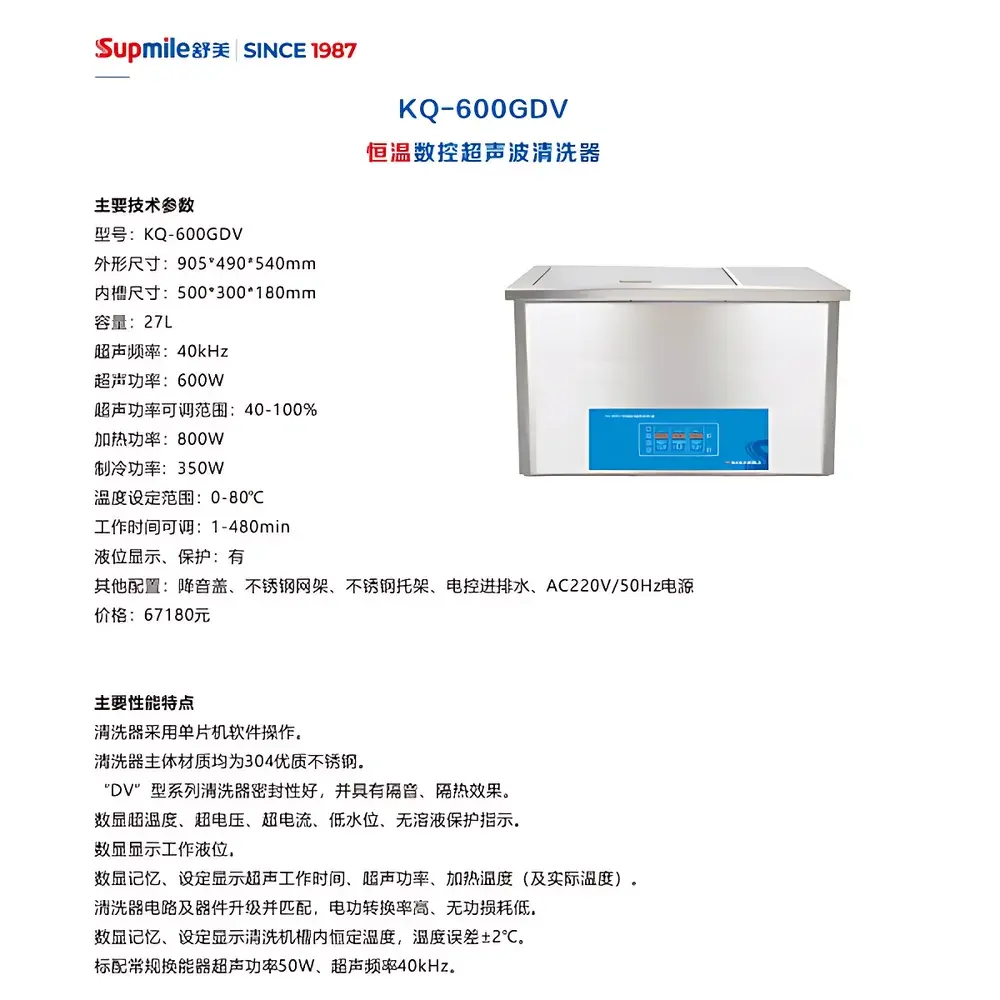
| Tank Capacity | 27 L |
| Ultrasonic Frequency | 40 kHz |
| Ultrasonic Power Output | 600 W |
| Adjustable Ultrasonic Power | 40–100% |
| Temperature Control Range | 0–80 °C |
| Heating Power | 800 W |
| Cooling Power | 350 W |
| Timer Range | 1–480 min |
| Sound-Dampening Lid | Yes |
| Electronic Inlet/Drain Control | Yes |
| Power Supply | AC 220 V / 50 Hz |
| Internal Tank Dimensions | 500 × 300 × 180 mm |
| External Dimensions | 905 × 490 × 540 mm |
| Tank Material | 304 Stainless Steel |
| Temperature Accuracy | ±2 °C |
| Liquid Level Monitoring & Protection | Yes |
| Standard Accessories | Stainless Steel Mesh Basket, Stainless Steel Rack, Sound-Dampening Lid |
Overview
The Shumei KQ-600GDV Digital Temperature-Controlled Ultrasonic Cleaner is a general-purpose laboratory cleaning system engineered for precision, repeatability, and operational safety in routine and regulated environments. It operates on the principle of piezoelectric ultrasonic cavitation at a fixed frequency of 40 kHz—optimized to generate stable, high-energy microbubbles within aqueous or mild solvent-based cleaning media. These collapsing bubbles produce localized shockwaves and microstreaming that effectively dislodge particulate contaminants, organic residues, and biofilms from complex geometries—including pipette tips, glassware, surgical instruments, optical components, and semiconductor wafers. Integrated Peltier-assisted cooling (350 W) and resistive heating (800 W) enable precise thermostatic control across a broad operational range (0–80 °C), supporting temperature-sensitive cleaning protocols such as enzyme deactivation or low-temperature solvent compatibility. The unit’s 27 L stainless steel tank (304 grade) ensures long-term corrosion resistance and compliance with ISO 15190:2020 requirements for laboratory equipment construction.
Key Features
- Microprocessor-controlled digital interface with real-time display of ultrasonic power (%), set/actual temperature (°C), elapsed time (min), and liquid level status
- Adjustable ultrasonic intensity (40–100% of 600 W nominal output) to match sample fragility and soil load without compromising cleaning efficacy
- Active thermal regulation with ±2 °C temperature stability—validated per ASTM E2234 for laboratory thermal uniformity testing
- Integrated safety interlocks: automatic shutdown on low liquid level, over-temperature, over-current, and over-voltage conditions
- Sound-dampening lid with sealing gasket reduces ambient noise to ≤55 dB(A) at 1 m distance—meeting OSHA 29 CFR 1910.95 workplace noise exposure guidelines
- Electrically actuated inlet and drain valves enable hands-free fluid handling and support automated wash-rinse-dry sequences in multi-step protocols
- Full 304 stainless steel construction—including tank, transducer housing, and support rack—ensures compatibility with alkaline, acidic, and enzymatic cleaning solutions per CLSI GP26-A5 standards
Sample Compatibility & Compliance
The KQ-600GDV accommodates a wide range of laboratory and industrial specimens, including but not limited to borosilicate glassware, anodized aluminum fixtures, titanium implants, quartz cuvettes, and printed circuit boards. Its non-aggressive 40 kHz frequency minimizes surface pitting on delicate optics and polished metals while maintaining effective particle removal down to sub-10 µm scale. The system conforms to IEC 61000-6-3 (EMC emissions) and IEC 61000-6-2 (immunity), and its electrical architecture complies with IEC 61010-1:2010 for safety in laboratory equipment. While not certified for sterile processing per ISO 17664, it supports cleaning steps preceding autoclaving or ethylene oxide sterilization in GLP/GMP workflows when operated under documented SOPs.
Software & Data Management
The embedded firmware supports parameter logging with timestamped records of cycle start/end times, temperature profiles, power settings, and fault events. Data export is available via USB port in CSV format for integration into LIMS or electronic lab notebooks (ELN). Audit trail functionality meets FDA 21 CFR Part 11 requirements for electronic records when paired with user-access controls and password-protected configuration menus. Firmware updates are performed offline using signed binary files to ensure integrity and traceability.
Applications
- Pre-analytical sample preparation in clinical chemistry and microbiology labs (e.g., blood collection tube cleaning prior to hemolysis testing)
- Removal of flux residues and solder paste from PCB assemblies prior to AOI inspection
- Cleaning of HPLC and GC autosampler vials, injection ports, and column frits
- Decontamination of reusable surgical instruments before steam sterilization per AAMI ST79:2023
- Surface preparation of metal coupons for corrosion testing (ASTM G1–03)
- Ultrasonic-assisted extraction of plant metabolites in natural product laboratories
FAQ
What is the maximum recommended operating temperature for aqueous cleaning solutions?
The system is rated for continuous operation up to 80 °C; however, prolonged use above 60 °C with tap water may accelerate limescale deposition. Deionized or softened water is recommended for extended high-temperature cycles.
Can this unit be integrated into a central lab automation network?
No native Ethernet or RS-485 interface is provided; integration requires external PLC-level relay control of the timer and power enable signals via dry-contact terminals.
Is the cooling function suitable for cryogenic solvent applications?
The built-in thermoelectric cooler maintains bath temperatures no lower than 0 °C and is not designed for sub-zero operation or volatile solvent condensation control.
How often should the transducers be recalibrated?
Transducer performance is factory-verified and does not require periodic recalibration; however, annual verification of acoustic output intensity using a calibrated hydrophone (per ASTM E1065) is recommended for QA/QC-critical applications.
Does the unit include validation documentation for IQ/OQ protocols?
A basic Factory Acceptance Test (FAT) report is supplied; full Installation Qualification (IQ) and Operational Qualification (OQ) templates compliant with ISO/IEC 17025 are available upon request and require on-site execution by qualified personnel.



