
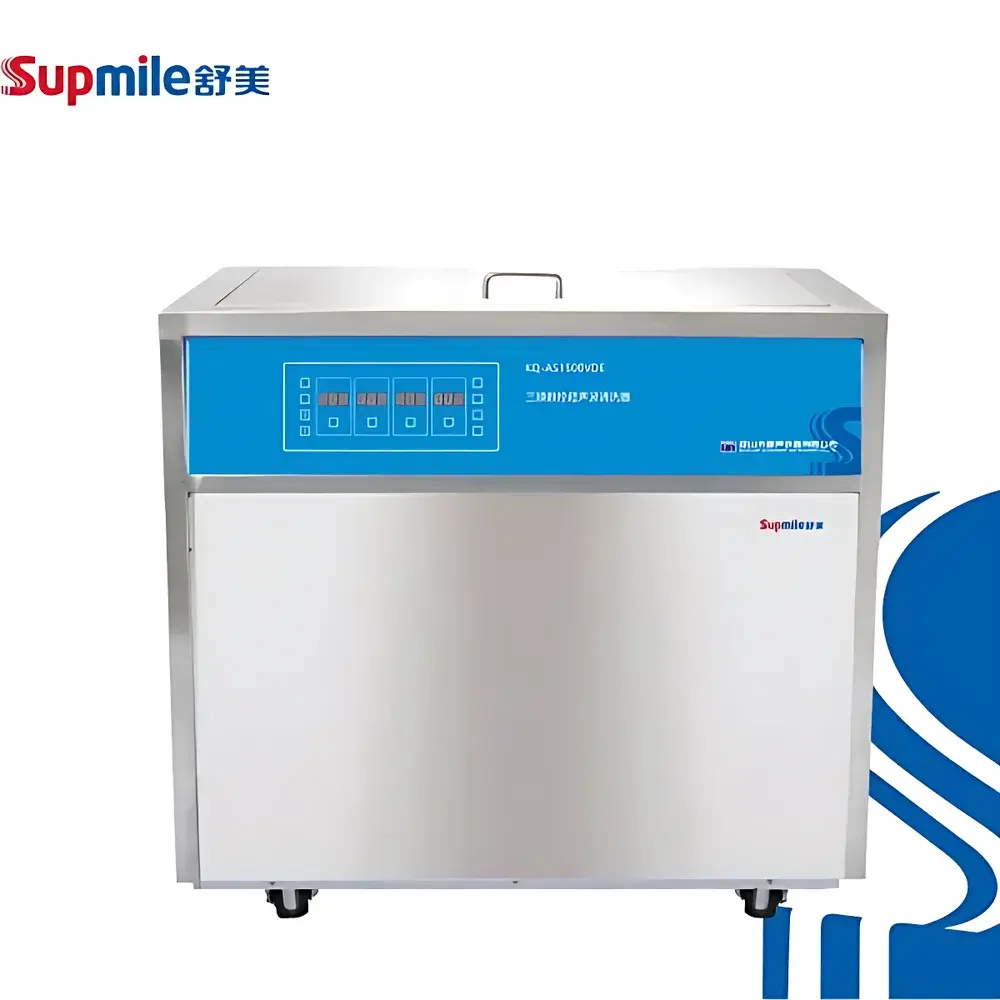
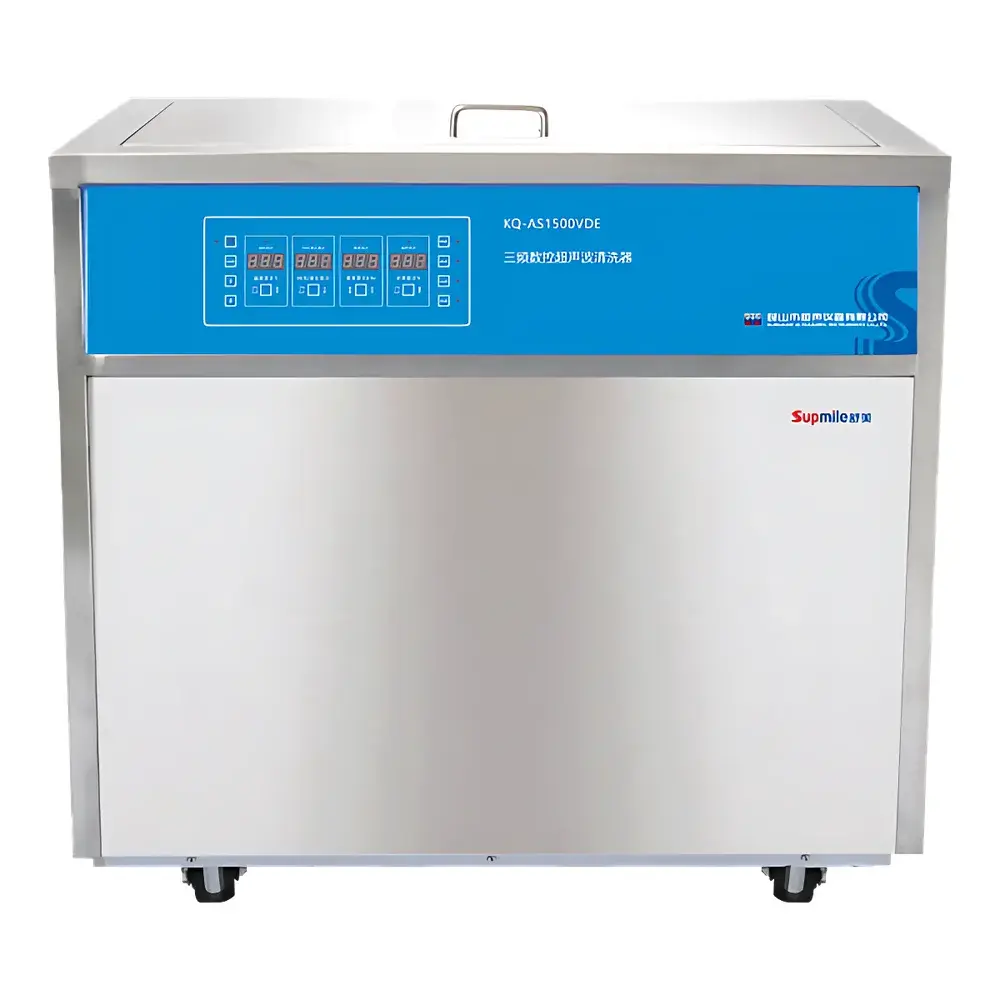
Shumei KQ-AS1500VDE Triple-Frequency Digital Ultrasonic Cleaner
| Brand | Shumei |
|---|---|
| Origin | Jiangsu, China |
| Manufacturer Type | Direct Manufacturer |
| Instrument Type | General-Purpose |
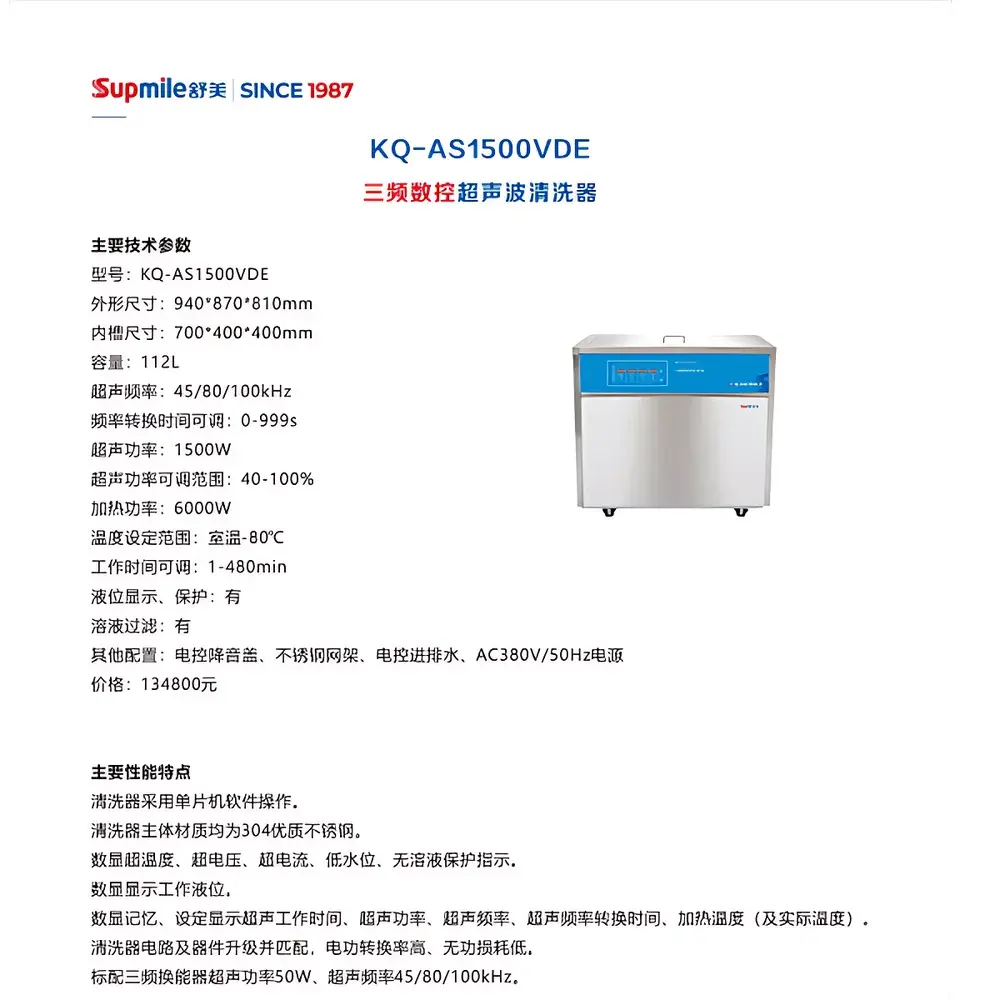
| Capacity | 112 L |
| Ultrasonic Frequencies | 45 / 80 / 100 kHz |
| Ultrasonic Power Output | 1500 W |
| Power Adjustment Range | 40–100% |
| Heating Temperature Range | Ambient to 80 °C |
| Timer Range | 1–480 min |
| Sound-Dampening Lid | Electrically Actuated |
| Drain/Inlet Control | Electrically Actuated |
| Heating Power | 6000 W |
| Internal Tank Dimensions | 700 × 400 × 400 mm |
| Overall Dimensions | 940 × 870 × 810 mm |
| Liquid Level Monitoring & Protection | Yes |
| Solution Filtration System | Integrated |
| Power Supply | AC 380 V, 50 Hz |
Overview
The Shumei KQ-AS1500VDE is a general-purpose, triple-frequency digital ultrasonic cleaner engineered for high-reproducibility cleaning of precision components, laboratory glassware, optical elements, semiconductor wafers, and medical instruments. It operates on the principle of cavitation-induced micro-scrubbing: high-frequency acoustic energy propagates through aqueous or solvent-based cleaning media, generating transient microbubbles that collapse near surfaces—releasing localized shockwaves and micro-jets capable of dislodging sub-micron particulates, organic residues, and biofilm without mechanical abrasion. Unlike single-frequency systems, its tri-band capability (45 kHz, 80 kHz, and 100 kHz) enables selective optimization across diverse sample geometries and contaminant types: lower frequencies deliver higher cavitation intensity for robust particulate removal from macro-scale parts; mid-range frequencies balance penetration depth and surface sensitivity; while the 100 kHz mode enhances resolution for delicate substrates such as MEMS devices or coated optics. The unit features a fully welded 304 stainless steel tank with reinforced structural integrity, designed to withstand sustained operation at elevated temperatures and aggressive chemistries under controlled laboratory or pilot-scale manufacturing environments.
Key Features
- Triple-frequency ultrasonic generation (45 / 80 / 100 kHz) with independent frequency switching and programmable dwell time per band (0–999 s)
- Digital microcontroller-based interface enabling precise, repeatable parameter recall and real-time monitoring of ultrasonic power (40–100% adjustable), temperature (ambient to 80 °C), and timer (1–480 min)
- Integrated safety architecture including over-temperature, over-voltage, over-current, low-level liquid detection, and dry-run protection — all displayed via LED indicators
- Electrically actuated sound-dampening lid with interlocked safety cutoff to meet ISO 14122-3 requirements for operator noise exposure control
- Automated electric inlet and drain system with level-sensing feedback, supporting unattended batch processing and GMP-aligned workflow integration
- Onboard solution filtration module with replaceable stainless steel mesh basket and optional filter cartridge compatibility (ISO 4406 Class 17/14 compliant filtration path)
- High-efficiency transducer array delivering 1500 W total acoustic output with >85% electroacoustic conversion efficiency and minimal harmonic distortion
Sample Compatibility & Compliance
The KQ-AS1500VDE accommodates a broad range of sample formats, including volumetric flasks, Petri dishes, syringe filters, surgical tools, printed circuit boards, and ceramic substrates up to 680 mm in length. Its large internal volume (112 L) supports immersion of multiple racks simultaneously while maintaining uniform acoustic field distribution, validated per ASTM E1722–22 Annex A1 for field homogeneity mapping. All wetted surfaces are constructed from electropolished AISI 304 stainless steel (ASTM A240), ensuring corrosion resistance against common alkaline, acidic, and enzymatic cleaning solutions. The unit complies with IEC 61000-6-3 (EMC emissions), IEC 61000-6-2 (immunity), and meets CE marking requirements for laboratory equipment. Optional validation documentation packages support IQ/OQ/PQ execution in accordance with ISO/IEC 17025 and FDA 21 CFR Part 11-compliant data integrity protocols.
Software & Data Management
While the KQ-AS1500VDE operates via an embedded digital front panel, it supports external RS-485 serial communication (Modbus RTU protocol) for integration into centralized lab management systems. Logged operational parameters—including actual temperature, real-time power draw, elapsed cycle time, and fault codes—are timestamped and exportable as CSV files for audit trails. The system records up to 1,000 cycles with automatic overwrite logic, retaining critical metadata required for GLP/GMP traceability. Optional PC software provides graphical waveform visualization, historical trend analysis, and customizable report templates aligned with ISO 9001 quality record retention standards.
Applications
- Cleaning of HPLC columns, autosampler vials, and chromatography hardware prior to calibration or method validation
- Decontamination of reusable surgical instruments in ISO 13485-certified reprocessing units
- Removal of photoresist residues and metal oxides from silicon wafers in semiconductor R&D labs
- Preparation of TEM grids and AFM cantilevers requiring particle-free surfaces
- Extraction support for environmental samples (e.g., soil sieves, air filters) prior to ICP-MS analysis
- Restoration of vintage optical components and museum-grade instrumentation without surface etching
FAQ
What safety certifications does the KQ-AS1500VDE hold?
It carries CE marking under the EU Machinery Directive 2006/42/EC and Electromagnetic Compatibility Directive 2014/30/EU, with full test reports available upon request.
Can the unit be integrated into a cleanroom environment?
Yes — its sealed electronics housing, non-shedding stainless steel construction, and optional HEPA-filtered recirculation add-on make it suitable for ISO Class 7 (10,000) cleanrooms.
Is remote monitoring supported out of the box?
Standard RS-485 Modbus RTU connectivity enables integration with SCADA or LIMS platforms; Ethernet or Wi-Fi modules are available as configurable accessories.
How is acoustic uniformity verified across the tank?
Field mapping is performed using calibrated hydrophones per ASTM E1722–22 methodology, with uniformity tolerance ±15% across the central 80% volume.
Does the system support automated detergent dosing?
Not natively — however, third-party peristaltic pump interfaces can be installed via the auxiliary I/O port for synchronized chemical injection during fill cycles.



