
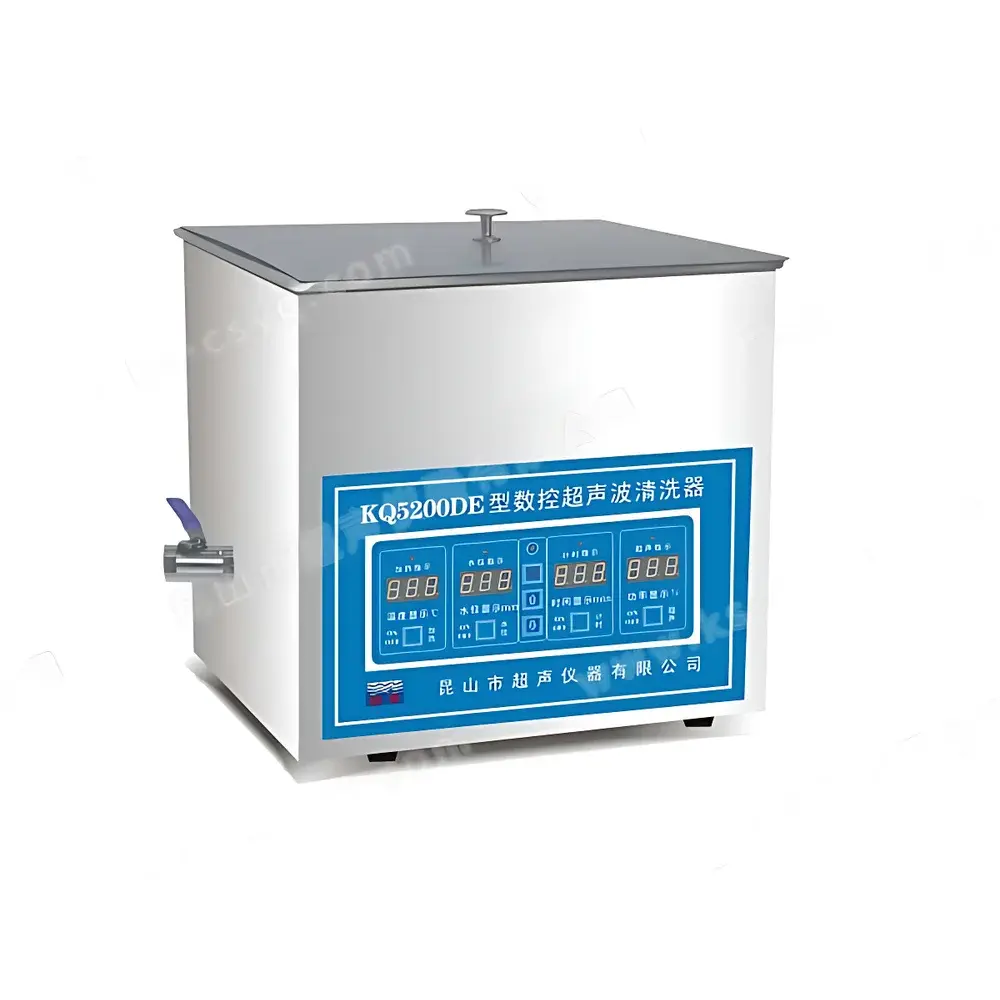
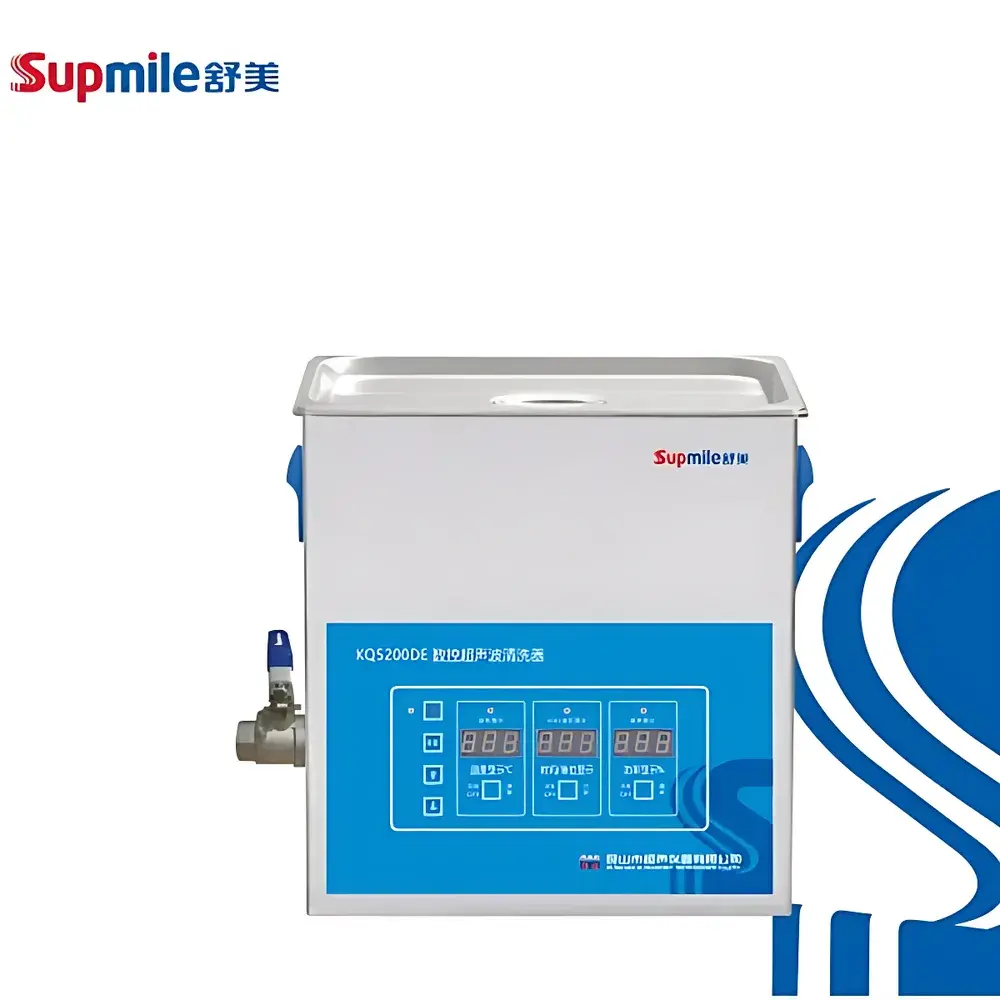
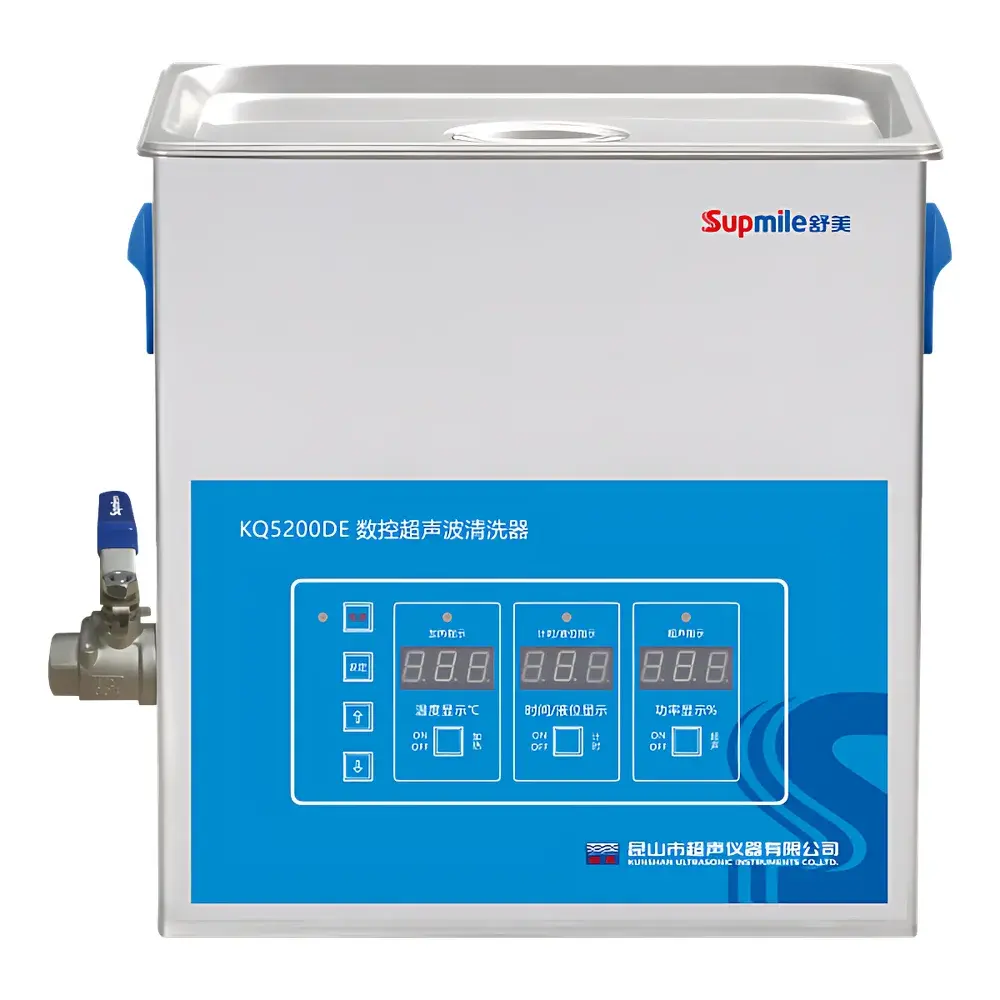
Shumei KQ5200DE Digital Ultrasonic Cleaner
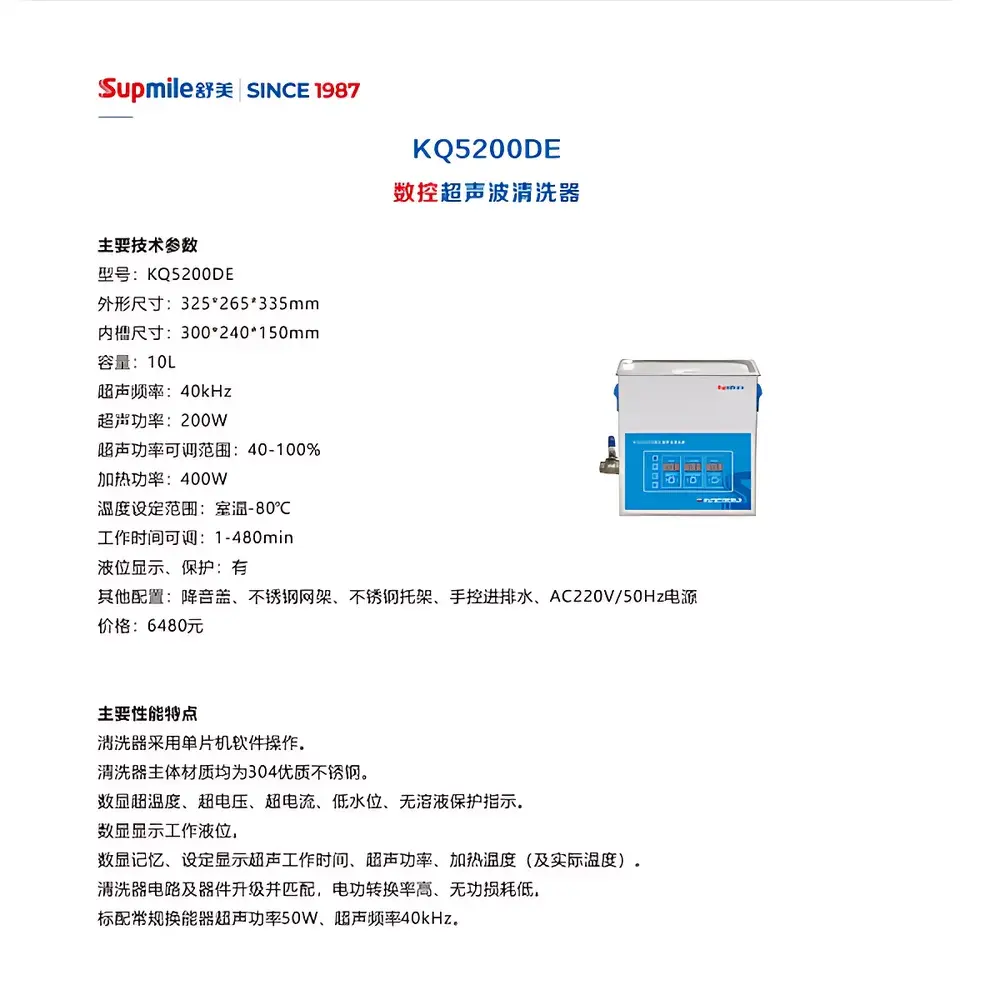
| Brand | Shumei |
|---|---|
| Origin | Jiangsu, China |
| Manufacturer Type | Direct Manufacturer |
| Instrument Type | General-Purpose |
| Capacity | 10 L |
| Ultrasonic Frequency | 40 kHz |
| Ultrasonic Power | 200 W |
| Power Adjustment | Yes (40–100%) |
| Heating Temperature Range | 10–80 °C |
| Timer Range | 1–480 min |
| Sound-Dampening Lid | Included |
| Drain/Inlet | Manual Control |
| Dimensions (W×D×H) | 325 × 265 × 335 mm |
| Tank Internal Dimensions (W×D×H) | 300 × 240 × 150 mm |
| Heating Power | 400 W |
| Protection Features | Low-Level Liquid Detection, Over-Temperature, Over-Voltage, Over-Current, No-Solution Safety Lockout |
| Display | Digital LED (Time, Power %, Temp Setpoint & Actual, Water Level Indicator) |
| Construction Material | 304 Stainless Steel |
| Power Supply | AC 220 V / 50 Hz |
Overview
The Shumei KQ5200DE Digital Ultrasonic Cleaner is a general-purpose laboratory-grade cleaning system engineered for precision, repeatability, and operational safety in routine sample preparation workflows. It operates on the principle of ultrasonic cavitation—generating high-frequency pressure waves (40 kHz) in liquid media to produce microscopic vacuum bubbles that collapse with localized energy release, effectively dislodging particulate contaminants, organic residues, and biofilms from surfaces of immersed objects. Designed for consistent performance across diverse sample geometries and material compositions, the unit integrates digital microcontroller-based operation with real-time parameter monitoring, enabling precise control over cleaning intensity, thermal conditioning, and exposure duration. Its 10-liter stainless steel tank (300 × 240 × 150 mm internal dimensions) supports standard laboratory glassware, metal components, optical parts, and small instrumentation assemblies without requiring custom fixtures.
Key Features
- Digital microprocessor control with intuitive LED interface for independent adjustment of ultrasonic power (40–100% of 200 W nominal output), heating temperature (10–80 °C), and cleaning duration (1–480 minutes).
- Robust 304 stainless steel construction for both tank and housing—resistant to corrosion, thermal stress, and chemical degradation under repeated solvent or aqueous cleaning cycles.
- Integrated safety architecture including automatic shutdown on low liquid level detection, over-temperature cutoff, over-voltage/over-current protection, and no-solution lockout to prevent transducer damage.
- Real-time dual-display showing setpoints and actual values for temperature and ultrasonic power, plus visual water-level indication for process verification.
- Sound-dampening lid included as standard equipment to reduce ambient noise and minimize solvent evaporation during extended operations.
- Manual inlet and drain valves facilitate controlled fluid handling; compatible with deionized water, ethanol, isopropanol, aqueous alkaline solutions, and other commonly used cleaning solvents.
- High-efficiency electro-acoustic conversion design minimizes reactive power loss and improves long-term reliability of piezoelectric transducers mounted directly to the tank bottom.
Sample Compatibility & Compliance
The KQ5200DE accommodates a broad range of sample types—including glass vials, cuvettes, pipette tips, surgical instruments, semiconductor wafers, filter housings, and precision mechanical components—provided they are chemically and thermally stable within the specified operating envelope. While not certified for medical device reprocessing per ISO 15883 or EN 285, its operational parameters align with common laboratory cleaning validation protocols referenced in ASTM D4292 (standard practice for ultrasonic cleaning of analytical equipment) and USP (Cleaning and Sanitization of Laboratory Equipment). The unit supports GLP-compliant documentation when paired with external logging tools, though it does not include FDA 21 CFR Part 11–compliant audit trail functionality natively.
Software & Data Management
The KQ5200DE operates via embedded firmware with no external software dependency. All operational parameters are stored in non-volatile memory, retaining user-defined settings across power cycles. The digital display provides immediate visual feedback for critical process variables but does not support data export, remote monitoring, or PC connectivity. For laboratories requiring traceable cleaning records, integration with external temperature loggers or time-stamped video documentation is recommended. Firmware updates are not field-upgradable; revisions are implemented at the manufacturing level prior to shipment.
Applications
- Routine cleaning of HPLC vials, GC autosampler inserts, and spectrophotometer cells prior to quantitative analysis.
- Preparation of substrates for surface characterization techniques (e.g., SEM, AFM, XPS) where particle-free surfaces are essential.
- Removal of flux residues from printed circuit boards and electronic components before solderability testing.
- Decontamination of reusable labware in QC/QA environments supporting ISO/IEC 17025-accredited testing.
- Supporting dissolution testing apparatus maintenance per USP by cleaning baskets and paddles without mechanical abrasion.
- Assisting in histology labs for gentle removal of paraffin wax and embedding media from tissue cassettes and forceps.
FAQ
What is the maximum recommended operating temperature for aqueous solutions?
The unit is rated for continuous operation up to 80 °C; however, for aqueous cleaning above 60 °C, ensure adequate ventilation and monitor solution volume to prevent premature boil-off.
Can this cleaner be used with flammable solvents such as acetone or hexane?
No. The KQ5200DE lacks explosion-proof certification and internal spark suppression; only non-flammable, low-volatility solvents are permitted.
Is the ultrasonic frequency fixed or variable?
The transducer operates exclusively at 40 kHz—optimized for general-purpose cleaning efficacy and energy efficiency. Frequency sweeping or multi-frequency modes are not supported.
Does the unit include a degassing function?
It does not feature an automated degas cycle; however, initiating ultrasonication at reduced power (40–60%) for 2–5 minutes before full-power operation achieves effective air removal from fresh solvent.
What maintenance is required for long-term reliability?
Routine inspection of the tank seal integrity, periodic descaling using dilute citric acid (if hard water is used), and visual checks of the sound-dampening lid gasket are advised every 6 months or after 500 operating hours.



