
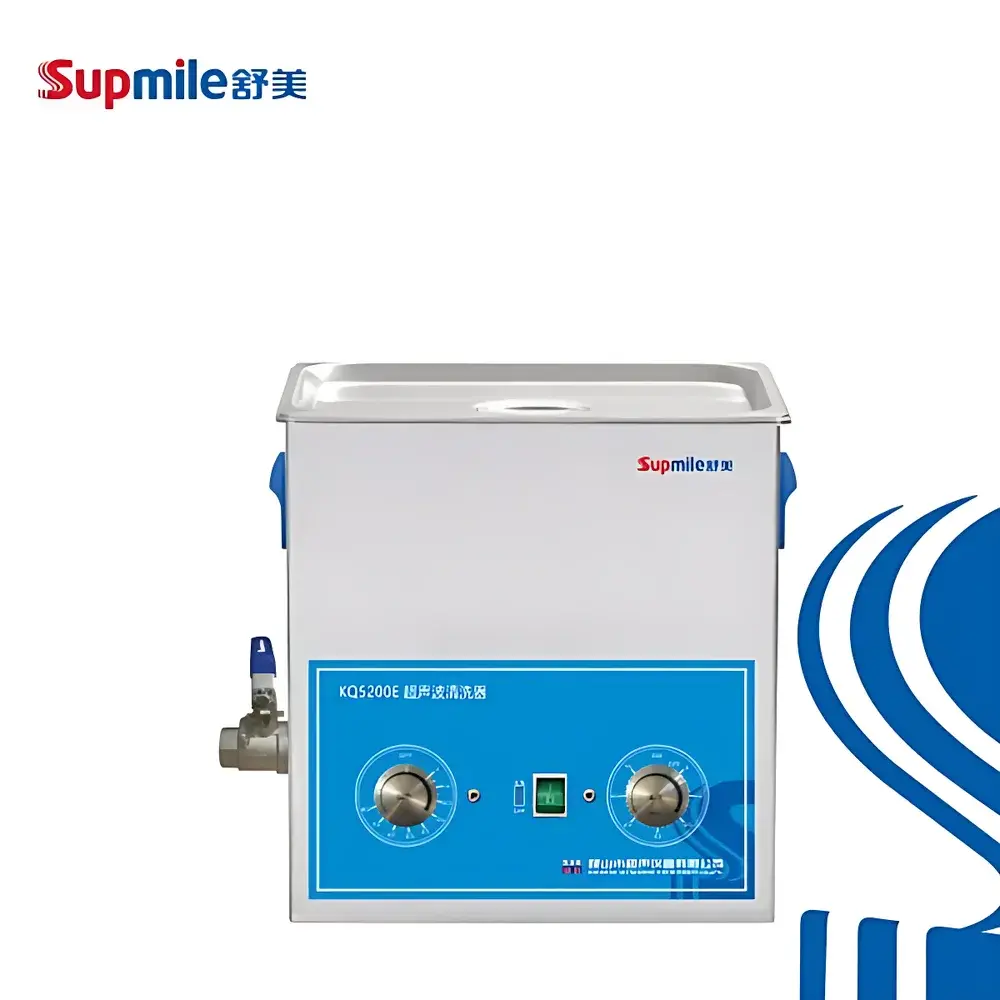
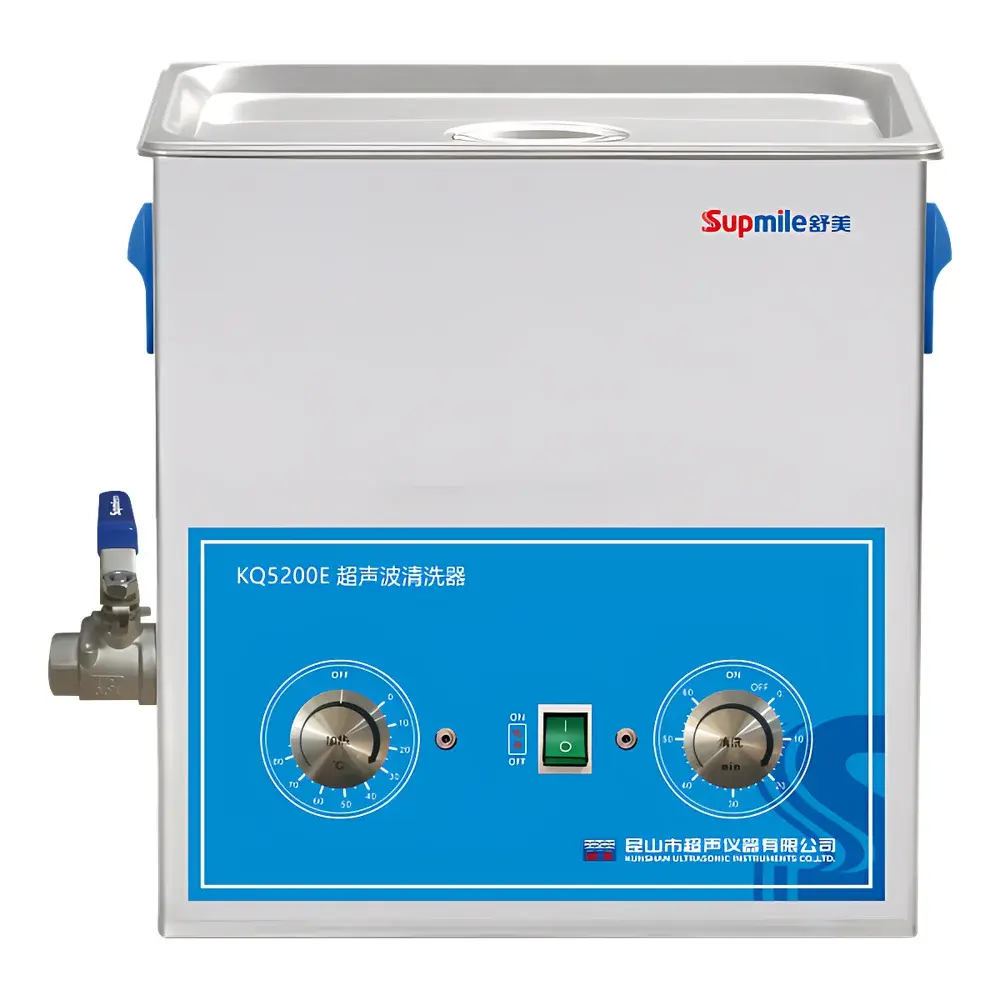
Shumei KQ5200E Benchtop Ultrasonic Cleaner
| Brand | Shumei |
|---|---|
| Origin | Jiangsu, China |
| Manufacturer Type | Direct Manufacturer |
| Instrument Type | General-Purpose Ultrasonic Cleaner |
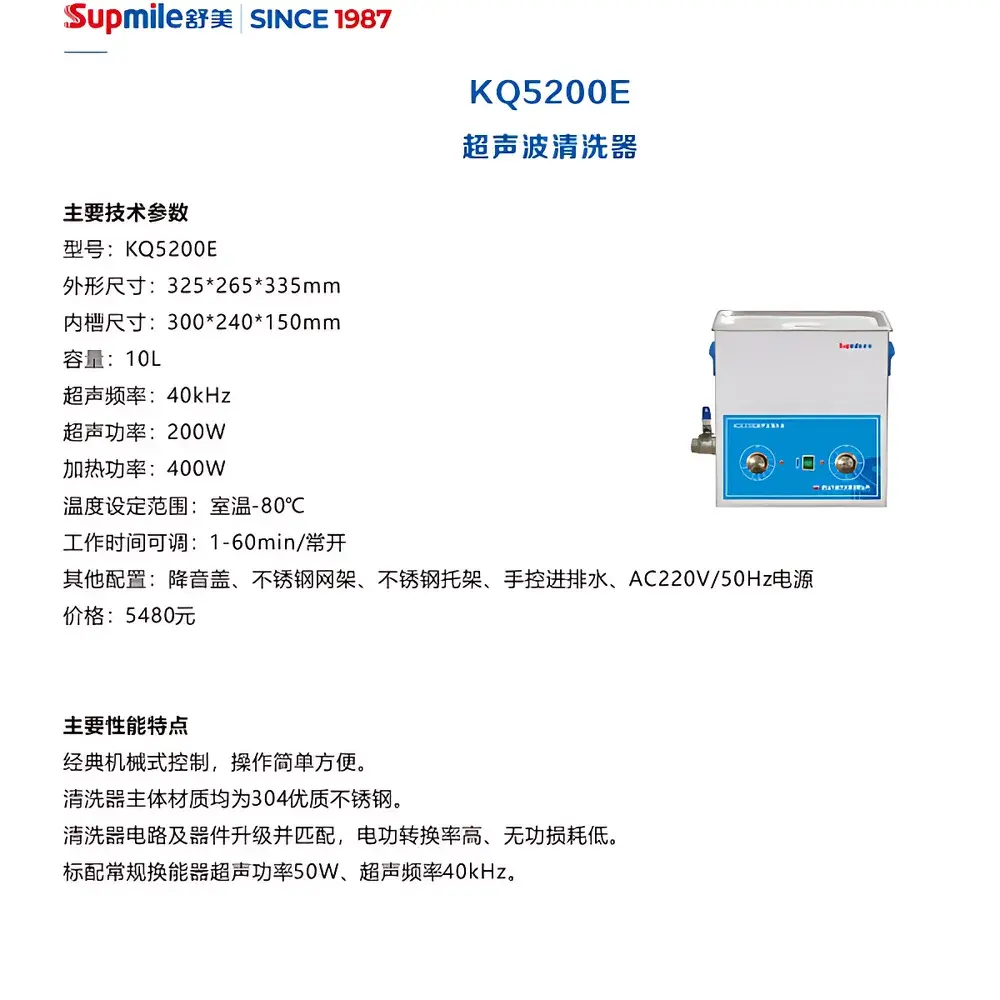
| Capacity | 10 L |
| Ultrasonic Frequency | 40 kHz |
| Ultrasonic Power Output | 200 W |
| Heating Power | 400 W |
| Temperature Range | Ambient to 80 °C (adjustable) |
| Timer Range | 1–60 min (plus continuous operation mode) |
| Sound-Dampening Lid | Included |
| Drain/Inlet | Manual valve control |
| Internal Tank Dimensions | 300 × 240 × 150 mm |
| External Dimensions | 325 × 265 × 335 mm |
| Power Supply | AC 220 V, 50 Hz |
| Construction Material | 304 Stainless Steel (tank and housing) |
Overview
The Shumei KQ5200E is a benchtop ultrasonic cleaner engineered for consistent, non-destructive removal of particulate contaminants, organic residues, and loosely adhered films from laboratory glassware, precision components, surgical instruments, and small-volume sample containers. It operates on the principle of acoustic cavitation: high-frequency sound waves (40 kHz) generated by piezoelectric transducers bonded to the stainless-steel tank induce rapid formation and collapse of microscopic vapor bubbles in the cleaning solution. This implosive energy releases localized shockwaves and micro-jets capable of dislodging sub-micron debris without mechanical abrasion or thermal degradation. Designed for routine lab use rather than high-throughput industrial applications, the KQ5200E delivers reproducible cleaning performance across diverse aqueous and mild solvent-based solutions—making it suitable for pre-analytical sample preparation, QC/QA validation workflows, and instrument maintenance in chemistry, pharmaceutical, and materials science laboratories.
Key Features
- Robust 304 stainless-steel construction throughout the tank, lid, and structural housing ensures long-term corrosion resistance and compatibility with common cleaning agents including alkaline detergents, ethanol-water mixtures, and low-concentration acidic solutions.
- Dedicated 400 W heating system enables precise temperature control from ambient up to 80 °C, supporting thermally enhanced cleaning protocols where solubility or reaction kinetics benefit from elevated temperatures.
- Adjustable digital timer (1–60 minutes) with continuous operation mode allows optimization of exposure duration based on soil type, substrate sensitivity, and cleaning solution chemistry.
- Integrated sound-dampening lid reduces airborne noise emission during operation and minimizes solvent evaporation, improving operator comfort and process consistency.
- Manual inlet and drain valves provide full user control over fluid handling—enabling safe disposal of spent solutions and facilitating rapid tank refills without external plumbing requirements.
- Mechanical control interface offers intuitive, reliable operation with minimal electronic complexity—reducing failure points and simplifying compliance documentation in regulated environments.
Sample Compatibility & Compliance
The KQ5200E accommodates standard laboratory items such as volumetric flasks, pipette tips, crucibles, watch glasses, syringe filters, and small metal or ceramic parts. Its 10 L capacity and internal dimensions (300 × 240 × 150 mm) support batch processing of multiple items simultaneously while maintaining uniform acoustic field distribution. The unit complies with general electrical safety standards applicable to Class I laboratory equipment (IEC 61010-1). While not certified to ISO 13485 or FDA 21 CFR Part 11 out-of-the-box, its mechanical controls, traceable temperature/timer settings, and stainless-steel wetted surfaces facilitate integration into GLP/GMP-aligned cleaning validation protocols—particularly when paired with documented cleaning SOPs, solution lot traceability, and periodic performance verification using standardized test foils (e.g., ASTM D2297 aluminum foil erosion assay).
Software & Data Management
The KQ5200E utilizes a fully mechanical control architecture—no embedded firmware, touchscreen interface, or data logging capability is present. All operational parameters (temperature setpoint, timer duration, power activation) are manually selected and visually indicated via analog dials and LED indicators. This design prioritizes operational reliability, electromagnetic compatibility, and ease of audit readiness in environments where electronic logging is either unnecessary or managed externally (e.g., via lab notebook entries or LIMS-integrated workflow records). For laboratories requiring electronic audit trails, external environmental monitoring systems or time-stamped video documentation may be employed alongside unit operation to satisfy ALCOA+ data integrity principles.
Applications
- Pre-cleaning of HPLC vials, GC autosampler inserts, and ICP-MS sample introduction components prior to acid washing or passivation.
- Removal of polishing compounds and residual oils from optical lenses, calibration standards, and metrology fixtures.
- Routine decontamination of reusable pipette tips, microcentrifuge tubes, and electrophoresis combs in molecular biology labs.
- Supporting ASTM E2874 and ISO 15528-compliant surface cleanliness verification for coated substrates and reference materials.
- Assisting USP and compounding facility cleaning validation through repeatable, parameter-controlled ultrasonic cycles.
FAQ
Is the KQ5200E suitable for cleaning delicate optics or MEMS devices?
Yes—when operated at lower temperatures (25–40 °C), short durations (3–10 min), and with low-surface-tension, non-ionic surfactant solutions, it has been successfully used for preliminary cleaning of coated lenses and silicon wafers. Always validate with representative samples first.
Can this unit be used with flammable solvents like acetone or IPA?
No. The KQ5200E lacks explosion-proof certification and uses non-intrinsically-safe heating elements and controls. Only aqueous or water-miscible, non-flammable cleaning solutions should be used.
What maintenance is required to ensure long-term transducer performance?
Regular inspection of the tank bottom for pitting or delamination, periodic descaling with citric acid solution (if hard water is used), and avoidance of dry operation or prolonged use above 70 °C will extend transducer service life beyond 5,000 operating hours.
Does the unit include a degassing function?
No dedicated degas mode is provided; however, initiating ultrasonic operation for 5–10 minutes before loading samples effectively removes dissolved air from aqueous solutions, enhancing cavitation efficiency.
How is temperature accuracy verified during qualification?
Use a calibrated NIST-traceable PT100 probe immersed at three positions (center, corner, near transducer) and record deviations against setpoint over a 30-minute stabilization period per ISO 17025-recommended practices.



