
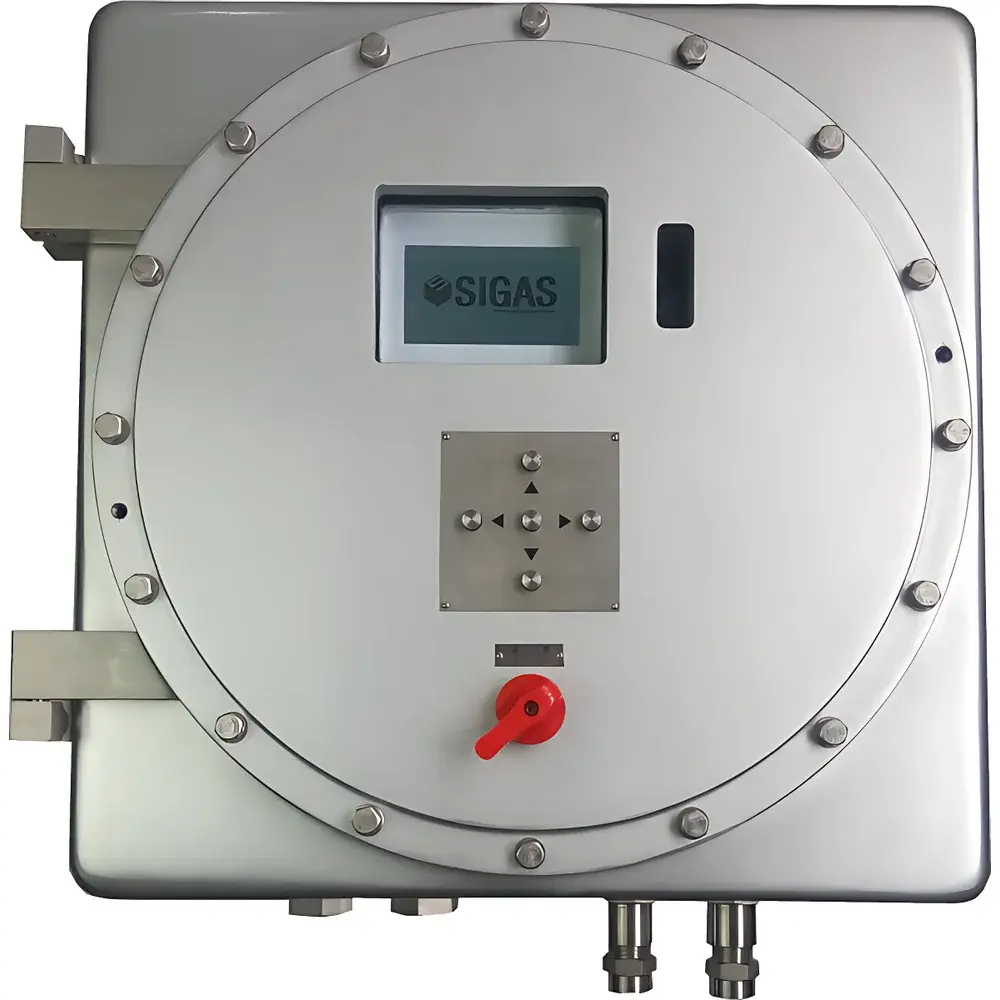
SIGAS S-ANALYZER ATEX Intrinsically Safe Multicomponent Gas Analyzer
| Brand | SIGAS |
|---|---|
| Model | S-ANALYZER ATEX V5.0 |
| Type | Online Industrial Explosion-Proof Multicomponent Gas Analyzer |
| Principle | Non-Dispersive Infrared (NDIR) Absorption |
| Channels | Up to 5 simultaneous gas measurements |
| Response Time | <25 s (t90 @ 60 L/h constant flow) |
| Repeatability | CH₄, CO, CO₂, O₂, and other supported gases |
| Enclosure Rating | Ex d IIC T6 Gb (certified per GB3836.1–2010 & GB3836.2–2010, NEPSI certified) |
| Operating Temperature | 5–45 °C |
| Inlet Flow Rate | 0.4–0.8 L/min (±0.02 L/min stability) |
| Power Supply | (198–242) V AC, 50/60 Hz, <125 W |
| Weight | ~50 kg |
| Dimensions | Not specified in input |
| Analog Output | 4–20 mA (2 mA fault signal), load: 250–350 Ω |
| Relay Outputs | 6 configurable dry-contact relays (1 A @ 250 V AC / 2 A resistive) |
| Gas Inlet | NPT 1/8″ female |
| Moisture Requirement | Non-condensing |
| Particulate Limit | ≤100 µg/m³, ≤1 µm |
| Zero Gas | 99.999% N₂ |
| Span Gas Range | 75–125% of full scale |
| Mid-point Calibration Gas | 37.5–62.5% of full scale |
| Ingress Protection | Not explicitly stated |
| Compliance | GB3836.1/2–2010, NEPSI-certified, suitable for Zone 1/21 hazardous areas |
Overview
The SIGAS S-ANALYZER ATEX V5.0 is an online, explosion-proof multicomponent gas analyzer engineered for continuous, real-time monitoring of up to five gas species in hazardous industrial environments. Based on non-dispersive infrared (NDIR) absorption spectroscopy, the instrument delivers high selectivity and long-term stability for hydrocarbons (e.g., CH₄), carbon monoxide (CO), carbon dioxide (CO₂), oxygen (O₂), sulfur dioxide (SO₂), nitrogen oxides (NO), and other IR-active gases—subject to sensor configuration. Its Ex d IIC T6 Gb certification (NEPSI verified per GB3836.1–2010 and GB3836.2–2010) confirms compliance with international requirements for flameproof enclosures in Zone 1 (gas) and Zone 21 (dust) locations. Designed for uninterrupted operation in semiconductor fabrication cleanrooms, coal-fired power plants, chemical synthesis units, metallurgical off-gas streams, landfill biogas recovery systems, and tunnel ventilation networks, the analyzer integrates robust mechanical construction—including pressure-tested aluminum die-cast housing—with precision optical path alignment and thermal management to ensure measurement integrity under fluctuating ambient conditions.
Key Features
- Modular, user-configurable sensor architecture: Operators select from a validated library of NDIR, electrochemical, and paramagnetic sensors to match application-specific gas matrices and regulatory reporting requirements.
- Full-pressure-tested explosion-proof enclosure: Each unit undergoes 100% hydrostatic testing at 1.5× rated pressure to verify structural integrity of the flameproof joint and housing.
- Integrated flow monitoring: Built-in flowmeter with transparent sight glass enables visual verification of sample flow stability (0.4–0.8 L/min) without compromising the Ex d barrier.
- Standardized DIN-rail mounting and fully labeled internal cabling: Simplifies field commissioning, troubleshooting, and replacement of individual modules during scheduled maintenance.
- ATEX-compliant interface hardware: Includes certified cable glands (TDJT-15, ∅6–∅13 mm) and NPT 1/8″ female gas fittings—available in threaded or喇叭口 (flare-type) configurations per site installation standards.
- Consistent human-machine interface (HMI): Shares identical menu navigation, calibration workflows, and data visualization logic with the non-hazardous-area S-ANALYZER 200 series—reducing operator retraining time and minimizing procedural errors.
- Thermally stabilized optical bench: Minimizes drift induced by ambient temperature gradients (5–45 °C operating range), supporting repeatability better than ±1% of reading across CH₄, CO, CO₂, and O₂ channels.
Sample Compatibility & Compliance
The S-ANALYZER ATEX accepts conditioned sample gas streams meeting strict inlet specifications: non-condensing moisture content (dew point ≤5 °C ±0.1 °C mandatory for SO₂ and NO measurement), particulate loading ≤100 µg/m³ (particle size ≤1 µm), and pressure stability within 76–116 kPa (equivalent to altitudes ≤2000 m). It supports zero calibration with ultra-high-purity nitrogen (99.999%) and two-point span verification using traceable standard gases at 37.5–62.5% and 75–125% of full-scale concentration. The analyzer complies with China’s mandatory explosion protection standard GB3836 series and is certified by NEPSI—the National Supervisory and Inspection Center for Explosion-Protected Electrical Equipment. While not intrinsically safe (i.e., not Ex i), its flameproof (Ex d) design meets IEC 60079-0 and IEC 60079-1 equivalency for global deployment in petrochemical, pharmaceutical, and energy infrastructure where ignition source containment is mandated.
Software & Data Management
The embedded firmware provides full local control via explosion-proof membrane keypad and backlit LCD display. All operational parameters—including analog output scaling, relay assignment logic, alarm thresholds, and auto-calibration scheduling—are configurable without external software. The 4–20 mA analog outputs support HART-compatible transmitters and integrate seamlessly with DCS/SCADA systems compliant with IEC 61131-3. Relay outputs are assignable to discrete events: system fault, zero/span valve actuation, and channel-specific high/low concentration alarms. Audit trails for calibration events, parameter changes, and fault logs are stored onboard with timestamping. Though no native Ethernet or Modbus TCP is specified in base configuration, optional communication modules can be added to support protocols required for GLP/GMP-aligned facilities—ensuring traceability per FDA 21 CFR Part 11 when paired with validated electronic record systems.
Applications
- Continuous emissions monitoring (CEMS) in thermal power stations and waste-to-energy plants, tracking CO, CO₂, SO₂, NOₓ, and O₂ for regulatory reporting (e.g., China’s HJ 75–2017).
- Process gas analysis in semiconductor front-end fabs, where CH₄ and CO detection ensures purity control in CVD and etching tool exhaust lines.
- Biogas upgrading verification in anaerobic digesters and landfill sites, quantifying CH₄, CO₂, H₂S (via optional electrochemical sensor), and O₂ to optimize membrane separation efficiency.
- Combustion optimization in blast furnaces and coke ovens, measuring CO/CO₂ ratios and residual O₂ to calculate excess air and combustion efficiency.
- Tunnel air quality surveillance, detecting CO buildup and NOₓ accumulation during peak traffic periods to trigger ventilation control logic.
- TOC off-gas analysis in wastewater treatment plants, correlating CO₂ evolution from oxidized organic carbon with influent load metrics.
FAQ
What hazardous area classifications does the S-ANALYZER ATEX support?
It is certified Ex d IIC T6 Gb per GB3836.1/2–2010, permitting use in Zone 1 (gas) and Zone 21 (combustible dust) environments, including atmospheres containing acetylene (C₂H₂).
Can the instrument measure SO₂ and NO simultaneously with CH₄ and CO?
Yes—provided the configured sensor set includes dedicated NDIR cells for SO₂ and NO, and the sample gas is dried to ≤5 °C dew point to prevent spectral interference and optical window fouling.
Is remote calibration supported?
Local manual calibration is standard; remote calibration requires integration with a PLC or DCS that triggers preprogrammed valve sequences via the 6-channel relay interface—no built-in web server or cloud connectivity is included.
What maintenance intervals are recommended?
Optical path inspection and zero/span verification every 3 months; filter replacement every 6 months; full sensor recalibration annually or after exposure to poisoning agents (e.g., siloxanes, H₂S above 10 ppm).
Does the analyzer support 21 CFR Part 11 compliance?
Out-of-the-box, it provides audit-trail-capable local logging; full Part 11 compliance requires integration with a validated third-party electronic records system that manages user authentication, electronic signatures, and change control for calibration data.
Related Products







