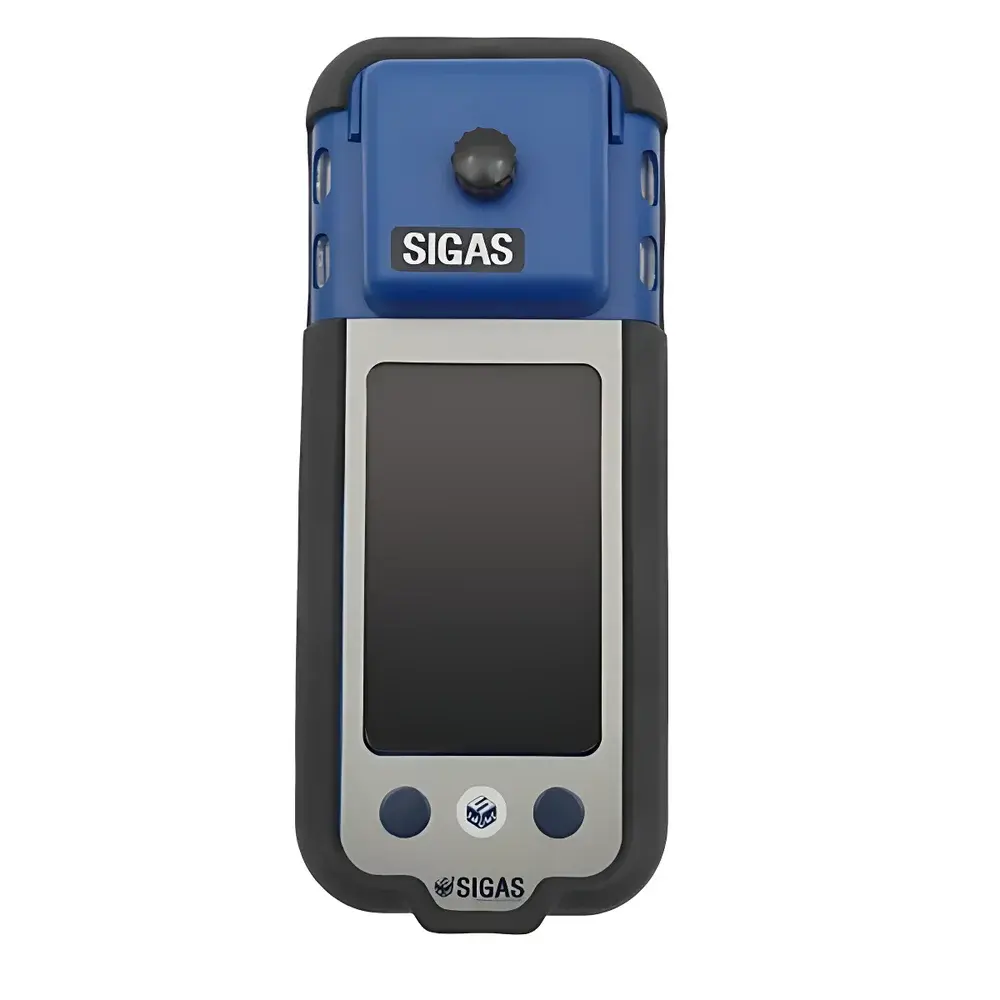
SIGAS S-Handheld 10 Intelligent Portable Gas Analyzer
| Brand | SIGAS |
|---|---|
| Origin | Jiangsu, China |
| Manufacturer Type | Authorized Distributor |
| Product Origin | Domestic (China) |
| Model | S-Handheld 10 |
| Pricing | Upon Request |
| Detection Principles | Infrared (NDIR), Electrochemical, PID, Catalytic Bead |
| Sensor Lifespan | Electrochemical: 2–3 years |
| NDIR | 5–10 years |
| Catalytic Bead | ~3 years |
| PID | 2–3 years |
| Response Time (T90) | ≤60 s |
| Operating Temperature | 5–45 °C |
| Relative Humidity Range | 10–95 %RH (non-condensing) |
| Barometric Pressure Measurement | 300–1100 hPa (±1 hPa accuracy) |
| Power Supply | 5 VDC, rechargeable 6800 mAh Li-ion battery |
| Runtime | Up to 8 h (pump-on continuous operation) |
| Display | 4.3″ TFT-LCD, 800 × 480 resolution |
| Sampling Method | Integrated active pump, 300 mL/min flow rate |
| Filtration | Built-in hydrophobic particulate filter and water trap |
| Data Storage | 100,000 records (concentration + timestamp + alarm flags) |
| Connectivity | USB Type-C (data transfer & charging), optional Bluetooth 5.0 |
| Dimensions | 217 × 92 × 80 mm (L × W × H) |
| Weight | ~850 g |
| Alarm Types | Low/High, STEL, TWA |
| Certifications | CE, RoHS, IP65-rated enclosure |
| Compliance | Designed for alignment with ISO 10156, IEC 60079-0/-11 (for intrinsic safety configurations), and applicable regional occupational exposure standards (e.g., OSHA PELs, ACGIH TLVs) |
Overview
The SIGAS S-Handheld 10 Intelligent Portable Gas Analyzer is a field-deployable, multi-sensor platform engineered for quantitative real-time analysis of hazardous and process gases in industrial, environmental, and confined-space applications. It integrates modular sensor technologies—including non-dispersive infrared (NDIR), electrochemical (EC), photoionization detection (PID), and catalytic bead (CB) principles—within a single ruggedized housing. Unlike fixed online analyzers requiring permanent installation and gas conditioning systems, the S-Handheld 10 employs an internal diaphragm pump with calibrated 300 mL/min suction flow, enabling rapid response (<60 s T90) to transient gas events without external sampling infrastructure. Its architecture supports simultaneous measurement of up to four target gases, with independent calibration protocols per sensor type and automatic cross-interference compensation algorithms embedded in firmware. The device operates across ambient pressure ranges (300–1100 hPa) and humidity extremes (10–95 %RH, non-condensing), validated for use in semiconductor fab tool exhaust ducts, coal-fired power plant stack access points, chemical reactor headspaces, grain silo fumigation zones, and municipal wastewater treatment confined entries.
Key Features
- Integrated active sampling system with hydrophobic particulate filter and condensate trap—enabling reliable operation in high-humidity and high-dust environments without sensor fouling or drift.
- 4.3-inch high-resolution TFT-LCD (800 × 480) with dynamic real-time concentration display, time-series trend curves, and intuitive icon-based menu navigation compliant with IEC 61000-4-2 ESD immunity requirements.
- 100,000-point onboard data logger capturing timestamped gas values, alarm triggers (Low/High, STEL, TWA), pump status, battery level, and environmental parameters (T, RH, pressure).
- Dual-power architecture: 6800 mAh Li-ion battery supporting ≥8 h continuous pump-on operation; intelligent power management reduces screen brightness and disables pump during idle periods to extend runtime.
- Multi-modal alarm system meeting IEC 61508 SIL 2 functional safety guidelines—comprising 95 dB audible tone, dual-color LED strobe, tactile vibration, and full-screen visual warning with gas-specific color coding.
- USB Type-C interface supporting simultaneous charging and bidirectional data exchange; firmware-upgradable via signed .bin files; optional Bluetooth 5.0 module enables wireless telemetry to mobile apps or asset management platforms.
Sample Compatibility & Compliance
The S-Handheld 10 is validated for direct measurement in nitrogen- and oxygen-balanced matrices, including air, flue gas, inert purge streams, and biogas mixtures. It accommodates sample temperatures up to 45 °C and tolerates transient condensation due to its dual-stage filtration. Sensor configurations are selected per application: NDIR for CO₂, CH₄, SF₆; EC for CO, H₂S, NO₂, Cl₂; PID for VOCs (e.g., benzene, toluene, xylene); CB for combustible hydrocarbons (LEL monitoring). The unit complies with CE marking directives (2014/30/EU EMC, 2014/35/EU LVD), RoHS 2011/65/EU, and carries IP65 ingress protection. While not intrinsically safe certified out-of-box, explosion-proof variants (with ATEX/IECEx certification) are available upon request for Zone 1/21 deployment. All firmware and calibration routines adhere to GLP traceability requirements, with audit logs recording operator ID, calibration gas lot number, span/gas date, and deviation metrics.
Software & Data Management
Data extraction and reporting are supported through SIGAS PC Suite v3.2—a Windows-based desktop application enabling CSV export, time-aligned multi-gas overlay plots, statistical summaries (min/max/avg/std dev), and customizable alarm report generation. Each stored record includes UTC timestamp, sensor-specific confidence indicators, and raw ADC counts for metrological review. The software enforces 21 CFR Part 11-compliant user authentication (role-based access control), electronic signatures for calibration events, and immutable audit trails for all configuration changes. Optional cloud integration (via MQTT over TLS) allows secure ingestion into enterprise SCADA or CMMS systems, with configurable retention policies and automated anomaly alerts based on user-defined thresholds.
Applications
- Industrial process monitoring: Real-time verification of purge gas purity (N₂/O₂), leak detection in semiconductor ALD/CVD tooling, combustion efficiency assessment in boiler stacks, and H₂S monitoring in sour gas handling facilities.
- Environmental compliance: Stack emission audits per EPA Method 21, landfill gas migration surveys, fugitive VOC screening in petrochemical plants, and ambient air quality spot checks near industrial perimeters.
- Confined space entry: Pre-entry atmospheric verification per OSHA 1910.146, including O₂ deficiency/enrichment, LEL, CO, and H₂S assessment in tanks, sewers, and transformer vaults.
- Maintenance & troubleshooting: Root-cause analysis of catalyst deactivation (via CO/NOx spikes), identification of refrigerant leaks (SF₆, R-134a), and validation of fumigant concentrations (PH₃, SO₂) in grain storage.
- Emergency response: Rapid hazard mapping during chemical spills or railcar breaches, with GPS-tagged readings (when paired with external GNSS module) and offline map overlay capability.
FAQ
What sensor technologies are supported, and how are they selected for a given application?
Sensor modules are pre-configured at order stage based on target analytes, matrix composition, and regulatory requirements. NDIR is preferred for stable diatomic/triatomic gases; EC for toxic species with low ppm detection limits; PID for broad-spectrum VOC screening; CB for flammability risk assessment. Cross-sensitivity tables and interference correction coefficients are documented per configuration.
Is field calibration possible, and what documentation accompanies calibration gases?
Yes—zero and span calibration can be performed in-field using certified reference standards. Each calibration gas cylinder includes NIST-traceable certificate of analysis, uncertainty budget, and expiration date. Calibration events generate tamper-evident digital logs with operator signature and environmental metadata.
How is data integrity ensured during USB transfer or Bluetooth transmission?
All communications employ AES-128 encryption. USB transfers use signed firmware packages and checksum-verified data packets. Bluetooth sessions require mutual authentication and enforce TLS 1.2 handshake prior to payload exchange.
Can the S-Handheld 10 operate continuously as a fixed monitor?
It is designed primarily for portable, intermittent use. For unattended 24/7 operation, SIGAS recommends the S-Online series with dedicated sample conditioning, redundant power, and remote diagnostics—though the S-Handheld 10 may be deployed on tripod mounts with external power for short-term stationary tasks.
What maintenance intervals are recommended for filters and sensors?
Particulate/water filters should be inspected before each use and replaced after 200 hours of cumulative pump operation or upon visible saturation. Electrochemical sensors require annual verification; NDIR cells undergo optical path inspection every 24 months. Full preventive maintenance is outlined in the service manual (Revision D, 2024).