
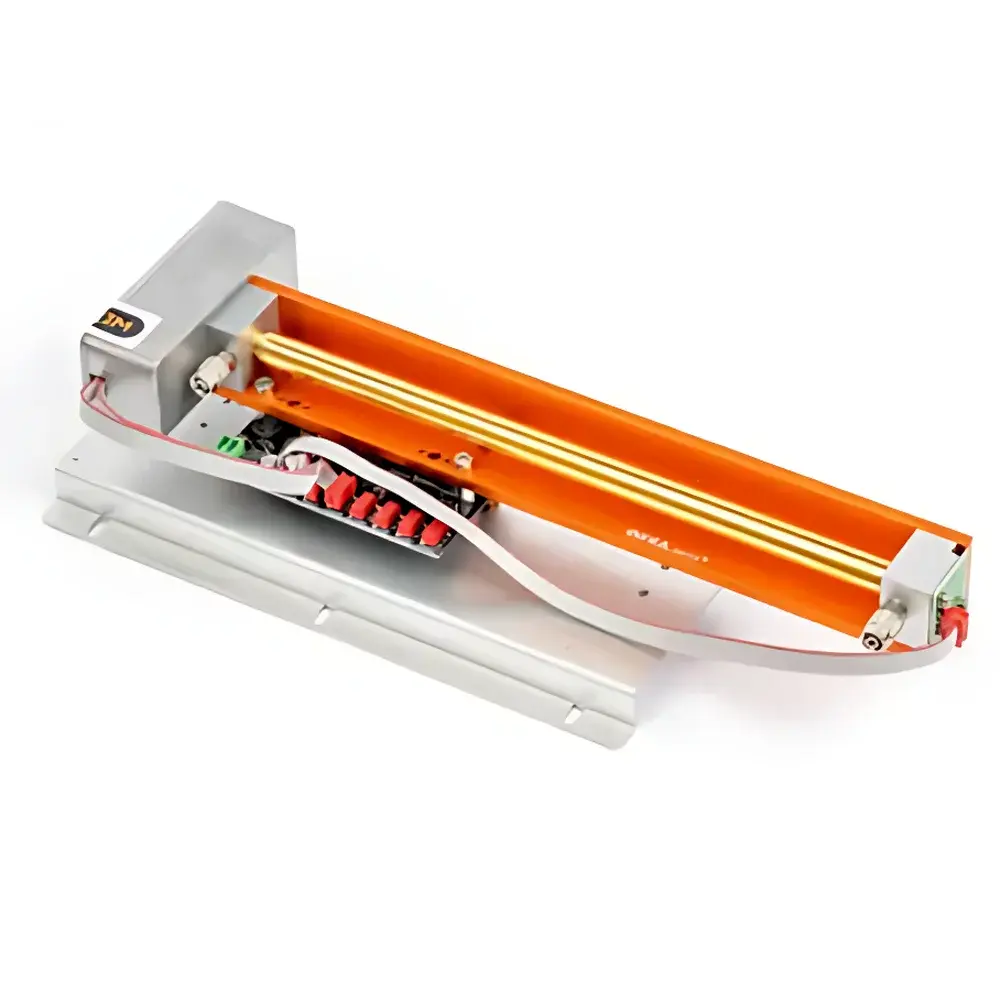
SIGAS S-Infra.Sens Multi-Component High-Precision NDIR Gas Sensor
| Brand | SIGAS |
|---|---|
| Model | S-Infra.Sens |
| Detection Principle | Non-Dispersive Infrared (NDIR) |
| T90 Response Time | < 3 s @ 1 L/min |
| Digital Resolution | 1 ppm to 0.1 vol.% |
| Accuracy (3σ) | ±0.5% FS |
| Repeatability | ±1% FS |
| Linearity | ±1% FS |
| Zero Stability | ±1% FS / 30 days |
| Span Stability | ±1% FS / 30 days |
| Zero Temp. Drift | ±1% FS / 10 K |
| Span Temp. Drift | ±1% FS / 10 K |
| Pressure Drift | ±0.015% / mbar |
| Operating Temperature | 5–45 °C |
| Storage Temperature | −10–60 °C |
| Relative Humidity | 0–95% RH (non-condensing) |
| Ambient Pressure | 800–1200 mbar |
| Warm-up Time | < 10 min |
| Power-On Time | < 2 min |
| Sample Gas Temperature | +5–35 °C |
| Sample Gas Humidity | ≤10 °C dew point (non-condensing) |
| Flow Rate | 0.2–1 L/min (stable) |
| Output Interfaces | RS232 (9-pin Sub-D), CANopen, Optional Analog (0–10 V / 4–20 mA) |
| Supply Voltage | 24 VDC ±0.3 V |
| Power Consumption | 2 W (typ., without heater) |
| Optical Path Length | 5–250 mm (modular) |
| Housing Material | Aluminum or Stainless Steel (optional) |
| Cell Wall Coating | Gold-plated (optional, for enhanced reflectivity) |
| Response Time (Signal Rise) | ≈200 ms |
| Power Consumption (Sensor Only) | < 1 W |
Overview
The SIGAS S-Infra.Sens is a modular, multi-component non-dispersive infrared (NDIR) gas sensor engineered for high-precision, long-term stability in continuous environmental and industrial process monitoring applications. Leveraging mature near-infrared absorption spectroscopy, the sensor quantifies target gases—including CO2, CH4, CO, N2O, SO2, and hydrocarbons—based on their unique vibrational absorption bands in the 1.2–4.5 µm spectral range. Its optical architecture employs thermally stabilized light sources, precision-machined gas cells with gold-coated internal walls (optional), and temperature-compensated pyroelectric or photodiode detectors. The modular cell design—offering path lengths from 5 mm to 250 mm—enables optimization of sensitivity and dynamic range for specific gas species and concentration levels, supporting detection limits from sub-ppm to percent-level vol.% with minimal cross-sensitivity.
Key Features
- Modular optical cell construction with O-ring sealed, field-replaceable units for simplified maintenance and calibration traceability
- Ultra-fast signal response: <200 ms rise time and T90 < 3 s at 1 L/min flow rate—validated per ISO 12039 and EN 14625 protocols
- Gold-plated measurement cell interior (optional) to maximize infrared reflectivity and enhance low-concentration measurement fidelity
- Dual-material housing options: anodized aluminum (lightweight, cost-optimized) or electropolished stainless steel (corrosion-resistant, ATEX/IECEx-ready)
- Low-power operation: <1 W active sensing power; total system draw ≤2 W (excluding optional integrated heater)
- Multi-interface digital output: RS232 (9-pin D-sub), CANopen (CiA 301 compliant), plus configurable analog outputs (0–10 V or 4–20 mA)
- Integrated thermal management: optional heated enclosure with vacuum-insulated jacket enables stable operation across ambient fluctuations (5–45 °C), critical for compliance with EPA Method TO-15 and EU Directive 2015/1480 requirements
Sample Compatibility & Compliance
The S-Infra.Sens is validated for use with dry, non-aggressive gas streams meeting ISO 8573-1 Class 4 purity (oil-free, particulate <1 µm, dew point ≤10 °C). It supports dual-cell configurations for simultaneous reference/analysis channel operation or differential measurement setups. All wetted materials comply with FDA 21 CFR 177.2600 (food-contact polymers) and REACH Annex XIV restrictions. The sensor meets EMC Directive 2014/30/EU (EN 61326-1), Low Voltage Directive 2014/35/EU, and carries CE marking for indoor and outdoor fixed-installation use. For hazardous area deployment, explosion-proof variants (ATEX II 2G Ex db IIB T4 Gb / IECEx DBEX 22.0020X) are available upon request. Calibration certificates are traceable to NIST and PTB standards, supporting GLP/GMP audit readiness.
Software & Data Management
The sensor operates autonomously but integrates seamlessly into SCADA, DCS, or cloud-based IoT platforms via its native ASCII command protocol over RS232 or CANopen object dictionary (PDO/SDO). Firmware supports user-configurable averaging windows (1–60 s), alarm thresholds (pre-set or dynamically adjustable), and diagnostic logging (temperature, pressure, signal SNR, detector bias drift). Data output includes raw absorbance values, compensated concentration readings, and built-in self-test flags. When deployed with SIGAS’ optional DataBridge Gateway, measurements are timestamped, cryptographically signed, and exported in CSV or JSON format—fully compliant with FDA 21 CFR Part 11 requirements for electronic records and signatures. Audit trails record all configuration changes, zero/span events, and firmware updates.
Applications
- Ambient air quality monitoring networks (AQMS) for urban, roadside, and background stations (aligned with EU Directive 2008/50/EC and US EPA 40 CFR Part 58)
- Biogas upgrading plants: real-time CH4/CO2/H2S ratio control prior to grid injection
- Landfill and wastewater treatment off-gas analysis per ISO 16063 and ASTM D6787
- Industrial furnace and combustion efficiency optimization (O2-compensated CO/CO2 ratios)
- Indoor air quality (IAQ) systems in hospitals, laboratories, and cleanrooms requiring CO2 demand-controlled ventilation (per ASHRAE Standard 62.1)
- Leak detection and fugitive emission monitoring (LDAR) programs compliant with EPA Method 21 and ISO 16000-28
FAQ
What gases can the S-Infra.Sens detect simultaneously?
The base configuration measures up to four gases concurrently (e.g., CO2, CH4, CO, N2O); custom optical filter sets and firmware enable expansion to six components with minimal cross-interference.
Is factory calibration sufficient for regulatory reporting?
Yes—each unit ships with a full NIST-traceable calibration certificate (zero/span at two concentrations per gas). Field verification using certified standard gases every 3–6 months satisfies EN 14181 QAL1/QAL2 requirements.
Can the sensor operate in high-humidity environments?
It accepts sample gas with dew point ≤10 °C (non-condensing). For saturated streams, integration with a Nafion™ dryer or chilled mirror dew point controller is recommended prior to inlet.
Does the gold coating require special handling or cleaning procedures?
No—the electroless gold layer is chemically inert and abrasion-resistant; routine cell purging with dry nitrogen suffices for maintenance.
How is long-term zero drift managed during unattended operation?
The firmware implements automatic baseline correction using periodic reference channel sampling and adaptive offset compensation algorithms—validated over 180-day stability tests per ISO 6145-7.







