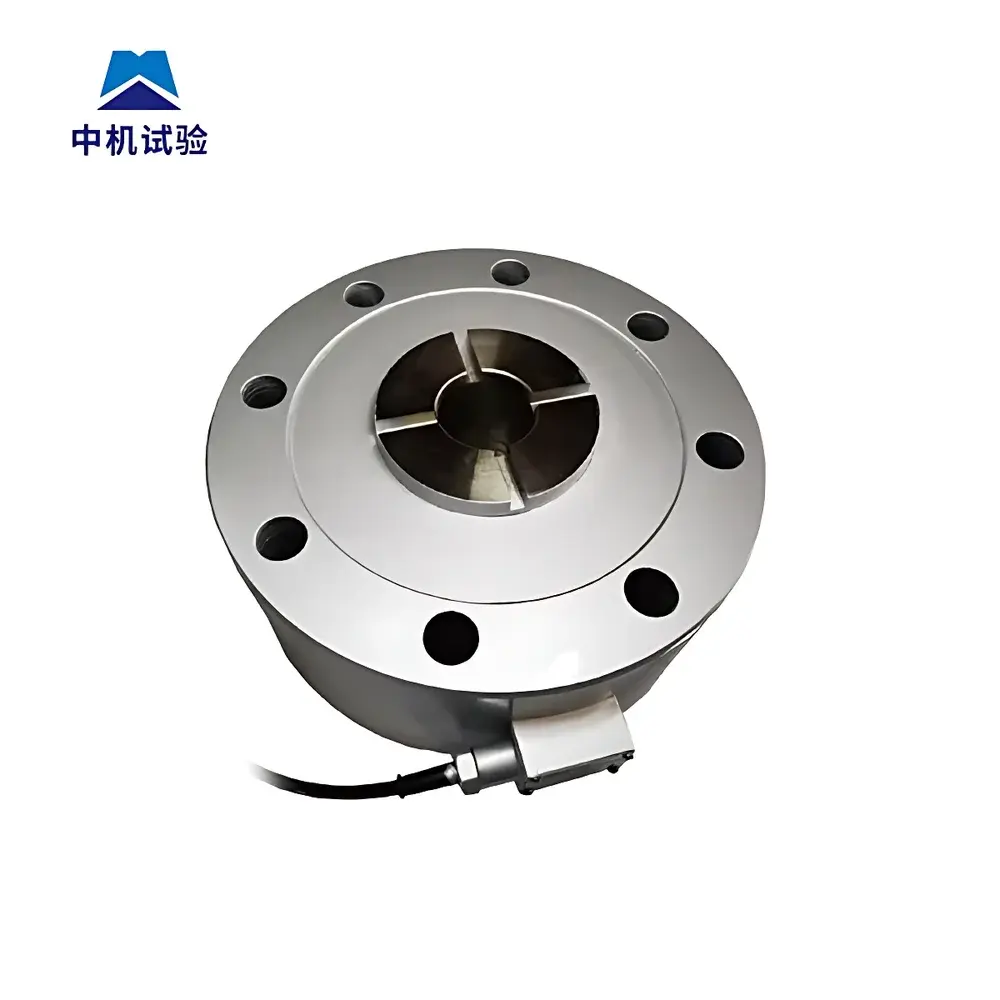
Sinotest CLY Series Static Spoke-Type Tension & Compression Load Cell
| Brand | Sinotest |
|---|---|
| Origin | Jilin, China |
| Manufacturer Type | Direct Manufacturer |
| Origin Classification | Domestic |
| Model | CLY Series Spoke-Type Tension & Compression Load Cell |
| Price Range | USD 420 – 690 |
| Rated Capacity Range | 5 kN to 3000 kN |
| Construction | Monolithic Steel Body |
| Height Profile | Low-Profile Design |
| Lateral Load Resistance | High |
| Sealing Rating | IP66 / IP68 |
| Output Configuration | 4-Wire Wheatstone Bridge |
Overview
The Sinotest CLY Series Static Spoke-Type Tension & Compression Load Cell is a high-stability, dual-directional force transducer engineered for precision static load measurement in industrial testing, process control, and weighing applications. Based on the proven spoke-type (or “wheel-spoke”) mechanical architecture, it employs a monolithic steel elastic element with strategically positioned strain gauge bridges arranged radially around a central hub. This geometry ensures uniform stress distribution under both tensile and compressive loading, delivering high linearity, minimal hysteresis, and excellent repeatability—key requirements for static calibration-grade measurements. Unlike cantilever or S-beam configurations, the spoke design inherently suppresses bending moments and torsional sensitivity, resulting in superior resistance to off-axis loads and moment-induced errors. The sensor operates exclusively in static or quasi-static regimes; it is not rated for dynamic or high-frequency impact loading.
Key Features
- Monolithic stainless steel construction ensures long-term structural integrity, thermal stability, and corrosion resistance across demanding industrial environments.
- Low-profile mechanical design minimizes overall installation height while maintaining high stiffness—critical for integration into compact test frames and automated assembly lines.
- Dual-directional capability enables seamless transition between tension and compression modes without recalibration or mechanical reorientation.
- Hermetically sealed housing meets IP66 and IP68 ingress protection standards, providing robust defense against dust, moisture, and temporary submersion—suitable for outdoor installations and washdown environments.
- 4-wire Wheatstone bridge output delivers stable mV/V signals compatible with standard industrial signal conditioners, PLC analog inputs, and data acquisition systems supporting ±10 V or 4–20 mA conversion.
- Zero temperature effect and span temperature compensation are factory-integrated, reducing drift over operating temperatures from −10 °C to +70 °C.
Sample Compatibility & Compliance
The CLY series is compatible with rigid, axially aligned load trains where the applied force vector remains within ±1° of the sensor’s primary axis. It supports mounting via threaded through-holes or flange interfaces per ISO 376 Annex B recommendations for calibration-grade load cells. While not certified to OIML R60 or NIST Handbook 44 for legal-for-trade weighing, its performance aligns with ISO 376:2011 Class 0.5 and ASTM E4-23 Annex A3 for static force calibration applications. For GMP or GLP-regulated environments, traceable calibration certificates (including as-found/as-left data) are available upon request. The sensor complies with RoHS Directive 2011/65/EU and CE marking requirements for electromagnetic compatibility (EMC Directive 2014/30/EU).
Software & Data Management
As a passive analog transducer, the CLY series does not incorporate embedded firmware or digital communication protocols (e.g., EtherCAT, CANopen). Signal conditioning and data acquisition must be performed externally using compatible instrumentation. When integrated with Sinotest’s proprietary TestExpert software suite—or third-party platforms such as LabVIEW, MATLAB Data Acquisition Toolbox, or NI CompactDAQ—the system supports real-time visualization, statistical analysis (mean, SD, CV), and export to CSV, Excel, or XML formats. Audit trails, user access logs, and electronic signatures can be implemented at the DAQ-software level to meet FDA 21 CFR Part 11 requirements for regulated laboratories.
Applications
- Universal testing machines (UTMs) and servo-hydraulic fatigue testers requiring bidirectional static load feedback during material tensile/compression testing (ASTM E8, ISO 6892-1).
- Industrial press monitoring systems for forging, stamping, and powder compaction, where overload detection and cycle consistency verification are essential.
- Calibration laboratories performing force metrology traceable to national standards (e.g., NIM, NIST, PTB) using deadweight or hydraulic comparison methods.
- Process weighing systems in bulk handling, tank level monitoring, and hopper load control—particularly where environmental sealing and mechanical ruggedness are prioritized over ultra-high resolution.
- Structural health monitoring of civil infrastructure elements (e.g., bridge bearings, foundation piles) under sustained static loads.
FAQ
What is the recommended excitation voltage for the CLY series?
Rated excitation is 10 V DC; maximum permissible is 15 V DC. Operating outside this range may affect linearity and thermal stability.
Can the sensor be used in tension-only or compression-only configurations?
Yes—its bidirectional design allows full utilization of rated capacity in either mode without hardware modification or zero-shift adjustment.
Is custom calibration available for non-standard capacities or mounting interfaces?
Sinotest offers factory calibration services for capacities outside the standard 5–3000 kN range and can accommodate custom flange patterns or thread specifications upon engineering review.
Does the IP68 rating permit continuous submersion?
IP68 denotes protection against prolonged immersion under defined pressure and duration (typically 1 m for 30 min); extended submersion requires validation per application-specific environmental testing.
How often should periodic recalibration be performed?
Annual recalibration is recommended for critical applications; intervals may extend to 24 months in stable, low-cycle environments—subject to internal quality procedures and regulatory requirements.