Slotdie Slot Coating System CS-18 – Desktop Precision Slot Die Coater for R&D and Pilot-Scale Thin-Film Deposition
| [Origin | Shanghai, China |
|---|---|
| Manufacturer Type | Authorized Distributor |
| Regional Origin | Domestic (China) |
| Model | CS-18 |
| Pricing | Upon Request] |
Overview
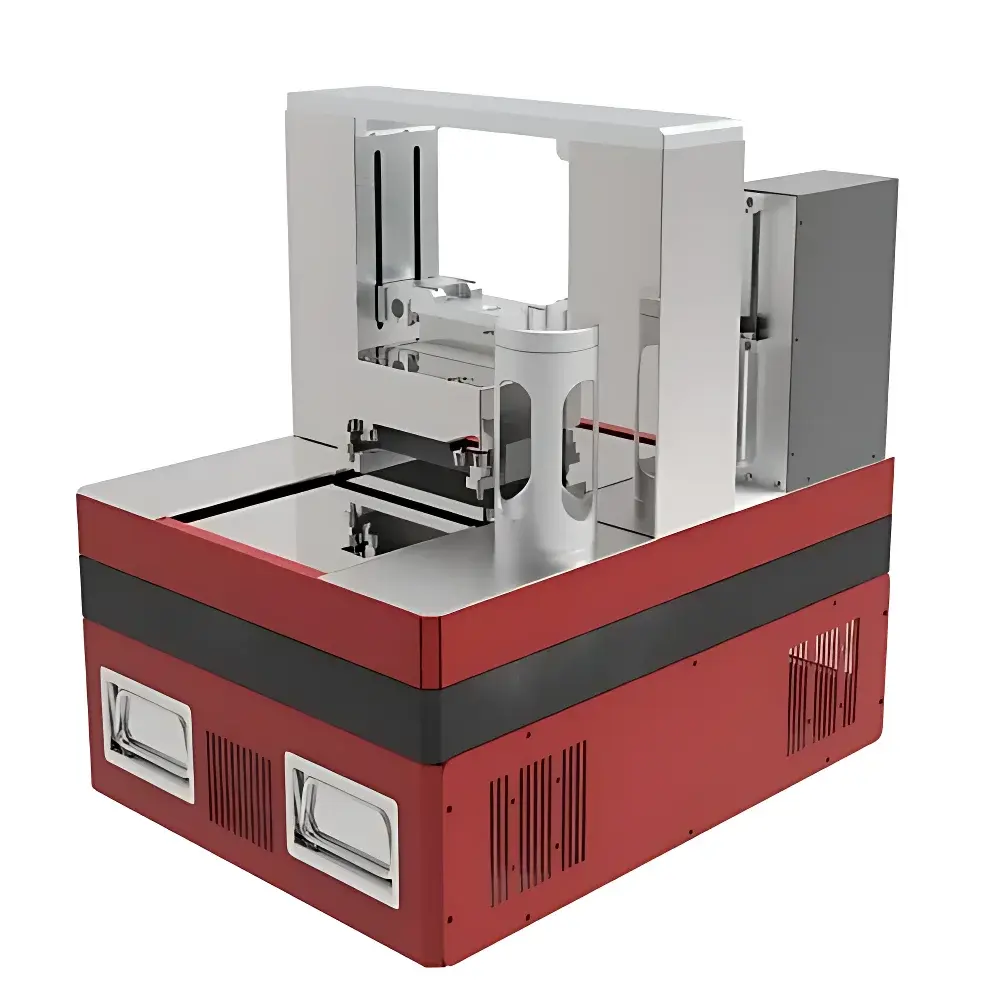
The Slotdie Slot Coating System CS-18 is a benchtop precision coating platform engineered for controlled, reproducible thin-film deposition via slot die extrusion—a deterministic, pre-metered coating technique rooted in fluid dynamics and precision motion control. Unlike contact-based methods (e.g., blade or roll coating), slot die coating operates in a non-contact regime where liquid material is extruded under pressure through a precisely defined linear slit between upper and lower tooling blocks, forming a continuous meniscus that transfers uniformly onto a moving substrate. This principle enables high-resolution thickness control, minimal material waste, and exceptional edge definition—critical for functional layers in optoelectronic, photovoltaic, and microelectronic applications. The CS-18 implements closed-loop z-axis height adjustment, digitally synchronized x-axis mold translation, and real-time flow-pressure coordination to maintain stable meniscus geometry across variable speeds (0–100 mm/s) and viscosities (1–20,000 cP). Its architecture supports both continuous web substrates (PET, PI, stainless steel foils) and discrete rigid carriers (LCD glass, silicon wafers), making it suitable for early-stage formulation screening, process window mapping, and pilot-line transfer validation.
Key Features
- Precision-engineered slot die head with interchangeable slit inserts (0.05 mm, 0.08 mm, 0.10 mm) enabling sub-micron gap control and chemical compatibility with aggressive solvents and high-solids slurries.
- Z-axis dynamic height adjustment with 0.001 mm fine-tuning resolution and ±2 µm knife-edge levelness, ensuring uniform gap integrity over full 200 mm effective coating width.
- Integrated dual-channel syringe pump system (0.1–60 mL/min flow range, 50 mL reservoir capacity) with pressure feedback for laminar, pulse-free extrusion.
- Heated vacuum chuck platform (220 mm × 220 mm) capable of sustained operation up to 200 °C with ±2 °C thermal stability—optimized for solvent evaporation kinetics and interfacial adhesion control.
- Digitally programmable acceleration/deceleration profiles for x-axis mold motion, minimizing start-stop thickness transients and enabling repeatable edge-to-edge uniformity within ±5% CV across 100–500 mm widths.
- Pre-deposition parameter calculator embedded in control software to estimate wet film thickness (10–200 µm), dry thickness (0.5–10 µm), and material utilization (>95%) based on flow rate, line speed, and solids content (10–50%).
Sample Compatibility & Compliance
The CS-18 accommodates rigid (glass, quartz, silicon, ITO-coated substrates) and flexible (PET, PI, PEN, metal foil) carriers with thicknesses ranging from 0.1 mm to 3 mm. It meets essential requirements for cleanroom-compatible thin-film development under ISO 14644-1 Class 7 environments when operated with optional inert gas shrouding. All wetted components are constructed from chemically resistant 316L stainless steel, PTFE, or sapphire—validated for compatibility with common electronic-grade solvents (NMP, DMF, GBL), metal oxide precursors, polymer dispersions, and photoresists. While not certified as GMP-compliant out-of-the-box, the system’s audit-ready data logging, user-access controls, and timestamped parameter history support GLP-aligned documentation practices per ISO/IEC 17025 and ASTM D7247-16 (Standard Practice for Slot Die Coating Process Characterization).
Software & Data Management
The proprietary control interface runs on Windows OS and provides synchronized acquisition of 16+ real-time process variables—including flow rate, substrate velocity, z-gap position, platform temperature, and motor current draw. All recipes are saved with metadata (user ID, timestamp, version tag) and exportable in CSV or HDF5 format. The software enforces role-based access (Operator, Engineer, Administrator) and maintains an immutable audit trail compliant with FDA 21 CFR Part 11 principles (electronic signatures, change tracking, secure logins). Optional integration with LabVIEW or Python APIs enables automated batch reporting, statistical process control (SPC) charting, and linkage to LIMS systems.
Applications
- Organic and perovskite photovoltaics: active layer, HTL/ETL, and interfacial coating on flexible and rigid substrates.
- OLED and QLED display manufacturing: emissive layer, charge transport layers, and encapsulation barrier films.
- Optical functional films: brightness enhancement films (BEF), anti-reflective (AR), hard coat, diffuser, and polarizer layers.
- Advanced glass technologies: electrochromic, thermochromic, and switchable privacy glazing coatings.
- Microelectronics: photoresist patterning on LCD TFT arrays, MEMS passivation layers, RFID antenna inks, and solid-state battery electrode slurries.
- Printed electronics: conductive polymer traces, dielectric gate layers, and sensor-grade nanomaterial dispersions.
FAQ
What is the maximum usable coating width on the CS-18?
The standard configuration supports up to 200 mm effective coating width; custom configurations extend to 500 mm with reinforced cross-slide mechanics and thermal compensation.
Can the system handle high-viscosity pastes above 10,000 cP?
Yes—equipped with high-torque extrusion pumps and heated fluid paths, the CS-18 processes materials up to 20,000 cP when paired with optional pre-heating and pressure-assisted feed modules.
Is vacuum chucking mandatory for glass substrates?
Vacuum fixation is recommended for substrates >150 mm diagonal to prevent thermal drift and ensure planarity during heated coating; mechanical clamping fixtures are available for smaller samples.
How is meniscus stability maintained during acceleration/deceleration?
Through synchronized ramping of pump flow rate and x-axis velocity using PID-controlled trajectory planning—ensuring constant volumetric delivery per unit area regardless of transient motion states.
Does the system support inline thickness monitoring?
While not integrated natively, the CS-18 includes analog/digital I/O ports for third-party optical interferometers or eddy-current sensors, with synchronization triggers embedded in the control timeline.