
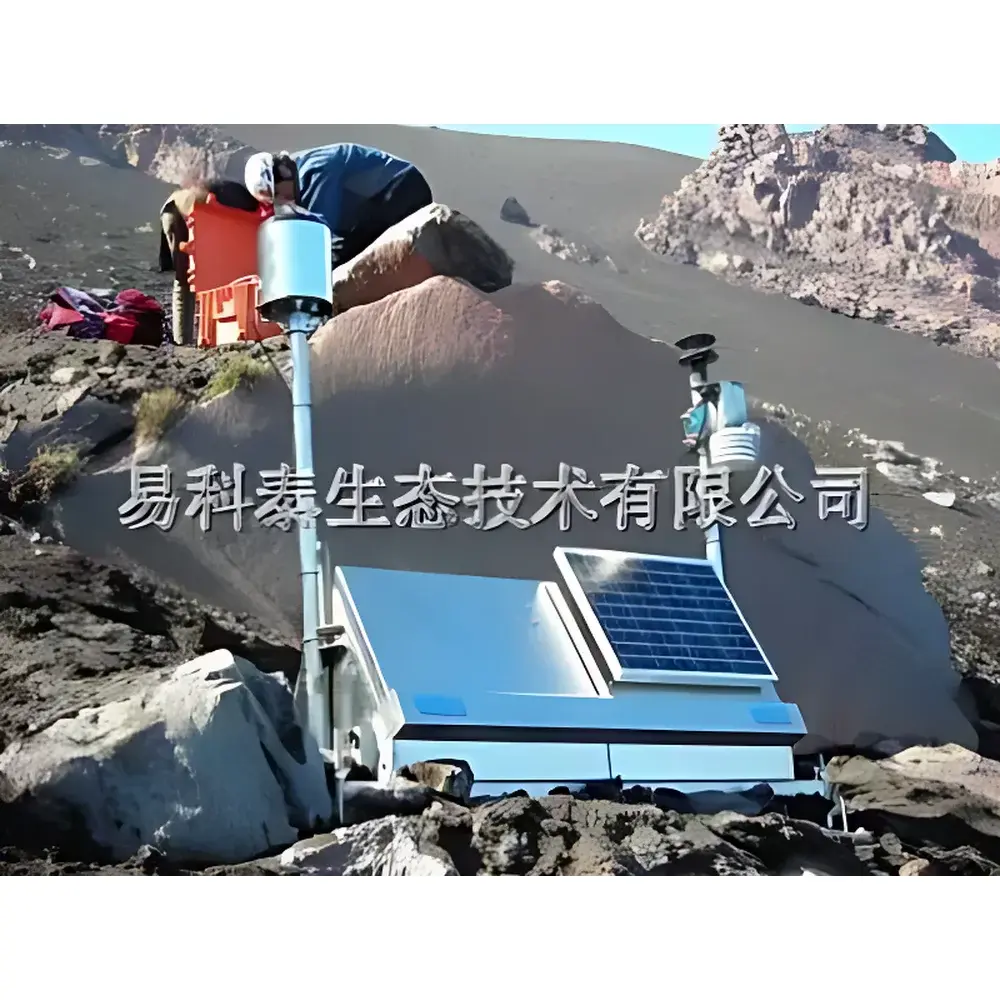
Soil Carbon Flux Automatic Monitoring Station
| Origin | USA |
|---|---|
| Manufacturer Type | Distributor |
| Origin Category | Imported |
| Model | Soil Carbon Flux Automatic Monitoring Station |
| Price | Upon Request |
Overview
The Soil Carbon Flux Automatic Monitoring Station is a fully integrated, field-deployable environmental monitoring system engineered for continuous, long-term quantification of soil-atmosphere gas exchange dynamics. It operates on the principle of eddy covariance (EC) combined with automated chamber-based flux measurement protocols—enabling high-temporal-resolution determination of net CO2, CH4, and H2S fluxes across heterogeneous terrestrial ecosystems. The station simultaneously acquires complementary micrometeorological and edaphic parameters—including 3D ultrasonic wind speed and direction, precipitation, ambient air temperature and relative humidity, soil temperature profiles, volumetric water content, atmospheric pressure, and optional thermal flux and soil gas pressure gradients. Designed for unattended operation in remote locations, it supports wireless telemetry over distances up to 40 km using licensed or license-free ISM-band radio modules compliant with FCC Part 15 and ETSI EN 300 220 standards. Data are time-stamped with GPS-synchronized UTC and stored locally on industrial-grade SD cards prior to secure transmission via encrypted protocols.
Key Features
- Multi-gas flux quantification: Simultaneous CO2, CH4, and H2S flux measurements using calibrated non-dispersive infrared (NDIR), tunable diode laser absorption spectroscopy (TDLAS), and electrochemical sensing technologies
- High-precision micrometeorological suite: Integrated 3D ultrasonic anemometer (0–60 m/s wind speed, ±4% accuracy; 0–360° wind direction, ±3° accuracy) and tipping-bucket rain gauge
- Comprehensive edaphic sensor array: PT100-class soil temperature probes (0–200 °C, ±0.3 °C), TDR-based soil moisture sensors (5–50 % vol, ±3 %), and barometric pressure transducer (Vaisala PT100B, 600–1060 hPa, ±0.5 hPa)
- Ruggedized enclosure rated IP67 for outdoor deployment under extreme conditions (−20 to +65 °C operating range, 0–95 % RH non-condensing)
- Modular architecture supporting optional add-ons: Soil heat flux plates, soil gas diffusion gradient arrays, and soil CO2 concentration profile sensors
- Onboard data logging with 16 GB internal storage, real-time clock with GPS synchronization, and dual communication interfaces (RS-485, Ethernet) plus long-range LoRaWAN or cellular fallback
Sample Compatibility & Compliance
The monitoring station is validated for use across diverse soil types and land-use categories—including agricultural croplands, boreal and temperate forests, alpine meadows, peatlands, tidal marshes, and landfill cover systems. Its gas flux algorithms conform to established methodologies outlined in ISO 18587:2016 (soil carbon stock change estimation), ASTM D5127 (CH4 emission from landfills), and USDA ARS protocols for soil respiration chamber calibration. All sensor calibrations trace back to NIST-certified reference standards. The system meets CE marking requirements for electromagnetic compatibility (EMC Directive 2014/30/EU) and low-voltage safety (LVD Directive 2014/35/EU). For regulated environmental reporting, raw and processed datasets support audit-ready metadata tagging aligned with FAIR principles (Findable, Accessible, Interoperable, Reusable).
Software & Data Management
Data acquisition, quality control, and flux computation are managed through the proprietary FluxNet Suite v4.2 software platform—deployed as a Windows/Linux-compatible desktop application and web-accessible server module. The software implements standardized post-processing workflows including spike detection, coordinate rotation, Webb-Pearman-Leuning (WPL) correction, spectral gap-filling, and u* threshold filtering per AmeriFlux and ICOS guidelines. All processing steps generate immutable audit logs compliant with 21 CFR Part 11 for electronic records and signatures. Export formats include NetCDF-4 (CF-1.8 compliant), CSV, and XML, with direct integration into EDI platforms such as NOAA’s NGEE-Tropics database and the EU’s LifeWatch ERIC infrastructure.
Applications
- Long-term soil respiration monitoring in climate change impact studies (e.g., warming manipulation experiments, drought stress trials)
- Quantification of greenhouse gas mitigation potential from regenerative agriculture practices (cover cropping, reduced tillage, biochar amendment)
- Baseline characterization and post-closure monitoring of municipal solid waste landfills per EPA Method TO-15 and SW-846 1821
- Volcanic CO2 and H2S degassing surveillance in geothermal fields and active volcanic zones
- Biogas leakage assessment at anaerobic digestion facilities and manure lagoons
- Carbon budget modeling for wetland restoration projects under IPCC Tier 3 methodology
FAQ
What is the recommended maintenance interval for sensor recalibration?
Annual field recalibration is recommended for all gas analyzers and meteorological sensors; soil moisture and temperature probes require verification every 18 months using traceable reference standards.
Can the station operate autonomously for more than one year without service intervention?
Yes—configured with dual 100 Ah deep-cycle batteries and a 120 W solar panel, the system supports >12 months of continuous operation in mid-latitude temperate climates with >3.5 kWh/m²/day insolation.
Is the system compatible with third-party data ingestion platforms such as ThingSpeak or AWS IoT Core?
Yes—via MQTT and RESTful API endpoints, with TLS 1.2 encryption and OAuth 2.0 authentication support.
Does the system meet GLP or GMP requirements for regulatory submissions?
While not certified for pharmaceutical GMP, the station’s data integrity architecture—including electronic signatures, audit trails, and ALCOA+ compliance—meets EPA, ISO 17025, and OECD GLP requirements for environmental monitoring data.
How is zero-drift compensated during extended deployments?
Automated zero-span cycles are executed hourly using certified zero air (N2) and span gases (CO2/CH4/H2S in N2); drift correction coefficients are applied in real time using onboard polynomial regression models.
Related Products







