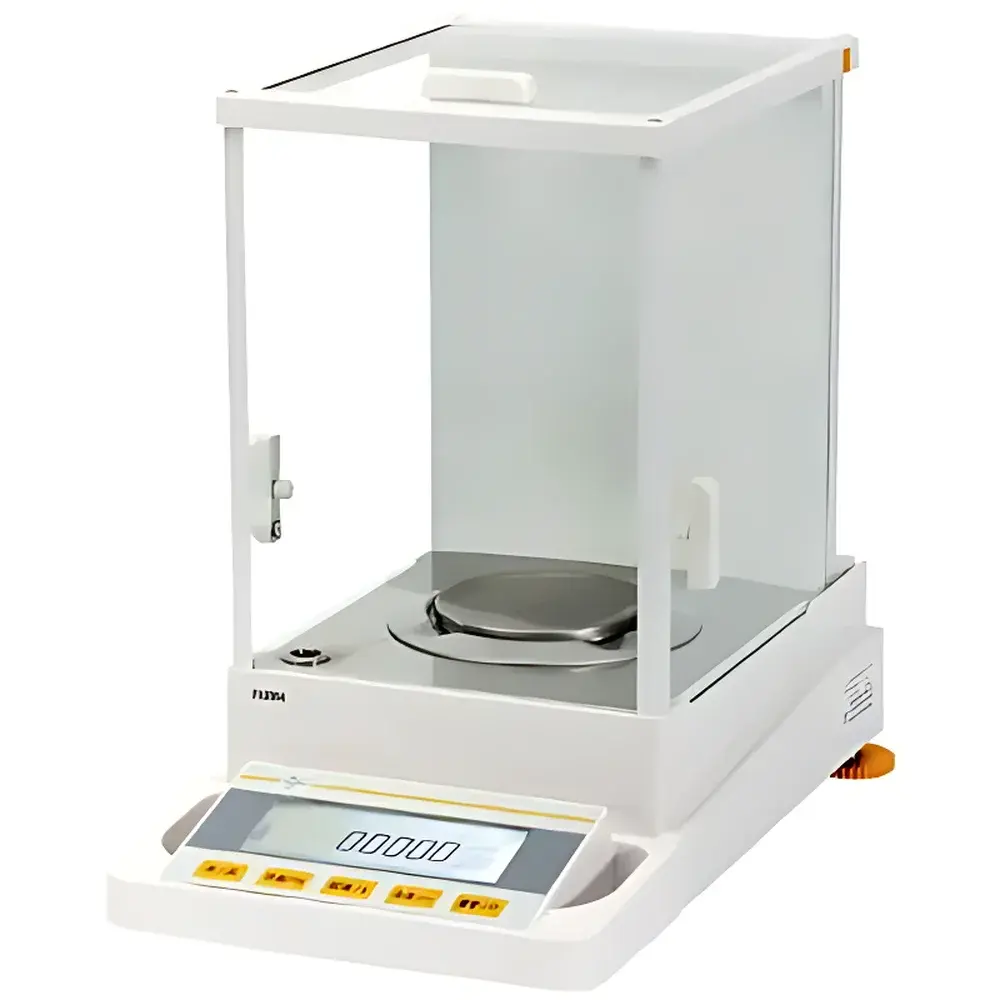
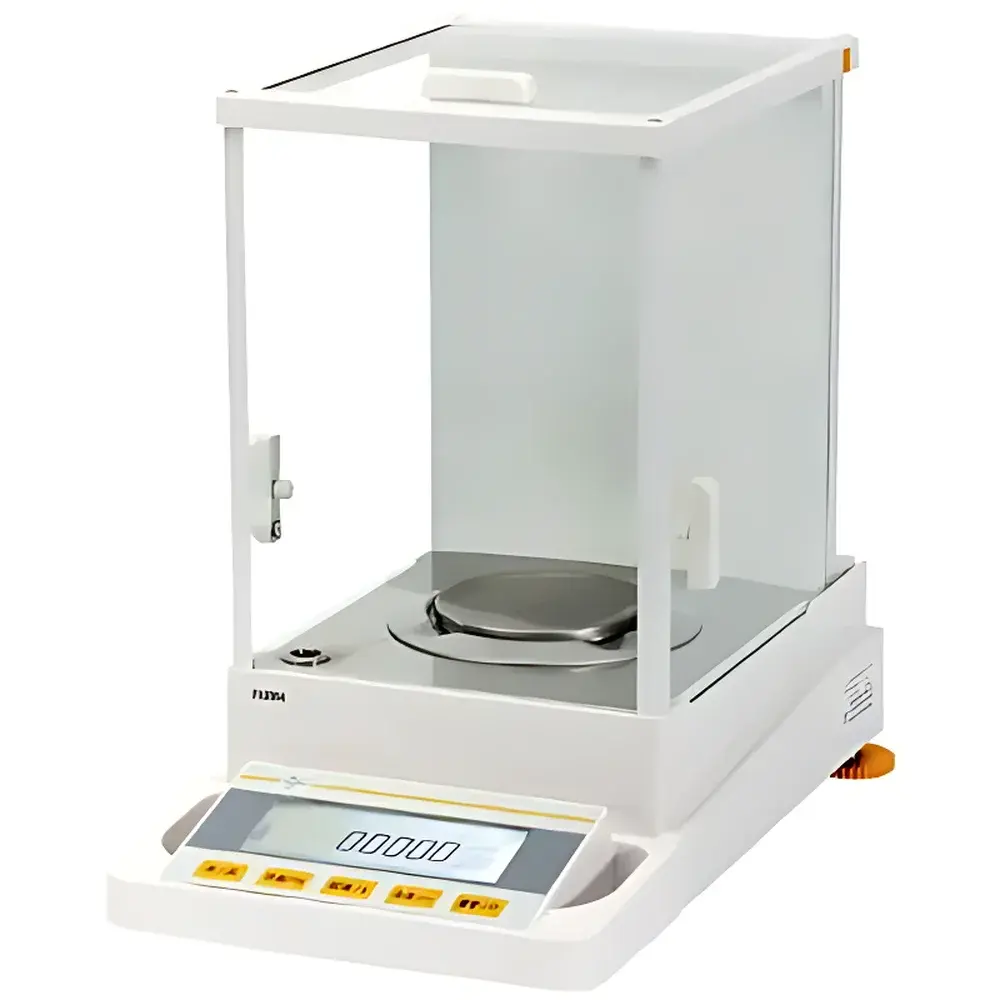
SOP TOP FA2004 Analytical Balance
| Brand | SOP TOP |
|---|---|
| Origin | Shanghai, China |
| Model | FA2004 |
| Instrument Type | Analytical Balance |
| Maximum Capacity | 200 g |
| Readability | 0.1 mg |
| Repeatability | ±0.1 mg |
| Linearity | ±0.2 mg |
| Pan Diameter | Φ90 mm |
| Draft Shield Dimensions (W×D×H) | 190 × 155 × 235 mm |
| External Dimensions (W×D×H) | 200 × 440 × 290 mm |
| Calibration Method | External |
| Connectivity | RS232 interface |
| Temperature Compensation | Dynamic full-range |
| Weighing Modes | Counting, Percentage Weighing, Unit Conversion (g, oz, ct, etc.) |
Overview
The SOP TOP FA2004 Analytical Balance is a precision laboratory instrument engineered for high-accuracy mass measurement in regulated and research-intensive environments. Based on electromagnetic force compensation (EMFC) technology, it delivers stable, drift-free weighing performance by generating a counterbalancing magnetic force proportional to the sample’s weight—eliminating mechanical wear and ensuring long-term metrological integrity. Designed for routine analytical workflows in pharmaceutical QC labs, academic chemistry departments, and materials science facilities, the FA2004 operates within a 200 g maximum capacity range with 0.1 mg readability—meeting the minimum sensitivity requirements for USP , ASTM E898, and ISO/IEC 17025-compliant weighing applications. Its rear-mounted EMFC sensor architecture enhances structural rigidity and minimizes thermal interference from operator proximity, while the integrated draft shield (190 × 155 × 235 mm) conforms to ISO 9001 environmental control recommendations for Class II analytical balances.
Key Features
- Electromagnetic force compensation sensor with dynamic temperature compensation across the full 0–40 °C operating range
- Four-stage shock absorption system to mitigate floor vibration and acoustic disturbances during microgram-level measurements
- Adjustable weighing speed (fast/standard/slow) to optimize stability versus throughput for volatile or electrostatic-prone samples
- Full-range tare function with auto-zero tracking and programmable zero-tracking threshold (0.001–0.01 g)
- Built-in underhook for density determination and below-balance weighing of suspended samples
- Self-diagnostic firmware that validates sensor linearity, zero stability, and load cell response prior to each calibration cycle
- Overload protection with audible and visual alert at ≥105% of max capacity; automatic shutdown at ≥110%
- Multi-unit conversion (g, mg, oz, ct, %, pcs) and built-in counting mode with statistical evaluation (mean, SD, CV%)
Sample Compatibility & Compliance
The FA2004 accommodates standard laboratory vessels—including crucibles, weighing boats, and volumetric flasks—on its Φ90 mm stainless-steel weighing pan. Its draft shield design allows unobstructed access for pipettes and spatulas while maintaining laminar airflow conditions per ISO 17025 Clause 6.4.2. The balance complies with OIML R76-1 (Class I) accuracy requirements for analytical instruments and supports GLP/GMP documentation through RS232 serial output compatible with LIMS integration. While external calibration is required per ISO/IEC 17025 Clause 6.5.2, the device stores calibration history (date, weight value, operator ID if entered manually) and permits user-defined linearization correction points to address nonlinearity at critical mass intervals.
Software & Data Management
Data export is facilitated via bidirectional RS232 interface using standard ASCII protocol (baud rate: 9600, 8N1), enabling direct transmission to Excel, LabWare, or custom database systems. No proprietary software is bundled; however, the balance transmits timestamped weight data with optional prefix/suffix identifiers (e.g., “QC-2024-08-01-FA2004-001”). Audit trail functionality is not embedded, but all manual operations—including tare, calibration initiation, and unit change—are logged in volatile memory and can be retrieved via serial command query. For FDA 21 CFR Part 11 compliance, third-party electronic lab notebook (ELN) systems may capture and digitally sign transmitted datasets with associated metadata.
Applications
- Pharmaceutical assay preparation requiring ≤0.1 mg accuracy per USP
- Gravimetric standard solution preparation in environmental testing labs (EPA Method 502.2)
- Residue-on-ignition (ROI) and loss-on-drying (LOD) determinations per ASTM D2879
- High-precision formulation of catalysts and nanomaterials in R&D settings
- Inventory management via piece-counting mode for tablets, capsules, or microcomponents
- Density measurement of solids and powders using Archimedes’ principle with optional density kit
FAQ
Is internal calibration available on the FA2004?
No—the FA2004 requires external calibration using certified weights traceable to NIST or BIPM standards. Internal motorized calibration mechanisms are absent per its Class I OIML design specification.
Can the balance be connected to a networked LIMS?
Yes—via RS232-to-Ethernet converters or USB-serial adapters, provided the host system accepts ASCII-formatted weight strings with configurable delimiters.
What environmental conditions are recommended for optimal performance?
Operate within 15–30 °C ambient temperature, <60% RH non-condensing, on a vibration-isolated granite or Sorbothane platform away from HVAC vents and foot traffic.
Does the FA2004 support GLP audit trails?
It records basic operational events locally but lacks non-erasable electronic signatures or time-stamped operator authentication. Full GLP compliance requires external data capture infrastructure.
How often should external calibration be performed?
Per ISO/IEC 17025, calibration frequency must be risk-assessed—typically daily pre-use verification with 100 g check weight, plus full multi-point calibration at least weekly or after relocation, maintenance, or observed drift exceeding ±0.1 mg.