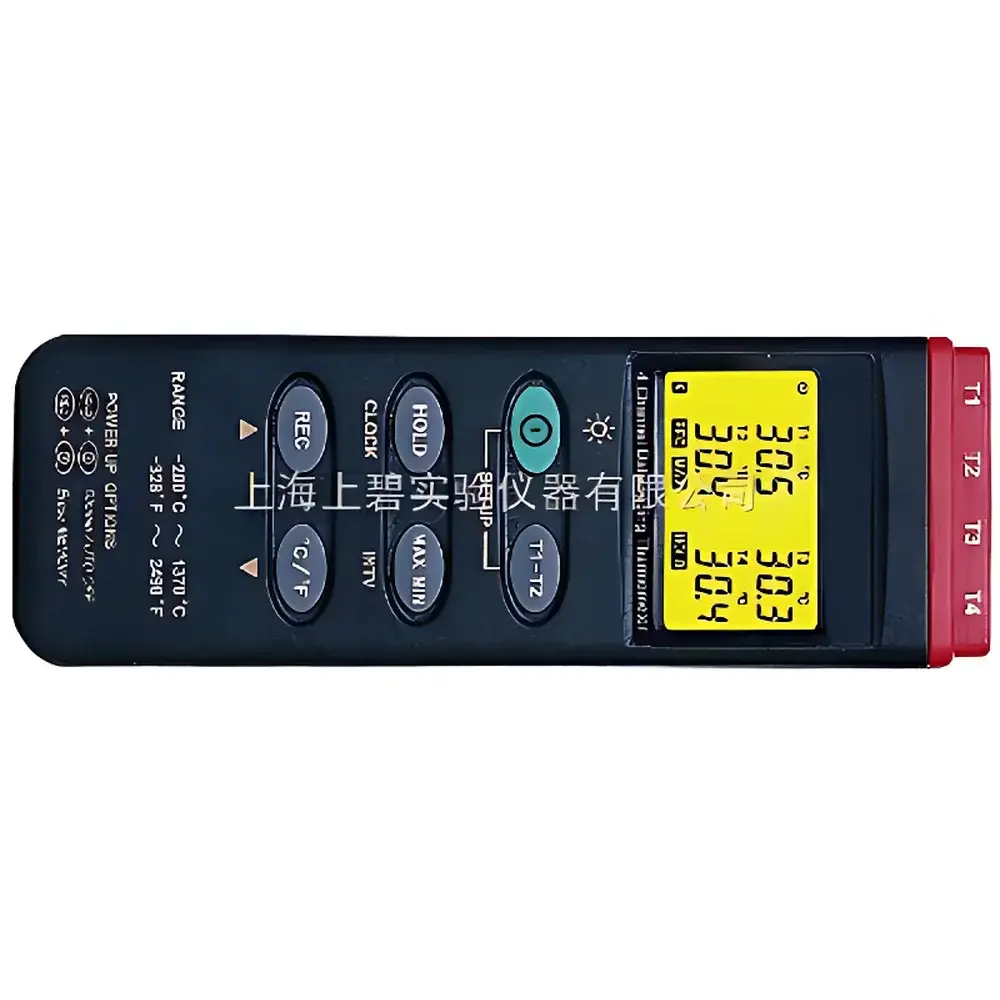
Sper Scientific 800024 Four-Channel K-Type Thermocouple Temperature Meter
| Origin | UK |
|---|---|
| Manufacturer Type | Authorized Distributor |
| Import Status | Imported |
| Model | 800024 |
| Price | Upon Request |
| Channels | 4 independent inputs |
| Sensor Type | K-type thermocouples |
| Temperature Range | −200 °C to +1370 °C |
| Resolution | 0.1 °C |
| Accuracy | ±0.2% of reading + 1 °C (−200 to 200 °C), ±0.5% of reading + 1 °C (200 to 400 °C), ±0.2% of reading + 1 °C (400 to 1370 °C) |
| Data Logging Capacity | 16,000 readings |
| Interface | RS232 serial port |
| Power Supply | 9 V alkaline battery or optional AC adapter |
| Dimensions (L×W×H) | 18.5 × 6.4 × 3.2 cm |
| Standard Accessories | Two K-type thermocouple probes, RS232 cable, data logging software |
Overview
The Sper Scientific 800024 is a precision-engineered four-channel digital temperature meter designed for laboratory, industrial process monitoring, and quality assurance applications requiring simultaneous multi-point thermal measurement. Built upon the industry-standard K-type thermocouple input architecture, it operates on the Seebeck principle—converting thermal voltage differentials into calibrated temperature values with traceable accuracy across an exceptionally wide operational range (−200 °C to +1370 °C). Unlike single-channel alternatives, the 800024 enables real-time comparative analysis of up to four independent thermal zones without manual probe swapping—critical for validating oven uniformity, mapping environmental chambers, monitoring HVAC duct arrays, or verifying thermal stability in material curing processes. Its robust handheld form factor, high-resolution LCD display, and configurable measurement modes—including ΔT (T1–T2), Min/Max hold, and dual °C/°F output—support both routine verification and structured validation protocols under ISO/IEC 17025 or ASTM E2251-compliant workflows.
Key Features
- Four independent K-type thermocouple inputs with simultaneous real-time readout on a single backlit LCD screen
- Configurable display modes: individual channel values, T1–T2 differential, Min/Max tracking, and auto-hold function
- High-resolution 0.1 °C resolution across full range with NIST-traceable accuracy specifications per IEC 60584-1
- Integrated data logger storing up to 16,000 timestamped readings with user-defined sampling intervals
- RS232 serial interface compliant with EIA/TIA-232-F standard; includes Windows-compatible software for data export, trend visualization, and CSV report generation
- Zero-offset calibration capability per channel to compensate for cold-junction reference drift or probe-specific offsets
- Auto-power-off after 15 minutes of inactivity; optional AC adapter support for continuous benchtop operation
- Compact ergonomic housing (18.5 × 6.4 × 3.2 cm) rated for use in Class II electrical environments
Sample Compatibility & Compliance
The 800024 accepts standard miniature or sheathed K-type thermocouples (IEC 60584-2 designation) with exposed, grounded, or insulated junctions—compatible with common industrial probe configurations including surface-mount, immersion, air-gap, and penetration types. It meets CE marking requirements under the EU Electromagnetic Compatibility Directive 2014/30/EU and Low Voltage Directive 2014/35/EU. While not intrinsically safe, its low-voltage DC operation and isolated analog front-end make it suitable for non-hazardous area use per IEC 60079-0. The instrument supports documentation practices aligned with FDA 21 CFR Part 11 when used with validated software configurations, and its accuracy profile satisfies ASTM E2251 (Standard Specification for Liquid-in-Glass and Digital Thermometers) for general-purpose temperature verification tasks.
Software & Data Management
The included PC software provides secure, audit-ready data handling capabilities. Users can configure logging parameters (sampling rate, trigger conditions, channel enable/disable), download stored datasets, and generate time-stamped reports with metadata (operator ID, location tag, calibration due date). Export formats include plain-text CSV and Excel-compatible XLSX files—facilitating integration with LIMS platforms or statistical process control (SPC) tools such as Minitab or JMP. Audit trail functionality records all configuration changes and data export events. For regulated environments, the software may be deployed under controlled validation protocols to satisfy GLP and GMP documentation requirements.
Applications
- Thermal mapping of autoclaves, incubators, stability chambers, and cleanroom HVAC systems
- Process validation in pharmaceutical manufacturing (e.g., sterilization cycle qualification per ISO 13485)
- Calibration verification of fixed-point furnaces and dry-well calibrators
- Material testing labs monitoring exothermic/endothermic reactions during DSC or TGA pre-screening
- Maintenance teams diagnosing thermal imbalances in electrical panels, motor windings, or refrigeration circuits
- Educational laboratories conducting heat transfer experiments with spatially distributed sensors
FAQ
What thermocouple types are supported by the 800024?
Only Type K thermocouples (Chromel–Alumel) are supported, per IEC 60584-1. Other types (e.g., J, T, or N) require external signal conditioning and are not compatible.
Can the device perform simultaneous logging from all four channels?
Yes—the internal logger captures synchronized readings from all active channels at user-defined intervals, preserving temporal correlation between measurements.
Is the RS232 interface opto-isolated?
No; the RS232 port uses standard line drivers without galvanic isolation. For electrically noisy environments, a USB-to-RS232 converter with isolation is recommended.
How is calibration traceability maintained?
The unit ships with a manufacturer’s certificate of conformance referencing NIST-traceable standards. Field recalibration requires a certified dry-block or bath source and must follow documented SOPs per ISO/IEC 17025 Clause 6.5.
Does the software comply with 21 CFR Part 11?
The base software does not include electronic signatures or role-based access control out-of-the-box; however, it can be integrated into validated IT infrastructures where those controls are implemented at the system level.