
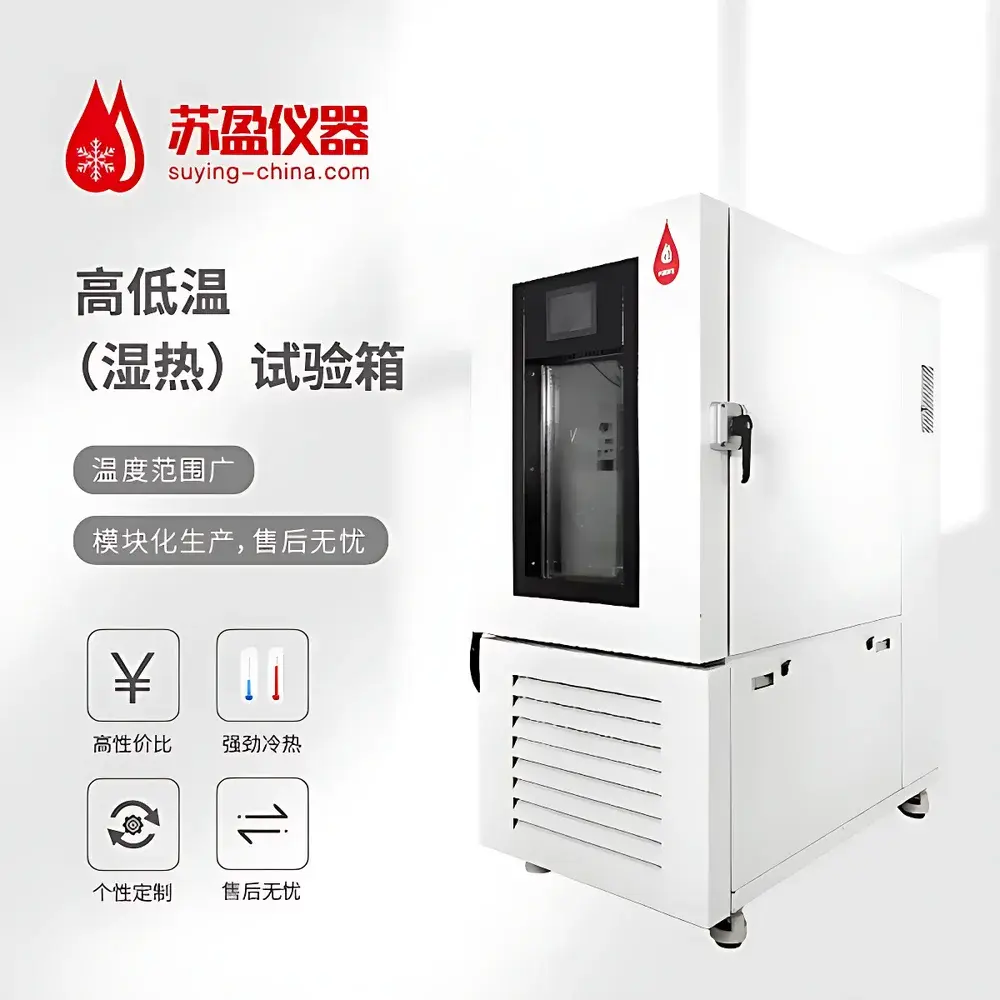
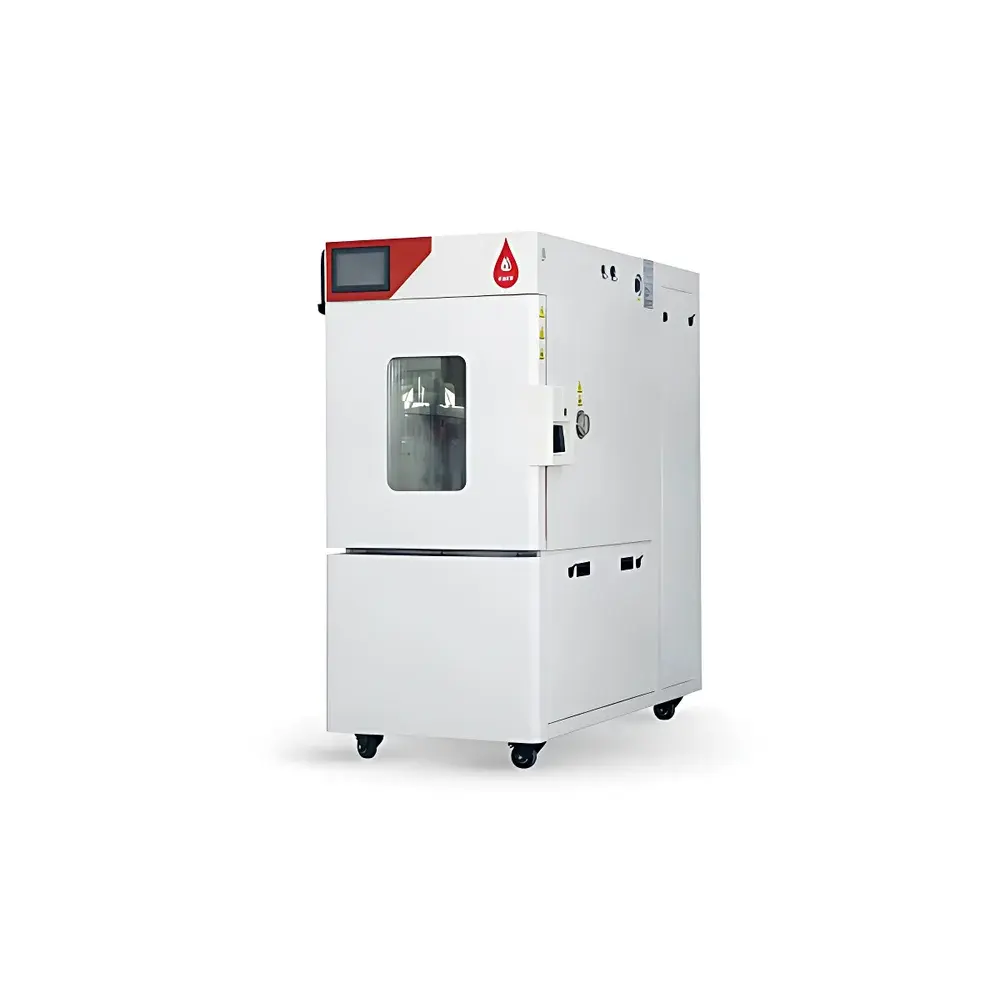
SuYing GDW Series High-Low Temperature Alternating Environmental Test Chamber
| Brand | SuYing |
|---|---|
| Origin | Shanghai, China |
| Model | GDW-100 / GDW-250 / GDW-500 / GDW-800 / GDW-1000 |
| Temperature Range | A: −20°C to +150°C |
| B | −40°C to +150°C |
| C | −60°C to +150°C |
| D | −70°C to +150°C |
| Temperature Uniformity | ≤ ±2°C |
| Temperature Fluctuation | ≤ ±0.5°C |
| Heating Rate | −20°C → +100°C in ~35 min (typical) |
| Cooling Rate | +25°C → −40°C in ~50 min (typical) |
| Internal Dimensions (D×W×H, mm) | 450×450×500 to 1000×1000×1000 |
| External Dimensions (D×W×H, mm) | 1150×450×500 to 1650×1480×2200 |
| Power Supply | AC 380 V ±10%, 50 Hz ±0.5 Hz, 3-phase 5-wire |
| Safety Protections | Over-temperature, over-current, compressor high-pressure, motor overload, leakage current, short-circuit |
| Compliance | GB/T 2423.1–2001, GB/T 2423.2–2001, GB 10589–1989, GB 10592–1989, GB 11158–1989, GB/T 5170.2–1996 |
Overview
The SuYing GDW Series High-Low Temperature Alternating Environmental Test Chamber is an engineered precision system designed for accelerated environmental stress testing of electronic components, automotive interior materials, aerospace hardware, polymer composites, and metallic assemblies under controlled thermal cycling conditions. Operating on the principle of forced-air convection with dual independent heating and refrigeration circuits, the chamber delivers reproducible, traceable temperature profiles across a wide operational range—from −70°C to +150°C—enabling compliance-driven validation per IEC 60068-2-1 (cold), IEC 60068-2-2 (dry heat), and ISO 16750-4 (road vehicles). Its architecture supports both steady-state exposure and programmed alternating cycles (e.g., −40°C/2 h → +85°C/2 h), facilitating failure mode analysis related to thermal expansion mismatch, solder joint fatigue, sealant delamination, and dimensional instability.
Key Features
- Robust dual-circuit thermal management: Independent heating (nickel-chromium alloy sheathed heaters) and refrigeration (French Tecumseh hermetic compressors with cascade configuration for sub-zero operation) ensure rapid ramp rates and minimal cross-interference during transitions.
- Precision airflow design: Multi-blade centrifugal fan with low-noise, high-torque AC motor and optimized duct geometry achieves ≤ ±2°C temperature uniformity across the full working volume—verified per GB/T 5170.2–1996 calibration protocol.
- Structural integrity: Inner chamber fabricated from mirror-finish SUS304 stainless steel (1.5 mm thickness); outer shell from electrostatically sprayed cold-rolled carbon steel; reinforced base frame with I-beam support for static load stability up to 100 kg.
- Human-centric interface: Touchscreen PID controller with auto-tuning algorithm, ±0.1°C setpoint resolution, and parameter lockout function to prevent unauthorized modification during qualification runs.
- Configurable access: Standard 50 mm diameter test port (left-side, gasket-sealed), double-layer silicone rubber door seal rated for −70°C to +150°C, and LED-illuminated observation window with embedded heated glass to prevent condensation.
- Comprehensive safety architecture: Dual-stage over-temperature cutoff, compressor discharge pressure monitoring, phase-loss detection, ground-fault interruption, and motor thermal protection—all compliant with IEC 61000-6-2 EMC immunity requirements.
Sample Compatibility & Compliance
The GDW series accommodates test specimens up to 1000 mm × 1000 mm × 1000 mm (GDW-1000 model), with adjustable stainless-steel sample racks supporting vertical/horizontal orientation. It meets mandatory regulatory frameworks including China’s GB standards (GB/T 2423.1–2001, GB/T 2423.2–2001), as well as international benchmarks referenced in automotive PPAP submissions (e.g., GM W3177, Ford CETP 00.00-L-467) and electronics qualification (JEDEC JESD22-A104). The chamber’s thermal performance data is fully traceable to national metrology institutes via optional third-party calibration certificates (ISO/IEC 17025 accredited). All electrical components—including Schneider contactors and Fuji solid-state relays—carry CE marking and conform to RoHS Directive 2011/65/EU.
Software & Data Management
While the base configuration features a standalone microprocessor-based controller with real-time display and manual logging, optional RS485/RS232 or Ethernet interfaces enable integration into centralized laboratory information management systems (LIMS). With compatible software (e.g., SuYing TestLink™), users can define multi-step thermal profiles, export time-stamped CSV datasets with PT100 sensor readings (±0.15°C accuracy), generate PDF test reports compliant with GLP audit requirements, and activate 21 CFR Part 11–compatible electronic signatures and audit trails. Optional thermal printer output provides hard-copy verification for QA documentation without external dependencies.
Applications
This test chamber serves critical roles across R&D, quality assurance, and production release workflows: validating thermal shock resistance of PCBAs per IPC-9701; verifying dimensional stability of injection-molded plastic housings under automotive thermal cycling (SAE J2223); screening adhesive bond strength degradation in EV battery module enclosures; assessing moisture barrier integrity of OLED display laminates during humidity-freeze sequences; and performing accelerated life testing of elastomeric seals per ASTM D573. Its repeatable thermal gradients support root-cause analysis of failures observed in field deployments—particularly where cumulative thermal cycling induces microcrack propagation or interfacial debonding undetectable under static conditions.
FAQ
What standards does the GDW chamber comply with?
It conforms to GB/T 2423.1–2001 (cold), GB/T 2423.2–2001 (dry heat), GB 10592–1989 (general performance), and supports test execution per IEC 60068-2-1, IEC 60068-2-2, and ISO 16750-4.
Can the chamber perform humidity-controlled tests?
The standard GDW series is a dry-thermal cycling chamber. For combined temperature-humidity testing, refer to SuYing’s complementary GDSW Series Humidity & Thermal Cycling Chambers.
Is remote monitoring supported?
Yes—via optional Ethernet or RS485 interface with Modbus RTU protocol, enabling integration into SCADA or MES platforms for real-time chamber status and alarm notification.
What maintenance intervals are recommended?
Compressor oil inspection every 2,000 operating hours; air filter cleaning every 3 months; annual calibration of PT100 sensors and controller thermocouple inputs per ISO/IEC 17025 procedures.
Can non-standard internal volumes be custom-engineered?
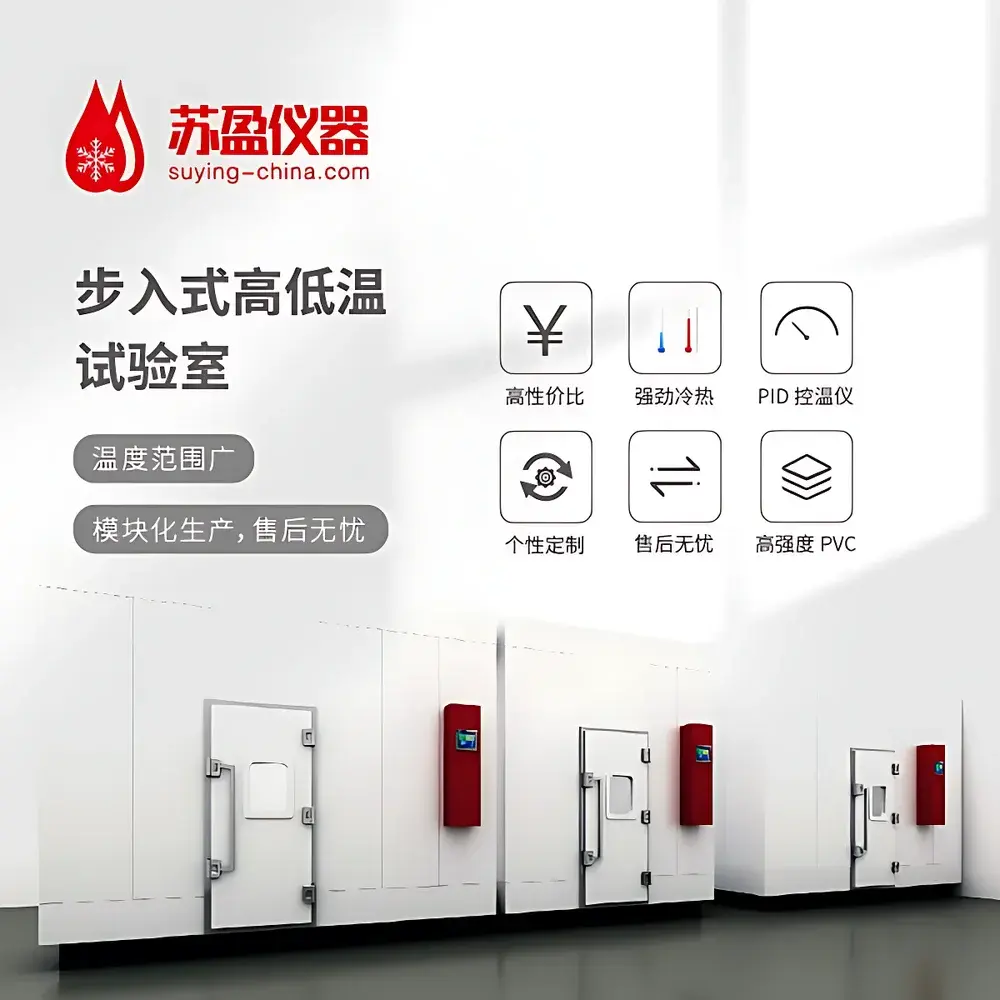
Yes—SuYing offers bespoke chamber fabrication, including walk-in configurations, extended temperature ranges (e.g., −80°C), and specialized airflow manifolds for large-format aerospace composite panels.
Related Products



