
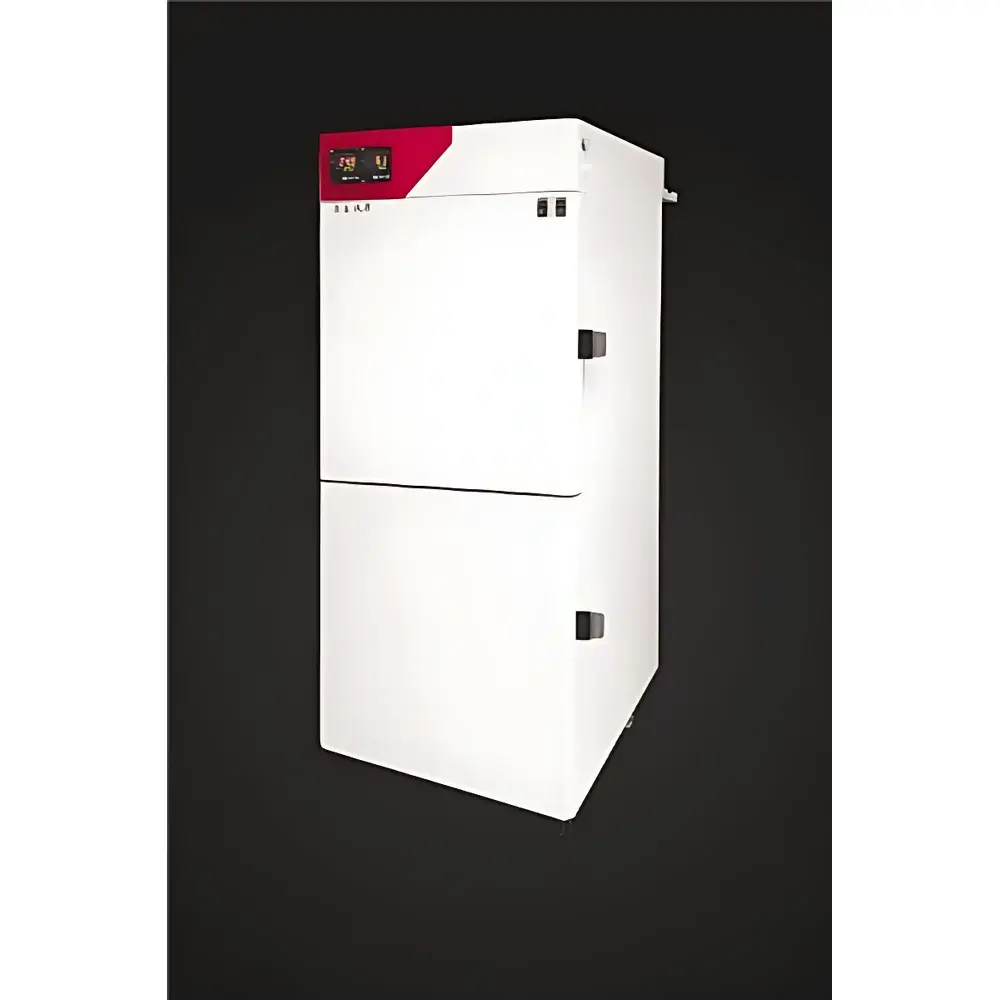
SuYing YP-TSD / YP-TGSD Series Tri-Chamber Drug Stability Testing Chamber
| Brand | SuYing |
|---|---|
| Origin | Shanghai, China |
| Chamber Configuration | Tri-chamber (Temperature/Humidity + Light + Optional Control Chamber) |
| Model Variants | YP-TSD, YP-TSDP, YP-TGSD, YP-TGSP (150L / 250L / 500L / 1000L capacities) |
| Temperature Range | 0–65°C (dark), 10–65°C (with illumination) |
| Temperature Uniformity | ±0.5°C |
| Humidity Range | 40–95% RH |
| Humidity Uniformity | ±0.5% RH |
| Illuminance Range | 0–4500 lx (adjustable) |
| Illuminance Accuracy | ±500 lx |
| Control Resolution | 0.1°C / 0.1% RH |
| Refrigeration | Danfoss hermetic compressor |
| Refrigerant | R404A / R23 |
| Cooling Method | Air-cooled fin-tube evaporator |
| Compliance | Chinese Pharmacopoeia (2010 Edition) Stability Guidelines, GB 10586–1989 Environmental Test Equipment Standards |
| Safety Protections | Compressor overheat, overload, water shortage, overtemperature, electrical short-circuit |
Overview
The SuYing YP-TSD and YP-TGSD Series Tri-Chamber Drug Stability Testing Chambers are engineered for precise, long-term simulation of ICH Q1–Q5 and WHO-recommended environmental stress conditions required in pharmaceutical stability studies. These chambers implement a physically segregated tri-compartment architecture—comprising independent temperature/humidity conditioning, photostability exposure, and optionally a dedicated control or transition chamber—to eliminate cross-parameter interference during concurrent accelerated, long-term, intermediate, and photostability testing per ICH Q1B, Q5C, and USP / . Unlike single- or dual-chamber systems, the tri-chamber design enables simultaneous execution of multiple protocols (e.g., 25°C/60% RH long-term storage alongside 40°C/75% RH accelerated testing and 1.2 million lux·hr UV-visible irradiation) without thermal or humidity carryover, ensuring data integrity required for regulatory submissions to FDA, EMA, PMDA, and NMPA.
Key Features
- Tri-Chamber Physical Isolation: Independent air handling, refrigeration, and lighting circuits per chamber prevent parameter crosstalk; validated spatial uniformity meets ICH Q1A(R2) criteria (±0.5°C temp, ±0.5% RH humidity, ±500 lx illuminance).
- Precision Climate Control: Dual PID-controlled microprocessor system (Fuji or TEMI880 programmable controller) with Pt100 platinum resistance sensors and high-stability capacitive humidity transducers; resolution 0.1°C / 0.1% RH.
- Photostability-Optimized Illumination: Adjustable 0–4500 lx white-light array compliant with ICH Q1B Option 1 (cool white fluorescent) and Option 2 (UV-enhanced); calibrated against NIST-traceable lux meters; lamp aging compensation algorithm integrated.
- Corrosion-Resistant Construction: Interior lined with mirror-finish SUS304B stainless steel; seamless welding and rounded internal corners minimize microbial retention; validated for repeated cleaning with ethanol, isopropanol, and low-concentration hydrogen peroxide.
- Uniform Air Distribution: Optimized tangential airflow path with backward-curved centrifugal blower ensures ≥90% volume coverage at ≤0.3 m/s velocity; thermal mapping confirms ≤1.5°C max deviation across full working volume (per ISO 14644-3 Class 5 validation protocol).
- Regulatory-Ready Safety Architecture: Redundant safety layers including compressor thermal cutoff, refrigerant pressure monitoring, condensate level sensor, overtemperature cutout, and real-time electrical fault detection—all logged with timestamped event records.
Sample Compatibility & Compliance
Chambers accommodate standard pharmaceutical packaging formats—including blister packs, HDPE bottles, glass vials, syringes, and sachets—on adjustable stainless-steel shelves (2 standard trays included; optional load-cell–equipped shelves available). All models conform to Chinese Pharmacopoeia (2010 Edition) “Guidelines for Stability Testing of Drug Substances and Products”, GB 10586–1989 “Technical Requirements for Environmental Test Chambers”, and support GLP-compliant operation when paired with 21 CFR Part 11–enabled software (available as optional upgrade). Validation documentation packages—including IQ/OQ/PQ templates, thermal mapping reports, and humidity distribution studies—are provided pre-validated for immediate use in GMP-regulated environments.
Software & Data Management
Standard configuration includes local touchscreen interface with 7-inch LCD panel supporting up to 100 programmable test profiles, each with multi-segment ramp/soak cycles, alarm thresholds, and user-access-level management. Optional Ethernet-enabled data logger (SuYing STS-Link v3.2) provides continuous timestamped recording of all critical parameters (temperature, humidity, illuminance, compressor status, door open events) with encrypted CSV export, audit trail, and electronic signature capability compliant with FDA 21 CFR Part 11 Annex 11 requirements. Remote monitoring via HTTPS-secured web portal supports real-time alerting (SMS/email) on deviation events and scheduled calibration reminders.
Applications
- ICH Q1A(R2)-compliant long-term stability studies (25°C ±2°C / 60% RH ±5%)
- Accelerated stability testing (40°C ±2°C / 75% RH ±5%, 6-month duration)
- Intermediate condition assessment (30°C ±2°C / 65% RH ±5%)
- Photostability testing per ICH Q1B (Option 1: cool white fluorescent; Option 2: UV + visible)
- Forced degradation studies under controlled thermal-hygrometric stress
- Stability protocol development for biologics, sterile products, and combination devices
- Environmental qualification of cleanroom buffer zones and cold chain logistics staging areas
FAQ
What chamber configurations are available beyond tri-chamber?
SuYing offers parallel two-chamber (YP-GSD) and tri-chamber (YP-TSD/YP-TGSD) variants; custom quad-chamber configurations with dedicated dark-control and UV-only modules are available upon engineering review.
Is remote validation support provided for global regulatory submissions?
Yes—SuYing provides on-site or virtual IQ/OQ execution support by certified metrology engineers; PQ protocols are co-developed with client QA teams to align with regional expectations (e.g., MHRA Annex 15, PIC/S PE 009-16).
How is illuminance calibrated and maintained over time?
Each chamber includes factory-installed, NIST-traceable lux sensor with automatic drift compensation; annual recalibration service includes spectral output verification across 320–800 nm range using calibrated spectroradiometer.
Can the system integrate with LIMS or MES platforms?
Via optional OPC UA or Modbus TCP gateway module; API documentation and HL7/FHIR-compatible data schema are supplied for enterprise integration.
What is the expected mean time between failures (MTBF) for critical subsystems?
Danfoss compressors: ≥35,000 operating hours; Fuji/TEMI controllers: ≥50,000 hours; LED illumination arrays: ≥20,000 hours at rated output.





