
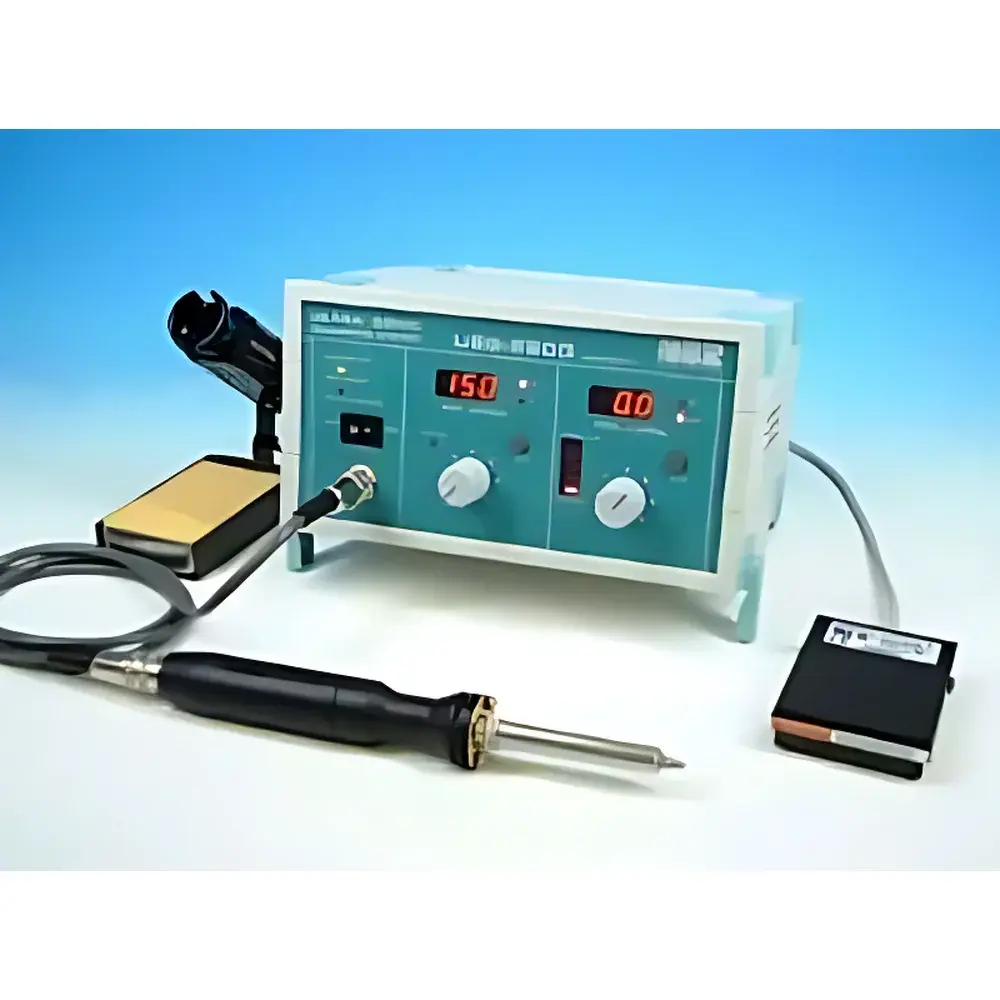
Swiss-made USS-9210 Ultrasonic Soldering System
| Origin | Switzerland |
|---|---|
| Supplier Type | Authorized Distributor |
| Origin Category | Imported |
| Model | USS-9210 |
| Pricing | Available Upon Request |
| Frequency | 60 kHz ± 3 kHz |
| Ultrasonic Output Power | 4–12 W (max) |
| Temperature Range | 150–480 °C |
| Ceramic Heater Power | 80 W |
| Input Voltage | 100–230 V AC, 48–65 Hz |
| Base Unit Dimensions | 240 × 130 × 200 mm |
| Base Unit Weight | 3 kg |
| Standard Hand Tool Length | 240 mm |
| Standard Hand Tool Diameter | 27 mm / 20 mm |
| Standard Hand Tool Weight (excl. cable) | 150 g |
| Light Hand Tool Weight (excl. cable) | 110 g |
| Cable Length (hand tool) | 1.5 m |
| Foot Switch Cable Length | 2 m |
| Soldering Tip Diameters | 1.0, 2.0, 3.0*, 4.0 mm (*standard) |
Overview
The USS-9210 Ultrasonic Soldering System is a precision-engineered, microprocessor-controlled soldering platform designed for low-heat, flux-free joining of dissimilar and thermally sensitive materials. Unlike conventional resistance or convection soldering, the USS-9210 employs high-frequency ultrasonic energy (60 kHz ± 3 kHz) to disrupt surface oxides and promote atomic bonding at temperatures significantly below traditional melting points—enabling metallurgical adhesion without bulk heating. This mechanism is particularly effective for aluminum, magnesium, tungsten, and thin-film photovoltaic interconnects where thermal distortion, intermetallic formation, or substrate degradation must be avoided. The system integrates ceramic resistive heating with real-time zero-crossing temperature control, ensuring stable thermal delivery across the full 150–480 °C operating range. Its modular architecture supports both manual operation via ergonomic hand tools and integration into semi-automated or robotic workcells—making it suitable for R&D labs, microelectronics assembly, and high-reliability repair applications compliant with IPC-A-610 and J-STD-001 guidelines.
Key Features
- Microprocessor-based base unit with intuitive rotary controls and digital display for independent adjustment of ultrasonic power (4–12 W), setpoint temperature, and dwell time
- Ceramic heater element embedded within the hand tool, delivering rapid thermal response and long-term stability under repeated thermal cycling
- Automatic resonance tracking circuitry maintains optimal transduction efficiency across tip wear and load variations
- Ergonomically optimized hand tools—including standard (150 g) and lightweight (110 g) variants—with integrated sonotrode and low-profile 3 mm soldering tip (default configuration)
- Interchangeable soldering tips (1.0, 2.0, 3.0, and 4.0 mm diameters) fabricated from wear-resistant alloys; custom tip geometries available upon request
- Optional compressed-air cooling interface on select hand tools for accelerated heat dissipation during high-duty-cycle operations
- Foot-switch activation enables hands-free start/stop control, supporting consistent operator positioning and repeatable process timing
Sample Compatibility & Compliance
The USS-9210 is validated for use with non-ferrous conductive substrates including aluminum foils (≥25 µm), magnesium ribbons, tungsten wires (50–200 µm), and silicon photovoltaic cells with aluminum front-surface metallization. It accommodates fine-pitch wire leads (e.g., 0.1–0.5 mm diameter Al/Mg), PCB repair traces (≥100 µm width), and thin-metal chassis (<0.5 mm thickness). All electrical components comply with IEC 61000-6-3 (EMC emission limits) and IEC 61000-6-2 (immunity requirements). Thermal control firmware implements resistance-based feedback from the ceramic heater, meeting the functional safety principles outlined in IEC 61508 SIL 2 for critical temperature regulation. The system supports GLP-compliant documentation when paired with external data loggers recording timestamped power, temperature, and actuation events.
Software & Data Management
While the USS-9210 operates as a standalone instrument with no proprietary software dependency, its analog and digital I/O interfaces (0–10 V output, TTL trigger input, RS-232 optional) enable integration with industrial PLCs, SCADA systems, or LabVIEW-based process monitoring platforms. All parameter settings are retained in non-volatile memory after power-down. For audit-ready environments, users may connect an external USB data logger to record real-time ultrasonic power envelope, tip temperature deviation (±0.5 °C resolution), and foot-switch actuation timestamps—supporting 21 CFR Part 11 compliance when paired with appropriate electronic signature protocols. Firmware updates are delivered via secure USB flash drive and require physical confirmation to prevent unauthorized modification.
Applications
- Wire bonding of aluminum or magnesium leads to semiconductor packaging substrates without flux residue or void formation
- Repair of fractured solder joints on aerospace-grade printed circuit boards where thermal stress must remain below 120 °C ambient rise
- Direct attachment of aluminum busbars to silicon solar cells in PV module manufacturing lines
- Hermetic sealing of glass-to-glass encapsulated photovoltaic devices using ultrasonically assisted low-melting-point solder alloys
- Joining of dissimilar metals (e.g., Al-to-W) in MEMS packaging where conventional soldering induces brittle intermetallic phases
- Low-temperature rework of thermally fragile flex circuits containing polyimide substrates and copper traces
FAQ
What distinguishes ultrasonic soldering from ultrasonic welding?
Ultrasonic soldering combines localized heat with high-frequency mechanical vibration to break oxide layers and enhance wetting—whereas ultrasonic welding relies solely on vibrational energy to create solid-state bonds between similar metals without filler material.
Can the USS-9210 be used with lead-free solder alloys?
Yes—the system is compatible with SnAgCu (SAC305), SnCu, and Bi-based low-temperature solders; optimal performance requires tip temperature calibration per alloy’s liquidus point and wetting kinetics.
Is nitrogen or formic acid atmosphere required for oxide-sensitive materials?
Not inherently—the ultrasonic cavitation effect provides in-situ oxide disruption, though inert gas shrouding may be added for ultra-high-reliability applications such as space-grade interconnects.
How often does the soldering tip require replacement?
Tip lifetime depends on duty cycle and material hardness; typical service life exceeds 5,000 solder joints under controlled thermal profiles and proper cleaning protocols.
Does the system support automated motion integration?
Yes—robot head variants (USS-9210-RH) provide standardized mounting flanges and synchronized I/O signals for integration with UR, KUKA, or EPSON robotic arms under ROS or EtherCAT control architectures.



