
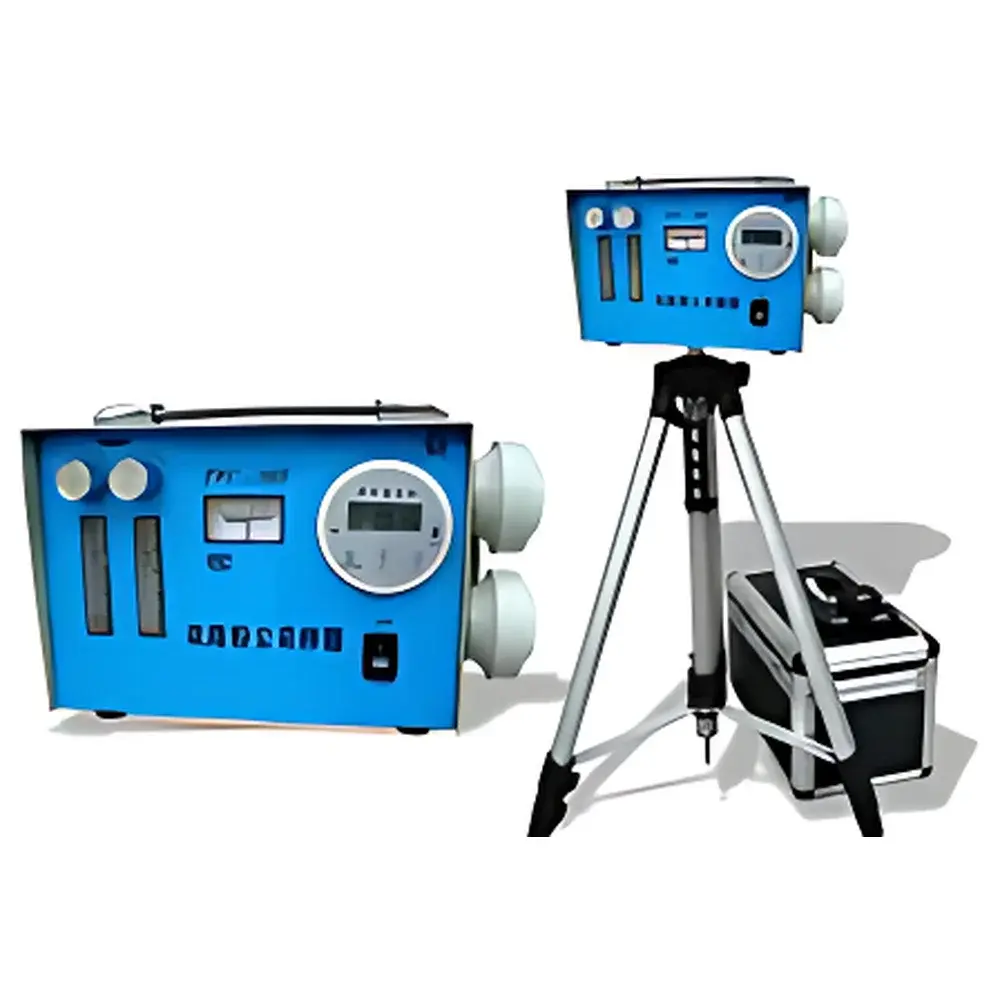
TFC-30S Dual-Channel Dust Sampler
| Origin | Jiangsu, China |
|---|---|
| Manufacturer Type | Authorized Distributor |
| Origin Category | Domestic (PRC) |
| Model | TFC-30S |
| Pricing | Available Upon Request |
| Flow Options | 5–30 L/min, 3–30 L/min, 1–15 L/min, or 5–25 L/min |
| Flow Accuracy | ≤ ±2.5% of full scale |
| Timing Accuracy | ≤ ±0.1% |
| Maximum Vacuum | ≥15,000 Pa |
| Charging Current | 300 mA (standard) |
| Power Supply | 10 V DC (rechargeable Ni-Cd battery) / 220 V AC, 50 Hz |
| Battery Runtime | ~3 hours continuous operation per full charge |
| Timer Range | 1 min to 99 h 59 min (programmable countdown) |
| Compliance | Designed for ISO 7708:1995 and GB/T 17061–1997 compliant airborne particulate sampling |
Overview
The TFC-30S Dual-Channel Dust Sampler is a precision-engineered, microprocessor-controlled instrument designed for simultaneous, independent collection of total suspended particulate (TSP) matter from ambient or workplace air environments. It operates on the principle of constant-flow gravimetric sampling—drawing air through pre-weighed filter media at user-selectable, stable volumetric flow rates. Its dual-pump architecture ensures true parallel sampling: each channel functions with mechanical and electronic isolation, eliminating cross-channel interference and enabling statistically robust paired measurements required for method validation, quality control audits, and occupational exposure assessment per OSHA Method ID-125G and NIOSH Method 0500. The device meets fundamental design requirements for field-deployable samplers under ISO 7708:1995 (airborne particles — definitions and particle size conventions) and aligns with Chinese national standard GB/T 17061–1997 (specifications for dust samplers). Its compact, rugged chassis and integrated Ni-Cd power system support both stationary and personal monitoring applications in industrial hygiene, environmental compliance, and indoor air quality investigations.
Key Features
- Dual independent sampling channels with isolated diaphragm pumps—ensures zero inter-channel pressure coupling and enables concurrent sampling under differing flow regimes or filter types.
- Microcontroller-based constant-flow regulation with real-time LCD display showing instantaneous flow rate, elapsed time, remaining timer duration, and battery voltage.
- Four selectable flow ranges: 5–30 L/min, 3–30 L/min, 1–15 L/min, and 5–25 L/min—each calibrated to ≤ ±2.5% full-scale accuracy per ANSI/AIHA RP-100 standard for flowmeter verification.
- Programmable countdown timer (1 minute to 99 hours 59 minutes) with audible end-of-sampling alert and automatic power cutoff to preserve battery integrity and data continuity.
- Hybrid power architecture: operable via 10 V DC (internal rechargeable nickel-cadmium battery) or 220 V AC, 50 Hz mains—enabling uninterrupted deployment in remote or infrastructure-limited locations.
- Robust mechanical design with sealed electronics housing, impact-resistant casing, and ergonomic carry handle—rated for continuous field use in temperature ranges of 0–40 °C and relative humidity up to 85% RH non-condensing.
Sample Compatibility & Compliance
The TFC-30S is compatible with standard 37-mm and 40-mm diameter filter cassettes—including mixed cellulose ester (MCE), polyvinyl chloride (PVC), polycarbonate (PC), and quartz fiber filters—supporting both total dust and respirable fraction sampling when used with appropriate cyclones (e.g., IOM, GK2.69). Each channel accepts independently mounted sampling heads, allowing differential collection (e.g., one channel for total dust, another for PM₁₀ or PM₂.₅ with size-selective inlets). The instrument satisfies core functional criteria outlined in ISO/IEC 17025:2017 for testing laboratories, particularly clause 6.4.3 (equipment suitability), and supports GLP-compliant documentation when paired with validated logbooks and calibration records. While not intrinsically safe, it is explicitly excluded from Class I, Division 1 hazardous locations per NEC Article 500; users must adhere to site-specific ATEX or IECEx zoning protocols.
Software & Data Management
The TFC-30S operates as a standalone hardware platform without proprietary software dependencies. All operational parameters—including start/stop timestamps, programmed duration, actual flow stability logs (via optional external datalogger integration), and battery status—are retained in non-volatile memory across power cycles. For regulatory traceability, users are advised to record instrument ID, filter IDs, pre/post-weighing data, and environmental conditions (temperature, barometric pressure) manually or within LIMS-compatible spreadsheets. Calibration certificates—traceable to NIM (National Institute of Metrology, China) or equivalent national metrology institutes—must be maintained per ISO/IEC 17025 requirements. Though lacking native 21 CFR Part 11 functionality, its deterministic timer logic and immutable hardware-based shutdown protocol support audit-ready procedural consistency in GMP-aligned occupational health programs.
Applications
- Workplace exposure monitoring per OELs (Occupational Exposure Limits) defined by ACGIH TLVs®, EU Directive 2004/37/EC, and China’s GBZ 2.1–2019.
- Baseline ambient air quality surveys in urban, industrial, and mining zones—particularly where parallel sampling reduces temporal variability bias.
- Validation of local exhaust ventilation (LEV) system performance through upstream/downstream concentration differentials.
- Research-grade particulate mass concentration studies requiring synchronized, dual-path filtration for filter loading homogeneity analysis.
- Educational laboratory instruction in aerosol science, industrial hygiene measurement techniques, and gravimetric sampling methodology.
FAQ
What filter types are supported?
The TFC-30S accommodates standard 37-mm and 40-mm diameter membrane filters, including MCE, PVC, PC, and quartz fiber—compatible with both total dust and size-fractionated sampling when coupled with certified cyclones.
Is the instrument suitable for explosive atmospheres?
No. The TFC-30S is not rated for Class I, Division 1 or ATEX Zone 0/1 environments. It must not be operated in areas where flammable gases, vapors, or combustible dusts are present.
How often does the flow calibration require verification?
Per ISO/IEC 17025 and AIHA RP-100, flow calibration should be verified before each sampling campaign and after any maintenance event affecting pump performance or flow path integrity.
Can the unit operate while charging?
Yes—the TFC-30S supports concurrent operation and battery charging via AC input, ensuring zero downtime during extended deployments.
What is the recommended storage protocol for long-term inactivity?
Store in a dry, ventilated environment at 15–25 °C. If unused for more than three months, perform a full recharge cycle to maintain Ni-Cd battery capacity and prevent voltage depression.
Related Products







