
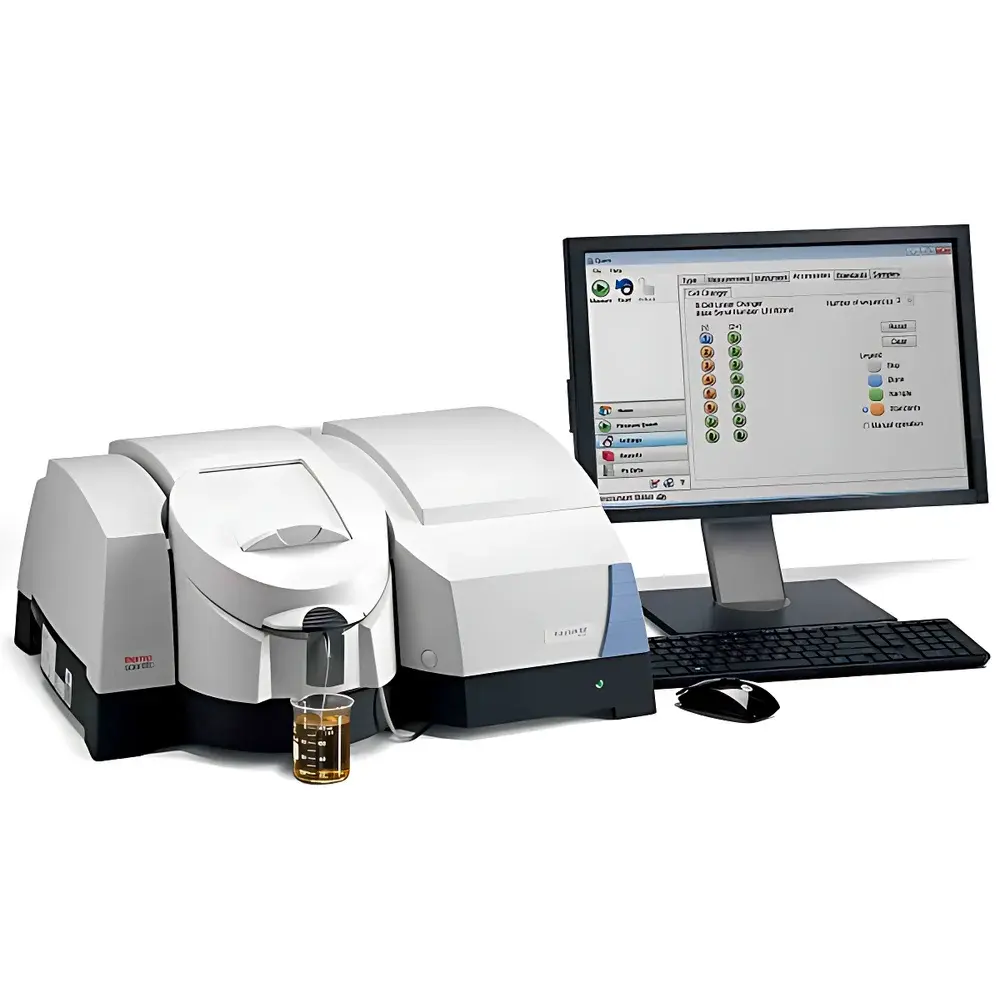
Thermo Scientific Evolution 350 UV-Vis Spectrophotometer
| Brand | Thermo Fisher |
|---|---|
| Origin | USA |
| Distributor Type | Authorized Distributor |
| Origin Category | Imported |
| Model | Evolution 350 |
| Instrument Architecture | Double-Beam |
| Detector Type | Photodiode Array (PDA) |
| Wavelength Range | 190–1100 nm |
| Automation Level | Automatic Wavelength Scanning |
| Spectral Bandwidth | 0.5, 1.0, 1.5, 2.0, 4.0 nm |
| Wavelength Accuracy | ±0.3 nm (190–900 nm) |
| Stray Light | <0.02% T at 220 nm (NaI), <0.02% T at 340 nm (NaNO₂) |
Overview
The Thermo Scientific Evolution 350 UV-Vis Spectrophotometer is a high-performance, double-beam instrument engineered for precision quantitative and qualitative analysis across life sciences, pharmaceutical development, and quality assurance/quality control (QA/QC) laboratories. It operates on the principle of absorption spectroscopy—measuring the attenuation of ultraviolet and visible light as it passes through a sample—to determine analyte concentration, purity, kinetics, and spectral characteristics. Its core optical architecture integrates a xenon flash lamp as the broadband light source, eliminating warm-up delays and enabling immediate measurement readiness. Unlike continuous-deuterium/tungsten systems, the pulsed xenon lamp activates only during data acquisition—significantly extending operational lifetime (guaranteed for 3 years) and reducing total cost of ownership. The instrument’s photodiode array (PDA) detector captures full spectra simultaneously with high signal-to-noise ratio, supporting rapid, reproducible scans across its 190–1100 nm wavelength range.
Key Features
- Double-beam optical design with real-time reference compensation for enhanced baseline stability and long-term measurement repeatability.
- Xenon flash lamp: zero warm-up time, >10⁹ flash cycles lifetime, and uniform spectral output across the entire UV-Vis range—critical for regulatory-compliant assays requiring daily instrument verification.
- Five selectable spectral bandwidths (0.5, 1.0, 1.5, 2.0, 4.0 nm) to optimize resolution vs. signal intensity based on sample matrix and application requirements—e.g., narrow bandwidth for sharp peak resolution in nucleic acid analysis; wider bandwidth for low-absorbance formulations.
- Data acquisition rate up to 50 points per second—enabling kinetic studies, dissolution profiling, and rapid method development workflows.
- Integrated PDA detector with linear dynamic range exceeding 3.5 AU, supporting both high-transmittance and highly absorbing samples without manual gain adjustment.
- Wavelength accuracy certified to ±0.3 nm (190–900 nm), traceable to NIST standards—meeting ASTM E275, ISO 6223, and USP <857> requirements for spectrophotometric system suitability.
Sample Compatibility & Compliance
The Evolution 350 accommodates standard 10 mm pathlength cuvettes (glass, quartz, plastic), microvolume platforms (including 1–2 µL capillary and 2–5 µL pedestal configurations), and automated sampling accessories such as 8- or 16-position autosamplers. All hardware and firmware comply with FDA 21 CFR Part 11 requirements when used with validated VISION or INSIGHT software configurations—including electronic signatures, audit trails, and user-access controls. Built-in performance verification routines support GLP/GMP environments: CVC (Certified Validation Check) accessories enable automated wavelength accuracy, photometric accuracy, and stray light verification per ICH Q2(R2) guidelines. Stray light performance (<0.02% T at 220 nm and 340 nm) ensures reliable quantitation in low-transmittance regions critical for protein A280/A260 ratios and impurity detection.
Software & Data Management
Instrument control and data processing are managed via Thermo Scientific INSIGHT software—a modular, validated platform supporting method creation, calibration curve generation (linear, quadratic, cubic), multi-component analysis, and kinetic modeling. Data export complies with ASTM E1382 and ISO/IEC 17025 reporting formats, including embedded metadata (operator ID, timestamp, instrument serial number, accessory configuration). Raw spectral files (.spc) are compatible with third-party chemometric tools (e.g., MATLAB, Unscrambler) via ASCII or JCAMP-DX interchange. Audit trail functionality logs all parameter changes, file modifications, and user logins—fully compliant with ALCOA+ principles for data integrity in regulated labs.
Applications
- Pharmaceutical QA/QC: Active pharmaceutical ingredient (API) assay, excipient compatibility testing, cleaning validation swab analysis, and dissolution testing per USP <711>.
- Life sciences: DNA/RNA quantification and purity assessment (A260/A280, A260/A230), enzyme kinetics (e.g., LDH, HRP), and cell culture density monitoring.
- Materials science: Thin-film thickness calculation via interference fringe analysis, semiconductor absorbance edge characterization, and nanoparticle plasmon resonance profiling.
- Environmental testing: Nitrate/nitrite quantification in water per EPA Method 353.2, formaldehyde detection in air samples, and COD determination.
- Food & beverage: Colorimetric analysis (e.g., anthocyanin content in juices), preservative concentration (sorbic acid, benzoic acid), and fat oxidation markers (TBARS).
FAQ
What regulatory standards does the Evolution 350 meet for pharmaceutical use?
It supports compliance with USP <857>, ICH Q2(R2), ASTM E275, and FDA 21 CFR Part 11 when deployed with validated software and documented IQ/OQ/PQ protocols.
Can the instrument perform automatic wavelength calibration without external hardware?
Yes—using the optional mercury lamp accessory, the system executes fully automated wavelength accuracy verification at user-defined intervals.
Is the photodiode array detector thermally stabilized?
Yes—the PDA module incorporates active temperature regulation to minimize dark current drift and ensure spectral fidelity across ambient lab conditions (15–30 °C).
How is data integrity maintained during multi-user operation?
INSIGHT software enforces role-based access control, encrypted audit trails with immutable timestamps, and electronic signature workflows aligned with Annex 11 and ALCOA+ principles.
Does the Evolution 350 support GMP-compliant instrument qualification?
Yes—Thermo Fisher provides IQ/OQ documentation templates, performance qualification test scripts, and vendor-supported PQ execution services for global regulatory submissions.
Related Products




