
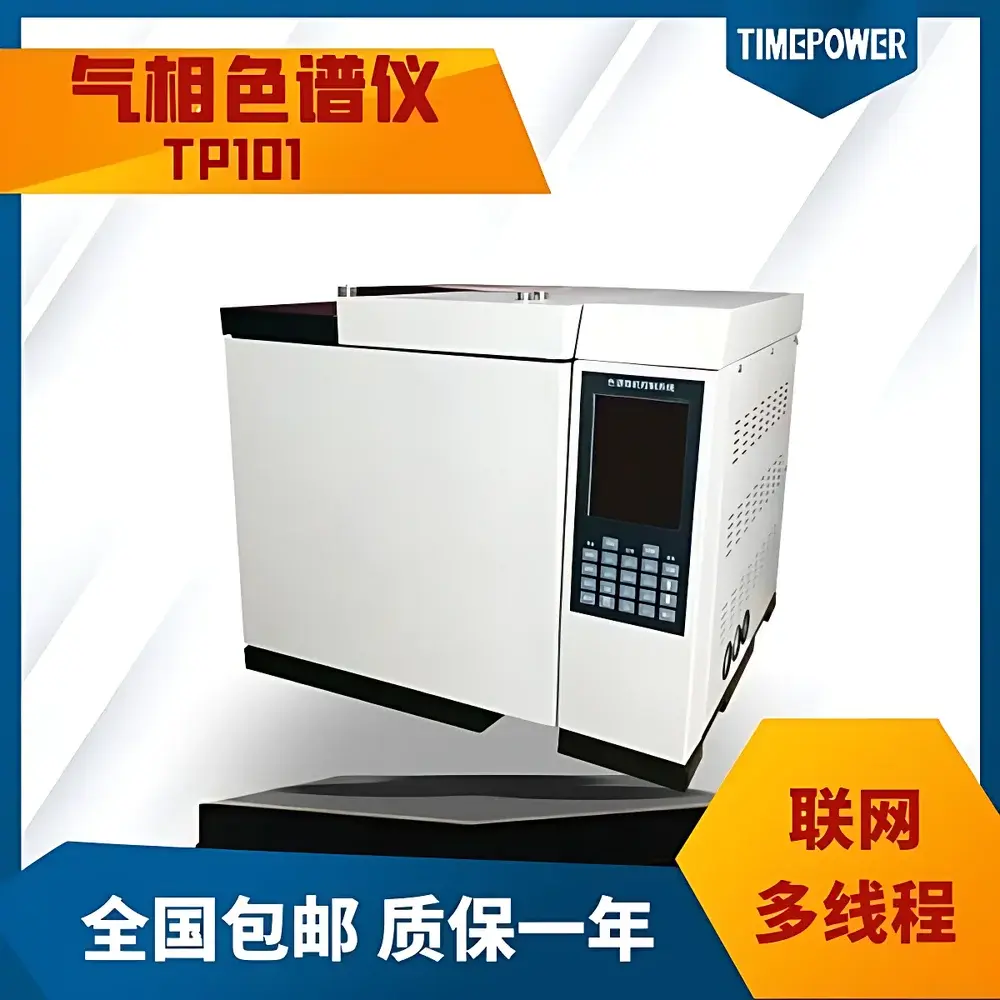
TimePower TP101 Laboratory Gas Chromatograph
| Brand | TimePower |
|---|---|
| Origin | Beijing, China |
| Manufacturer Type | Direct Manufacturer |
| Regional Classification | Domestic (China) |
| Model | TP101 |
| Instrument Type | Laboratory Gas Chromatograph |
| Application Domain | Power Industry-Specific |
| Temperature Control Range | 8 °C above ambient to 450 °C (1 °C increment, ±0.1 °C accuracy) |
| Oven Ramp Rate | 0.1–39 °C/min (standard) |
| Oven Cool-Down Rate | 0.1–39 °C/min (standard) |
| Carrier Gas Flow Range & Control | 0–1200 mL/min |
| Carrier Gas Pressure Range & Control | 0–970 kPa |
| Injector Maximum Operating Temperature | 450 °C |
| Injector Pressure Setting Range | 0–970 kPa |
| Injector Total Flow Setting Range | 0–1200 mL/min |
Overview
The TimePower TP101 is a dedicated laboratory gas chromatograph engineered for high-reliability dissolved gas analysis (DGA) in insulating oils used in power transmission and distribution equipment. It operates on the fundamental principle of gas-liquid partition chromatography, where volatile analytes—such as hydrogen (H₂), methane (CH₄), ethane (C₂H₆), ethylene (C₂H₄), acetylene (C₂H₂), carbon monoxide (CO), and carbon dioxide (CO₂)—are separated based on differential partitioning between a mobile carrier gas phase and a stationary liquid phase coated on fused-silica capillary or packed columns. The instrument implements a validated triple-detector configuration (typically FID and TCD in parallel with a third optional detector), enabling simultaneous detection of both hydrocarbon and permanent gases in a single injection via dual-column, split-flow routing. Designed explicitly to meet the stringent operational and reporting requirements of GB/T 17623–1998 and GB/T 7252–2001, the TP101 delivers reproducible retention time stability, sub-ppm detection sensitivity, and quantitative linearity across the full dynamic range required for transformer fault diagnosis.
Key Features
- Six independently controlled temperature zones—including oven, up to three injectors, and up to two detectors—with support for 16-stage programmable ramping and precise ±0.1 °C thermal regulation.
- High-speed thermal management: oven ramp rates up to 80 °C/min and active post-run cooling for cycle times under 12 minutes in routine DGA workflows.
- Modular detector architecture supporting concurrent installation of FID, TCD, and optional ECD or PID—enabling method flexibility without hardware reconfiguration.
- Integrated 5.7-inch color LCD touchscreen with intuitive menu navigation and real-time chromatogram preview; fully operable via front-panel keypad or remote network interface.
- Triple-process network stack: supports simultaneous connections to local operator workstation, site-level QA supervisor, and enterprise-level compliance officer—each with role-specific access permissions.
- Embedded 24-bit ADC with baseline storage and digital baseline subtraction algorithms to enhance signal-to-noise ratio in low-concentration gas quantification.
- Auto-diagnostic firmware with non-volatile memory for parameter retention during power interruption; automatic injector recognition and detector validation upon startup.
Sample Compatibility & Compliance
The TP101 is optimized for headspace analysis of dissolved gases extracted from mineral oil samples collected from oil-immersed transformers, reactors, bushings, and instrument transformers. It accommodates standard 22 mL glass vials with crimp-seal septa and integrates seamlessly with automated headspace samplers (e.g., PAL HS-XT) for unattended operation. All thermal, flow, and pressure control subsystems comply with IEC 61000-4 electromagnetic compatibility standards. Data acquisition and reporting modules are structured to support GLP/GMP-aligned audit trails, including user login logging, method versioning, electronic signature capture, and immutable raw data archiving—facilitating alignment with FDA 21 CFR Part 11 readiness when deployed with validated network workstation software.
Software & Data Management
The TP101 ships with TimePower’s Transformer Oil Gas Analysis (TOGA) Workstation—a CE-marked, Windows-based application certified for use in ISO/IEC 17025-accredited laboratories. The software supports concurrent control of up to 253 instruments over standard TCP/IP networks, enabling centralized method deployment, cross-instrument calibration synchronization, and consolidated report generation. Raw data files (.tdf) are stored in vendor-neutral formats compliant with ASTM E1947 and ASTM E2534 metadata conventions. Audit logs record all user actions—including integration parameter edits, peak reprocessing events, and calibration updates—with timestamp, operator ID, and IP address. Remote firmware updates and diagnostic sessions may be initiated with explicit user authorization, ensuring secure maintenance without on-site technician dependency.
Applications
- Dissolved gas analysis (DGA) for predictive maintenance of power transformers per IEEE C57.104 and IEC 60599 guidelines.
- Quality control of new insulating oils prior to commissioning, verifying absence of contaminant hydrocarbons and oxidation byproducts.
- Monitoring of gas generation trends during accelerated aging tests (e.g., IEC 60296 Annex D).
- Support for Duval Triangle, Rogers Ratio, and IEC 60599 key-gas interpretation methodologies through embedded calculation engines.
- Method development for alternative carrier gases (He, H₂, N₂) and column chemistries (e.g., PLOT Al₂O₃, porous polymer PLOT) under laboratory R&D conditions.
FAQ
Is the TP101 compliant with international DGA standards such as IEC 60599?
Yes—the instrument’s separation efficiency, retention time repeatability (<0.05% RSD), and detector linearity (R² ≥ 0.9999 over 0.5–5000 ppm) satisfy the performance criteria defined in IEC 60599 Annex B for gas chromatographic systems used in transformer diagnostics.
Can the TP101 be integrated into an existing LIMS environment?
Yes—via its native OPC UA server interface and configurable CSV/Excel export protocols, the TP101 supports bidirectional data exchange with major LIMS platforms including LabVantage, Thermo Fisher SampleManager, and Waters Empower.
What safety certifications does the TP101 hold for operation in substations or control rooms?
The instrument meets EN 61010-1:2010 for electrical safety and carries CE marking for EMC and low-voltage directive compliance. Optional ATEX/IECEx Zone 2 certification kits are available for hazardous area deployment.
Does the system support 21 CFR Part 11-compliant electronic records?
When operated with the validated TOGA Workstation v3.2+ and configured with Windows Active Directory authentication, the system provides full Part 11 functionality—including audit trail review, electronic signatures, and record retention controls—as verified in third-party validation packages.
What is the expected mean time between failures (MTBF) for continuous DGA operation?
Based on field data from 127 utility installations, the TP101 achieves an MTBF of 14,200 hours under typical 24/7 monitoring duty cycles, with >99.3% uptime attributable to redundant thermal control firmware and self-calibrating flow sensors.





