
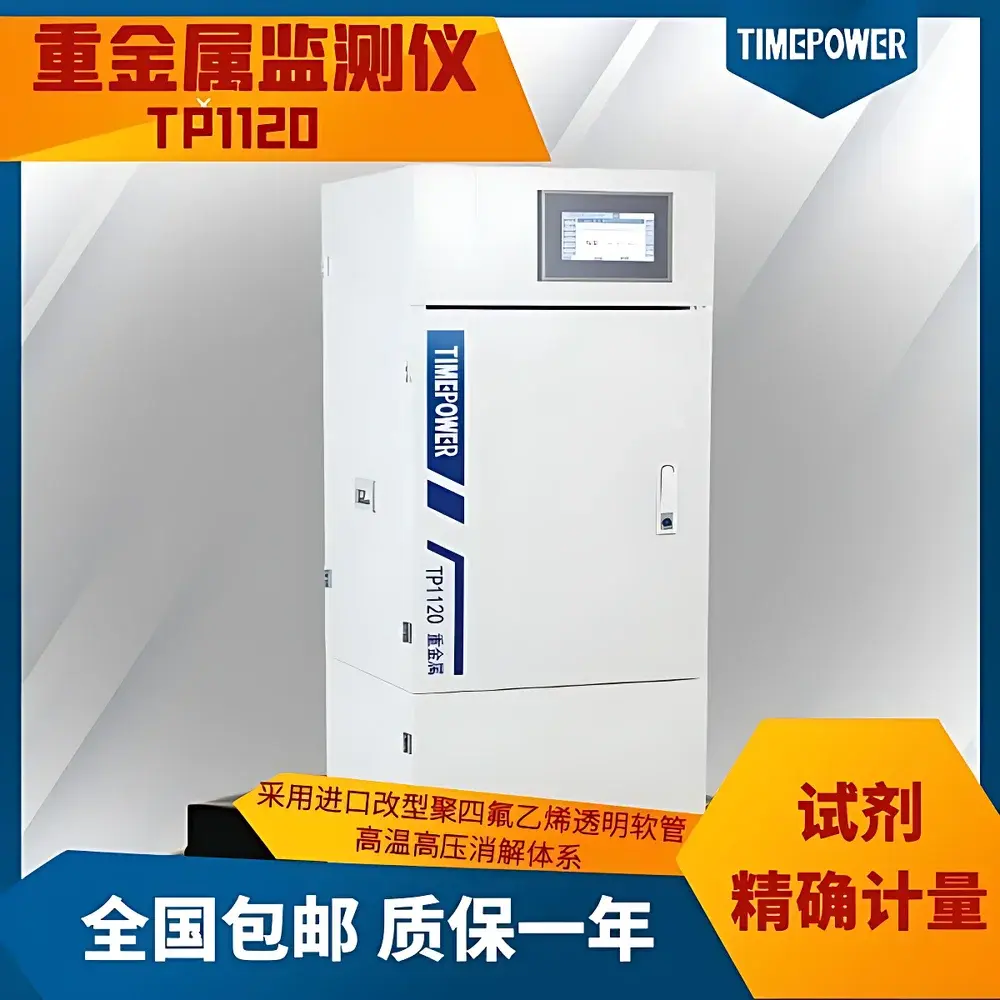
TimePower TP1120 Online Heavy Metals Analyzer
| Brand | TimePower |
|---|---|
| Origin | Beijing, China |
| Manufacturer Type | Original Equipment Manufacturer (OEM) |
| Product Category | Domestic |
| Model | TP1120 |
| Instrument Type | Online Analytical System |
| Detection Principle | Anodic Stripping Voltammetry (ASV) |
| Target Metals | Simultaneous dual- or multi-parameter analysis (Cu, Fe, Ni, Mn, Pb, Cd, As, Zn, Cr, Cr(VI)) |
| Measurement Cycle | ≥30 minutes per cycle |
| Accuracy | ±10% at concentrations ≥0.2 mg/L |
| Resolution | 0.1 mg/L |
| Reagent Consumption | 1 mL per dosing cycle |
| Sample Matrix | Surface water, industrial process water, and wastewater |
Overview
The TimePower TP1120 Online Heavy Metals Analyzer is an automated, laboratory-grade electrochemical instrument engineered for continuous, unattended monitoring of regulated heavy metal species in aqueous environmental and industrial effluent streams. Utilizing anodic stripping voltammetry (ASV)—a highly sensitive, trace-level electroanalytical technique—the system quantifies dissolved and total recoverable forms of copper (Cu), iron (Fe), nickel (Ni), manganese (Mn), lead (Pb), cadmium (Cd), arsenic (As), zinc (Zn), chromium (Cr), and hexavalent chromium (Cr(VI)). ASV enables detection at sub-ppb levels by pre-concentrating target metal ions onto a mercury-film or bismuth-film working electrode under controlled potential, followed by oxidative stripping and current measurement. The TP1120 is designed to operate within fixed-site water quality monitoring stations, municipal wastewater treatment plants, and industrial discharge points where regulatory compliance with national and regional water quality standards (e.g., China’s GB 3838–2002, EU Water Framework Directive Annex X, US EPA Method 7063) requires robust, repeatable, and auditable data.
Key Features
- Modular valve-driven fluidics architecture enabling flexible reagent and sample routing—supports up to 8 independent analytical channels with programmable sequencing.
- Optically calibrated photometric dispensing system replaces conventional peristaltic pump metering, eliminating volumetric drift caused by tubing fatigue and compression hysteresis.
- Air-gap isolation between reagents and peristaltic pump tubing prevents chemical degradation and extends pump life; negative-pressure aspiration ensures consistent draw without backflow risk.
- High-temperature, high-pressure digestion module (up to 120 °C / 0.3 MPa) achieves complete acid digestion of particulate-bound metals, ensuring total recoverable metal determination per ISO 15586 and EPA 200.8 protocols.
- Chemically resistant PTFE-transparent tubing (ID ≥1.5 mm) minimizes clogging from suspended solids commonly found in raw wastewater and surface runoff samples.
- Integrated temperature-controlled cell housing maintains electrochemical stability across ambient fluctuations (10–40 °C operating range).
Sample Compatibility & Compliance
The TP1120 accepts raw, filtered, or pretreated water samples with turbidity ≤100 NTU and total suspended solids (TSS) ≤150 mg/L. It complies with ISO/IEC 17025:2017 requirements for method validation and is configured to support GLP/GMP-aligned audit trails—including operator logins, method version control, calibration history, and raw voltammogram storage. All measurement outputs are timestamped and digitally signed to meet data integrity expectations under China’s HJ 353–2019 standard for online water quality monitoring instrumentation and align with principles referenced in FDA 21 CFR Part 11 for electronic records and signatures.
Software & Data Management
The embedded Linux-based controller runs TimePower’s proprietary Analytical Control Suite (ACS v3.2), offering remote configuration via secure HTTPS web interface or Modbus TCP integration into SCADA/DCS environments. Real-time chromatogram-equivalent voltammograms, calibration curves, QC check results, and maintenance alerts are logged in SQLite databases with automatic daily backup to external USB or network share. ACS supports configurable alarm thresholds (high/low, rate-of-change), automatic recalibration triggers, and export of CSV/Excel reports compliant with national environmental reporting templates.
Applications
- Regulatory compliance monitoring at municipal wastewater discharge outfalls (e.g., Cu, Pb, Cd limits per GB 8978–1996).
- Process water quality assurance in electroplating, battery manufacturing, and metal finishing facilities.
- Early-warning detection of accidental heavy metal spills in riverine and reservoir intake networks.
- Long-term trend analysis for ecological risk assessment in watershed management programs.
- Supporting ISO 14001-certified environmental management systems through automated, traceable metal concentration records.
FAQ
What sample pretreatment is required prior to analysis?
Minimal pretreatment is needed: samples must be homogenized and passed through a 63 µm sieve to remove coarse particulates. Acid preservation (HNO₃ to pH 24 h occurs between sampling and injection.
Can the TP1120 measure hexavalent chromium separately from total chromium?
Yes—via sequential analysis: total Cr is determined after UV digestion; Cr(VI) is measured directly in untreated sample using selective complexation and ASV peak deconvolution.
Is method validation documentation available for regulatory submission?
Yes—TimePower provides a full validation package including precision/recovery studies, LOD/LOQ determination per ISO 11843, and interlaboratory comparison data aligned with CNAS-CL01 requirements.
How often does the mercury-film electrode require replacement?
Under typical operation (one cycle per hour), the electrode sustains >6 months of stable performance; automatic film regeneration occurs during each measurement cycle.
Does the system support remote diagnostics and firmware updates?
Yes—via TLS-secured OTA (over-the-air) update capability and real-time diagnostic telemetry accessible through authorized service portals.
Related Products







