
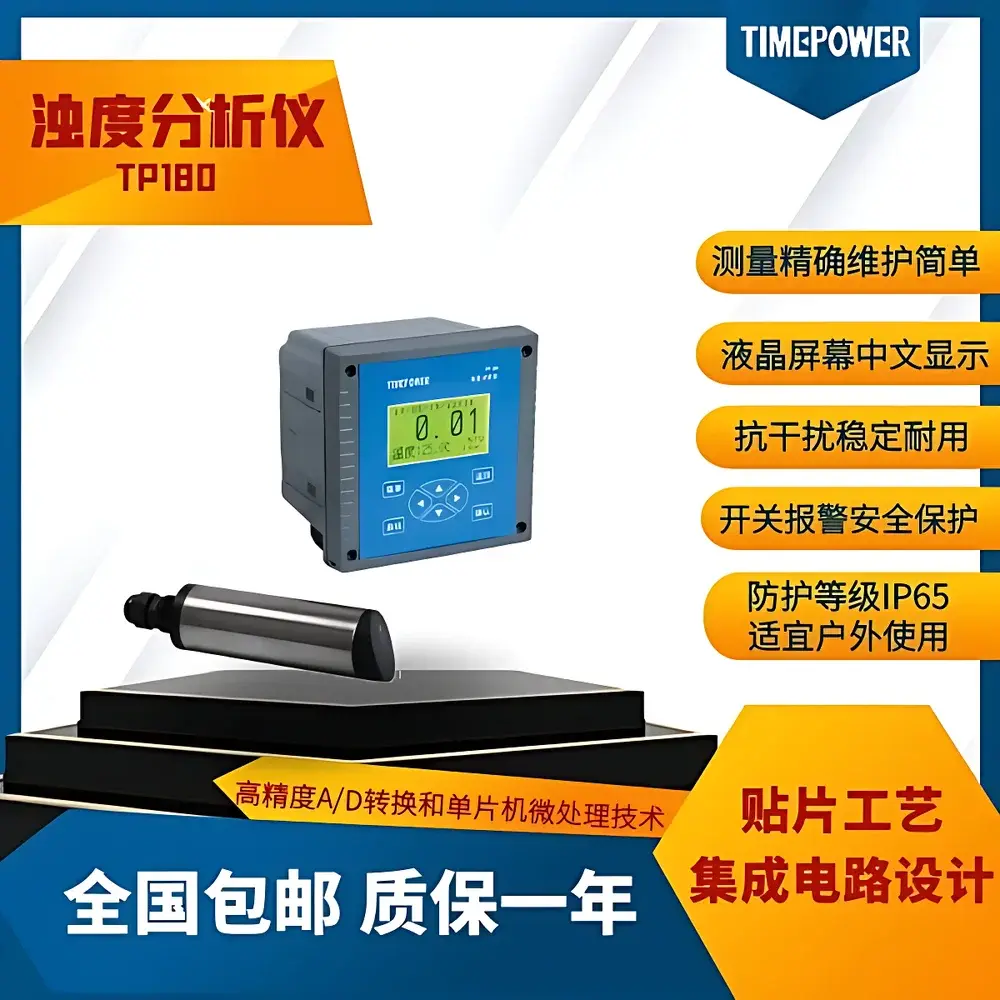
TimePower TP180 Online Turbidimeter
| Brand | TimePower |
|---|---|
| Origin | Beijing, China |
| Manufacturer Type | Direct Manufacturer |
| Regional Classification | Domestic (China) |
| Model | TP180 |
| Product Type | Online Turbidimeter |
| Measurement Range | 20–200 NTU |
| Resolution | 0.1 NTU |
| Operating Ambient Temperature | 0–25 °C |
| Accuracy | ±2 % |
| Display | 128×64 Dot-Matrix LCD (Chinese Interface) |
| Output Signal Options | 4–20 mA / 0–5 V / 0–10 V (configurable) |
| Relay Outputs | 2 programmable alarm relays |
| Enclosure Rating | IP65 |
| Data Storage | Cyclic internal memory with auto-overflow overwrite |
| Signal Processing | High-precision A/D conversion + embedded microcontroller architecture |
| Circuit Design | SMT assembly + galvanically isolated signal conditioning circuits |
| Calibration | Single-point calibration enabled via ratio of scattered-to-transmitted light |
Overview
The TimePower TP180 Online Turbidimeter is an industrial-grade optical instrument engineered for continuous, real-time monitoring of turbidity in liquid process streams and environmental water systems. It operates on the principle of nephelometric measurement—quantifying the intensity of light scattered at 90° relative to the incident beam—while incorporating a proprietary scattered-to-transmitted light ratio algorithm. This dual-signal ratio method compensates for lamp aging, window fouling, and sample color interference, thereby maintaining linearity across its full 20–200 NTU range without requiring multi-point calibration. Designed for unattended operation in fixed installations, the TP180 complies with ISO 7027:2016 (nephelometric method using 860 nm infrared LED source) and meets the optical performance criteria referenced in ASTM D6508 and USP . Its robust mechanical architecture supports long-term deployment in municipal water treatment plants, power generation cooling loops, wastewater effluent channels, and recreational water facilities.
Key Features
- Optical design based on dual-detector ratio metric sensing (90° scatter + forward transmission), minimizing drift from sensor surface contamination or source intensity decay
- Stable infrared LED light source (860 nm) with temperature-compensated drive circuitry to ensure spectral consistency under ambient fluctuations
- IP65-rated NEMA 4X enclosure with stainless-steel wetted parts and quartz optical windows, certified for outdoor and semi-industrial environments
- Embedded microcontroller with high-resolution 24-bit A/D conversion and galvanic isolation between analog input/output and digital logic domains
- Configurable analog output (4–20 mA, 0–5 V, or 0–10 V) compliant with IEC 61000-6-2/6-4 EMC standards for industrial instrumentation
- Two user-programmable SPDT relay outputs with adjustable hysteresis, supporting fail-safe alarm logic for exceedance events
- Cyclic non-volatile memory stores up to 30 days of 1-minute interval turbidity readings; overflow management ensures continuous logging without manual intervention
Sample Compatibility & Compliance
The TP180 is validated for use with low-to-moderate turbidity aqueous matrices including potable water, clarified surface water, filtered process water, and secondary-treated wastewater. It is not intended for highly colored, viscous, or suspended solids-laden samples exceeding 200 NTU without dilution or pre-filtration. The instrument conforms to key regulatory and quality frameworks applicable to water quality instrumentation: it supports audit-ready operation under GLP and GMP environments through deterministic timestamping and immutable data logging; its analog output and relay behavior are traceable per ISO/IEC 17025 requirements for measurement uncertainty estimation; and its firmware architecture permits configuration locking and event logging compatible with FDA 21 CFR Part 11 principles when integrated into validated SCADA or LIMS ecosystems.
Software & Data Management
While the TP180 operates as a standalone sensor with local LCD interface (Chinese-language only), it is designed for seamless integration into centralized monitoring infrastructures. Its analog output interfaces directly with PLCs, DCS systems, or data loggers supporting Modbus RTU over RS-485 (optional module). Internal memory retains time-stamped turbidity values with millisecond-resolution timestamps, accessible via serial command protocol for batch retrieval. No proprietary PC software is required; configuration and calibration parameters are adjusted via front-panel navigation or remote ASCII command set. All stored data retain integrity during power interruption due to EEPROM-backed storage architecture.
Applications
- Municipal drinking water distribution networks—continuous verification of filtration efficiency and coagulation performance
- Swimming pool and spa recirculation systems—automated feedback control of flocculant dosing and filter backwash cycles
- Surface water quality monitoring stations—long-term trend analysis of sediment transport dynamics in rivers and reservoirs
- Thermal power plant condensate and boiler feedwater loops—early detection of heat exchanger tube leakage or resin bed breakthrough
- Tertiary wastewater effluent compliance reporting—verification against discharge limits per local environmental regulations (e.g., EPA NPDES, EU Urban Wastewater Directive)
FAQ
What calibration protocol does the TP180 require?
The TP180 uses a single-point calibration method using a certified 100 NTU formazin standard; the ratio-based optical design eliminates need for multi-point calibration across the range.
Can the TP180 be installed in submerged or pressurized piping?
No—it is rated for insertion-type mounting in open-channel or side-stream bypass configurations; direct submersion or line pressure >1 bar requires optional flow cell adapter with pressure-rated housing.
Is the Chinese-only display a limitation for international deployment?
Yes—the front-panel interface is localized exclusively in Simplified Chinese; all operational configuration and diagnostics must be performed via hardware controls or external system integration.
Does the instrument support digital communication protocols out of the box?
Standard configuration includes analog output and relay contacts only; RS-485 Modbus RTU support requires optional communication module installation.
How is sensor fouling mitigated during extended operation?
The ratio metric measurement technique inherently corrects for gradual optical window soiling; however, scheduled mechanical cleaning or air-pulse purging is recommended every 7–30 days depending on suspended solids concentration.



