
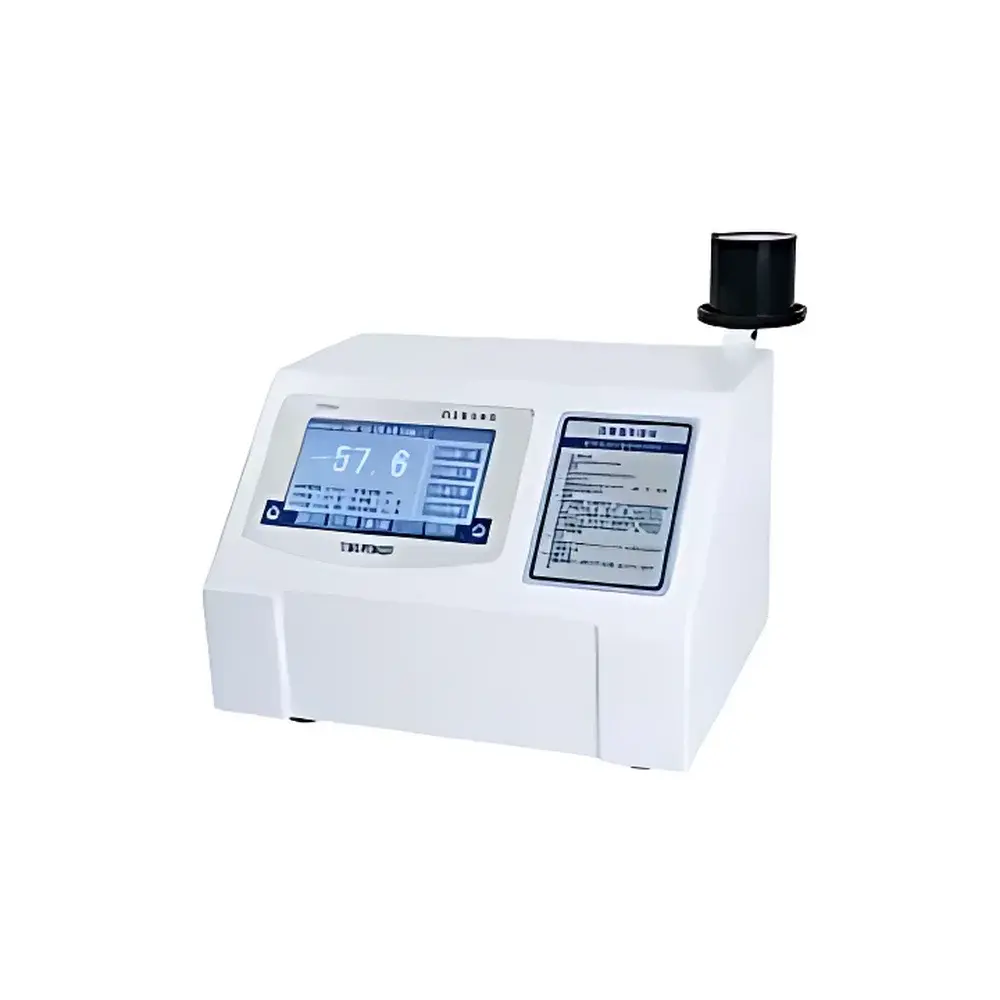
Timepower TP304 Iron Content Analyzer for Water Quality Testing
| Brand | Timepower |
|---|---|
| Model | TP304 |
| Origin | Beijing, China |
| Manufacturer | Timepower (Domestic Producer) |
| Instrument Type | Laboratory Water Quality Analyzer |
| Measured Parameter | Dissolved Iron (Fe²⁺/Fe³⁺) |
| Measurement Principle | Photometric Colorimetry (1,10-Phenanthroline Method) |
| Display | 5.0-inch Touchscreen Color LCD (Chinese Interface) |
| Measurement Range | 0.00–200.0 μg/L |
| Accuracy | ±3% of Full Scale |
| Resolution | 0.1 μg/L |
| Repeatability | ≤1% RSD |
| Stability | ±1.5% F.S./4 h |
| Light Source | Imported Monochromatic Cold LED |
| Power Supply | AC 85–265 V, 45–65 Hz |
| Power Consumption | ≤30 W |
| Operating Temperature | 5–45 °C |
| Operating Humidity | ≤90% RH (non-condensing) |
| Dimensions | 260 × 200 × 180 mm |
| Weight | 3.2 kg |
| Data Storage | Cyclic memory for up to 256 test records |
| Calibration | Automatic blank calibration |
| Compliance Standard | Based on Chinese National Standard GB/T 5750.6–2023 (Standard Methods for Examination of Drinking Water – Metals Section), aligned with ISO 8573-1 and ASTM D1068 for iron quantification in low-conductivity water matrices |
Overview
The Timepower TP304 Iron Content Analyzer is a dedicated laboratory-grade photometric instrument engineered for precise, trace-level quantification of total dissolved iron (Fe²⁺ and Fe³⁺) in ultra-pure and low-conductivity water samples. It operates on the fundamental principle of photometric colorimetry, specifically implementing the standardized 1,10-phenanthroline (o-phenanthroline) method—recognized in GB/T 5750.6–2023 and referenced in ASTM D1068 and ISO 8573-1 for iron analysis in boiler feedwater, condensate, turbine steam, generator internal cooling water, and natural surface waters. The analyzer employs a stable, temperature-insensitive monochromatic cold LED light source (center wavelength optimized for the Fe²⁺–phenanthroline complex at ~510 nm), eliminating thermal drift and ensuring long-term signal integrity. Its optical path design follows strict Beer–Lambert law compliance: absorbance (A) is linearly proportional to analyte concentration when path length and incident intensity remain constant. This enables reliable quantitation across the full 0.00–200.0 μg/L range with demonstrated repeatability ≤1% RSD and stability within ±1.5% F.S. over 4 hours—critical for high-integrity power plant chemistry monitoring and GLP-compliant environmental laboratories.
Key Features
- 5.0-inch capacitive touchscreen LCD with intuitive Chinese-language interface—designed for rapid operator onboarding and error-resistant workflow execution.
- High-integration circuit architecture based on industrial-grade microcontroller unit (MCU) technology—optimized for low power consumption (<30 W), electromagnetic compatibility (EMC), and continuous operation in ambient lab environments (5–45 °C).
- Imported monochromatic cold LED light source—provides consistent spectral output, eliminates warm-up delay, and achieves >10,000-hour operational lifetime without intensity decay or wavelength shift.
- Automated timing control for color development reaction—ensures standardized incubation duration per measurement cycle, minimizing inter-operator variability.
- Onboard blank calibration function—compensates for zero-point drift induced by cuvette imperfections, reagent background, and electronic baseline offset, improving absolute accuracy.
- Cyclic data storage for up to 256 measurement records—with automatic overwrite logic upon buffer saturation and timestamped retrieval capability for audit-ready documentation.
- Robust mechanical housing (260 × 200 × 180 mm, 3.2 kg) featuring EMI-shielded enclosure and conformal-coated PCBs—suitable for deployment in industrial labs and mobile field testing units.
Sample Compatibility & Compliance
The TP304 is validated for use with deionized water, mixed-bed demineralized water, and low-TDS natural waters where iron exists predominantly as soluble Fe²⁺ or Fe³⁺ species. Sample introduction requires filtration through 0.45 µm membrane prior to analysis to eliminate particulate interference. The instrument adheres to the national standard methodology GB/T 5750.6–2023, which specifies the o-phenanthroline spectrophotometric procedure—including mandatory use of high-purity reagents (≥analytical grade), Class I or II reagent water (per GB/T 6682), and polyethylene storage containers to prevent leaching or adsorption. While not FDA 21 CFR Part 11-certified out-of-the-box, its data logging architecture supports manual export to CSV files compatible with LIMS integration and satisfies basic GLP documentation requirements for calibration frequency (daily blank, biweekly calibration curve), reagent traceability, and environmental condition logging.
Software & Data Management
The embedded firmware provides local data management without external PC dependency. Each stored record includes date/time stamp, measured concentration (μg/L), operator ID field (manually entered), and calibration status flag. Data export is performed via USB port to standard FAT32-formatted flash drives. No proprietary software installation is required—raw CSV files are readable in Excel, MATLAB, or statistical process control (SPC) platforms. Audit trails are maintained implicitly through sequential record numbering and time-stamped calibration logs. For regulated environments, users may supplement with external electronic lab notebooks (ELN) or LIMS systems that ingest exported datasets alongside metadata (e.g., reagent lot numbers, analyst initials, ambient temperature/humidity).
Applications
- Power generation: Monitoring iron ingress in boiler feedwater, condensate polishing loops, and hydrogen-cooled generator stator cooling water per EPRI guidelines and IAPWS RP-12.
- Pharmaceutical water systems: Supporting USP purified water and water for injection (WFI) quality assurance where iron catalyzes oxidative degradation of APIs.
- Environmental compliance labs: Quantifying iron in surface water, groundwater, and wastewater effluents under China’s HJ 485–2009 and EPA Method 3500-Fe B equivalence.
- Research institutions: Supporting corrosion studies, geochemical speciation modeling, and catalyst leaching experiments requiring sub-ppb sensitivity and method transparency.
- Industrial boiler maintenance: Early detection of economizer or superheater tube corrosion via trending of dissolved iron spikes in return condensate.
FAQ
What water purity is required for accurate measurements?
Reagent water must meet GB/T 6682–2008 Grade II specifications (resistivity ≥1 MΩ·cm at 25 °C); ideally generated by a mixed-bed ion exchange system. Tap water or distilled water is unsuitable due to inherent iron contamination.
How often must calibration be performed?
A blank calibration is required before each analytical session. A full multi-point calibration curve using certified iron standards (e.g., 10, 50, 100 μg/L) is recommended every 14 days—or immediately after reagent batch change, lamp replacement, or instrument relocation.
Can the TP304 measure particulate iron?
No. The method quantifies only dissolved (filterable) iron species. Total iron determination requires acid digestion (e.g., HNO₃/HF microwave-assisted) prior to analysis—a separate sample preparation step not supported by the instrument’s hardware.
Is the instrument compatible with international regulatory reporting?
Yes—when used with documented SOPs, traceable standards (CRM), and controlled environmental logs, data meets minimum requirements for ISO/IEC 17025 accredited testing and provincial environmental monitoring reporting in China. Exported CSV files support third-party validation workflows.
What maintenance is required beyond calibration?
Routine cleaning of the sample cell compartment and optical window with lint-free tissue and isopropanol; annual verification of LED intensity and photodiode linearity using factory reference filters (available as optional service kit).
Related Products







