
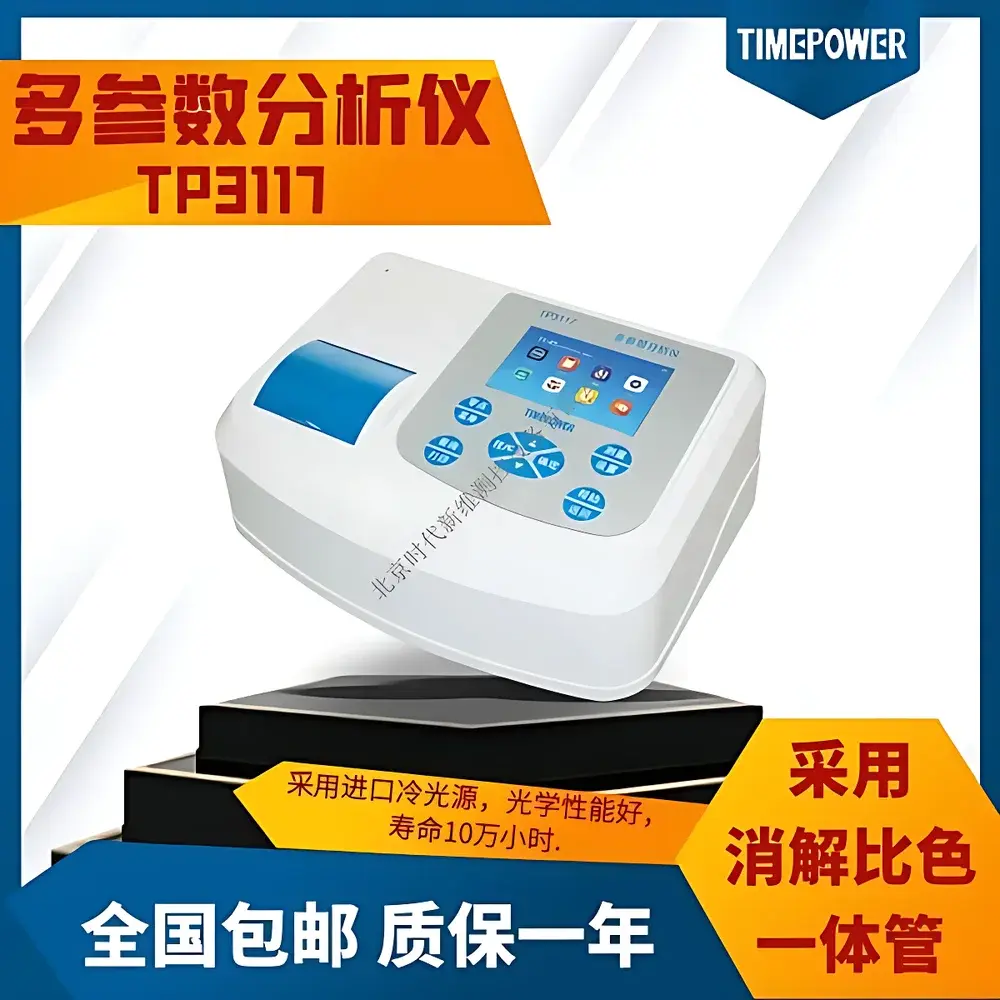
Timepower TP3117 Benchtop Multi-Parameter Water Quality Analyzer
| Brand | Timepower |
|---|---|
| Origin | Beijing, China |
| Manufacturer Type | OEM Manufacturer |
| Country of Origin | China |
| Model | TP3117 |
| Instrument Type | Laboratory Water Quality Analyzer |
| Measurable Parameters | Conductivity, Total Cyanide, COD, Ammonia Nitrogen, Total Phosphorus, Total Nitrogen, Turbidity, Suspended Solids (SS) |
| Display | Backlit LCD |
| Light Source | Imported Cold Light LED (Lifespan ≥ 100,000 h) |
| Measurement Modes | Standard Mode / Continuous Mode |
| Digestion-Cuvette Integration | Yes |
| Data Storage | Up to 30,000 records |
| Built-in Thermal Printer | Yes |
| Calibration Curves | 1 Preloaded Standard Curve Library + 96 User-Defined Curves |
| Connectivity | RJ45 Ethernet Port, USB 2.0 |
| Power Supply | AC 220 V ± 10%, 50 Hz |
| Dimensions | 350 × 280 × 180 mm |
| Weight | 5.2 kg |
Overview
The Timepower TP3117 Benchtop Multi-Parameter Water Quality Analyzer is a dedicated laboratory instrument engineered for simultaneous quantitative analysis of multiple physicochemical and contaminant parameters in aqueous samples. It operates on standardized wet-chemical methodologies—including colorimetric determination (e.g., for ammonia nitrogen, total phosphorus, and total cyanide), electrochemical sensing (conductivity), optical turbidimetry (turbidity), and gravimetric/spectrophotometric estimation (suspended solids). The system integrates digestion and measurement into a single disposable cuvette format, minimizing cross-contamination risk and operator exposure while maintaining analytical traceability per ISO 7027 (turbidity), ISO 15705 (COD), and EPA Method 335.4 (cyanide). Designed for routine compliance testing and process monitoring, the TP3117 meets functional requirements for laboratories operating under GLP, ISO/IEC 17025, and municipal wastewater discharge regulatory frameworks.
Key Features
- Benchtop modular architecture with robust ABS housing and ESD-protected electronics for stable operation in shared lab environments.
- High-stability cold-light LED source with spectral output optimized for common water quality chromogenic reagents (420–620 nm), ensuring repeatability ≤ ±2% RSD across 10,000+ measurements.
- Dual-mode operation: Standard mode delivers calibrated endpoint readings per ASTM D1253 (turbidity) and ISO 6060 (COD); Continuous mode enables real-time trend logging at user-selectable intervals (1–60 s).
- Integrated thermal printer supporting direct hardcopy output of current results, calibration logs, and audit-ready reports with timestamp, operator ID, and sample ID fields.
- Non-volatile flash memory retaining up to 30,000 data points with full metadata (date/time, method ID, curve ID, raw absorbance, calculated concentration), retained during power loss per IEC 60068-2-27 shock testing.
- Preloaded reference curves compliant with Chinese HJ Standards (e.g., HJ 535–2009 for ammonia nitrogen) and customizable curve sets supporting polynomial, linear, and logarithmic regression models.
Sample Compatibility & Compliance
The TP3117 accepts liquid samples within pH 2–12 and temperature range 5–40 °C. It supports standard 16-mm round glass or plastic digestion cuvettes (10–50 mL volume) and accommodates pretreated wastewater matrices including activated sludge effluent, pharmaceutical process streams, hospital discharge, and food processing rinse water. All analytical protocols align with national environmental monitoring standards (HJ series), ISO 5667-3 (sampling preservation), and US EPA-approved methods where applicable. Instrument firmware includes configurable QC checkpoints—blank verification, spike recovery validation (5–10% tolerance), and drift monitoring—to support internal QA/QC programs required under ISO 17025 Clause 7.7.
Software & Data Management
Data export is supported via USB mass storage mode (CSV/Excel-compatible format) or Ethernet TCP/IP communication using Modbus RTU protocol for integration into LIMS or SCADA systems. PC software (Windows 10/11 compatible) provides batch report generation, curve management, and electronic signature-enabled audit trails meeting FDA 21 CFR Part 11 requirements for electronic records. All stored measurements include immutable timestamps, method version identifiers, and operator-assigned sample tags. Firmware updates are delivered via signed .bin files with SHA-256 checksum verification to ensure integrity.
Applications
- Regulatory compliance testing for municipal and industrial wastewater dischargers subject to local environmental protection bureau (EPB) reporting mandates.
- Process control in biological treatment units (e.g., A/O, MBR) where rapid NH₃-N and COD feedback informs aeration and dosing adjustments.
- Pharmaceutical facility environmental monitoring programs requiring trace cyanide detection in alkaline hydrolysis effluents.
- Academic research on nutrient dynamics in synthetic wastewater matrices, supported by programmable multi-point calibration and custom curve development.
- Emergency response screening during chemical spill incidents, leveraging onboard battery-free operation and field-deployable reagent kits.
FAQ
Does the TP3117 comply with ISO/IEC 17025 documentation requirements for accredited labs?
Yes—the instrument maintains full traceability through embedded calibration logs, user-defined curve revision history, and time-stamped measurement records with operator authentication fields.
Can third-party reagents be used without compromising accuracy?
Only reagents validated against HJ or ISO reference methods are recommended; unqualified reagents may invalidate curve linearity and introduce bias exceeding ±5% relative error.
Is remote firmware update possible over Ethernet?
Firmware updates require local USB connection and authenticated administrator credentials; network-based updates are disabled by default for security and regulatory alignment.
What is the maximum allowable chloride interference for total cyanide measurement?
Interference is mitigated via EDTA masking and distillation pre-treatment per HJ 484–2009; chloride concentrations ≤ 1,000 mg/L do not affect recovery within ±3% of certified reference material values.
How often must the optical path be cleaned or recalibrated?
Optical alignment is factory-set and non-user-serviceable; annual verification using NIST-traceable turbidity standards (Formazin or AMCO AEPA) is advised per ISO 8754 maintenance guidelines.







