
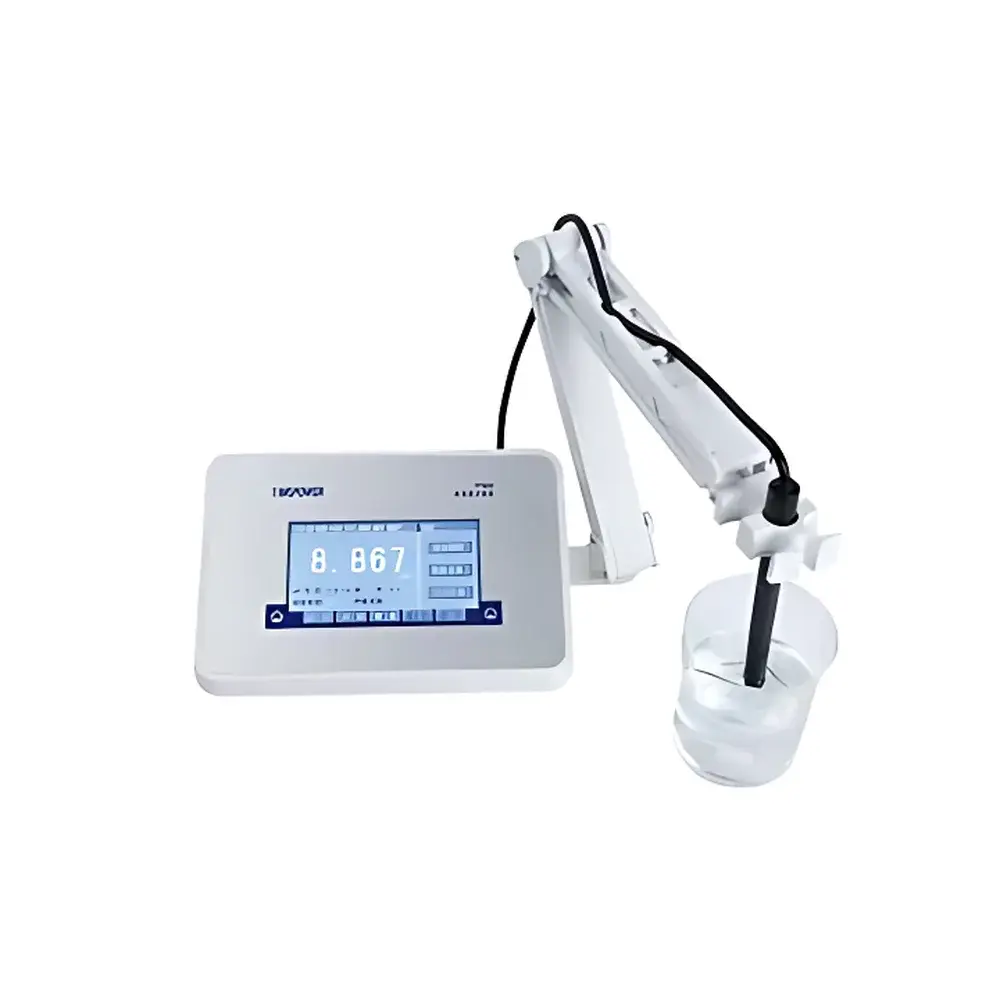
Timepower TP320 Desktop Precision Conductivity Analyzer for Power Plant Applications
| Brand | Timepower |
|---|---|
| Origin | Beijing, China |
| Manufacturer Type | Direct Manufacturer |
| Product Category | Domestic |
| Model | TP320 |
| Detection Parameter | Single-parameter (Conductivity) |
| Form Factor | Benchtop |
| Conductivity Range | K=0.01 cm⁻¹: 0.000–3.000 µS/cm and 0.00–30.00 µS/cm |
| K=0.10 cm⁻¹ | 0.00–30.00 µS/cm and 0.0–300.0 µS/cm |
| K=1.00 cm⁻¹ | 0.0–300.0 µS/cm and 0–3000 µS/cm |
| K=10.0 cm⁻¹ | 0–3000 µS/cm and 0–30,000 µS/cm |
| TDS Range | 0–100 g/L |
| Resistivity Range | Same as conductivity ranges per cell constant |
| Salinity Range | 0–100 ppt |
| Temperature Range | 0–60 °C |
| Accuracy | ±2.5% of Full Scale |
| Minimum Resolution | 0.001 µS/cm |
Overview
The Timepower TP320 Desktop Precision Conductivity Analyzer is an industrial-grade benchtop instrument engineered for continuous, high-stability conductivity monitoring in critical water quality control environments—particularly thermal power plants, chemical fertilizer facilities, metallurgical process streams, municipal water treatment systems, pharmaceutical clean utilities, and biotechnology purified water loops. It operates on the fundamental principle of two-electrode conductometric measurement: a known AC excitation voltage (1–3 kHz sinusoidal waveform) is applied across a pair of parallel or cylindrical electrodes with fixed geometric spacing (cell constant K), and the resulting current is measured to compute solution conductivity (σ = G × K, where G is conductance). The instrument integrates temperature compensation using a Pt1000 sensor and supports automatic range switching across four standardized cell constants (K = 0.01, 0.10, 1.00, and 10.0 cm⁻¹), enabling trace-level detection in ultrapure water (<1 µS/cm) and robust high-range operation up to 30,000 µS/cm.
Key Features
- Benchtop form factor with compact footprint (200 × 200 × 85 mm) and low power consumption (≤5 W), suitable for permanent installation in control rooms or QC laboratories.
- High-resolution 5.0-inch color touchscreen display with intuitive Chinese-language menu navigation—designed for rapid operator training and minimal error risk in shift-based plant operations.
- Multi-parameter real-time display: simultaneous readout of conductivity (µS/cm), temperature (°C), system status, and timestamp—all visible on a single screen.
- Automatic temperature compensation (ATC) across 0–60 °C using integrated Pt1000 sensor; user-selectable compensation algorithms (linear, non-linear, or disabled) compliant with ASTM D1125 and ISO 7888 standards.
- Four interchangeable conductivity cells supported (K = 0.01, 0.10, 1.00, 10.0 cm⁻¹), each optimized for specific conductivity regimes—enabling accurate measurement from ultrapure boiler feedwater to high-salinity cooling tower blowdown.
- Embedded microcontroller architecture with high-precision 24-bit ADC ensures stable baseline performance and repeatability ≤1% F.S., even under fluctuating ambient conditions (5–45 °C operating temperature, ≤90% RH non-condensing).
- Non-volatile memory with >10-year data retention after power loss; circular storage buffer logs time-stamped measurements with auto-overflow management.
Sample Compatibility & Compliance
The TP320 is validated for use with aqueous solutions across diverse industrial matrices—including deionized water, condensate, boiler feedwater, turbine lube oil rinse water, flue gas desulfurization (FGD) scrubber liquor, and wastewater effluents. Its electrode selection protocol aligns with IEC 60746-3 and USP guidance: K = 0.01 cm⁻¹ electrodes are recommended for ultrapure water (≤1 µS/cm); K = 0.10 cm⁻¹ for high-purity steam cycle condensate (1–100 µS/cm); K = 1.00/10.0 cm⁻¹ platinum black electrodes for conductive media (>100 µS/cm), minimizing polarization effects. The analyzer meets electromagnetic compatibility requirements per EN 61326-1 and is designed for deployment in Class 1 Div 2 hazardous locations when paired with appropriate enclosures. While not intrinsically safe certified, its low-power design and sealed housing support safe operation in controlled utility environments.
Software & Data Management
The TP320 operates autonomously without external software dependencies. All configuration, calibration, and data review occur via the onboard touchscreen interface. Calibration routines support one-point or two-point standardization using NIST-traceable KCl reference solutions (e.g., 1413 µS/cm at 25 °C). Audit trail functionality records calibration events—including date/time, operator ID (manual entry), standard used, and deviation from expected value—supporting GLP/GMP documentation requirements. Data export is enabled via optional RS-232 or USB-C interface (firmware v2.1+), allowing integration into SCADA or LIMS platforms. Raw measurement logs comply with FDA 21 CFR Part 11 principles when deployed with time-stamped, user-authenticated access controls and electronic signature capability (via external authentication middleware).
Applications
- Real-time monitoring of condensate polisher effluent conductivity to detect condenser tube leakage in fossil-fueled and nuclear power stations.
- Boiler feedwater purity verification prior to high-pressure drum injection, ensuring compliance with ASME PTC 19.11 and EPRI guidelines.
- Continuous tracking of demineralizer resin exhaustion through rising conductivity trends in service and rinse cycles.
- Quality assurance of purified water (PW) and water for injection (WFI) in pharmaceutical manufacturing per EU GMP Annex 1 and USP .
- Process control of electrolyte concentration in electroplating baths, acid pickling lines, and desalination pre-treatment systems.
- Environmental compliance reporting for wastewater discharge permits (e.g., EPA NPDES) requiring TDS and salinity-derived conductivity correlation.
FAQ
What cell constant should I select for ultrapure water measurement?
For conductivity below 1 µS/cm—such as nuclear-grade reactor makeup water or semiconductor rinse water—use the K = 0.01 cm⁻¹ electrode with a sealed flow-through cell to minimize CO₂ absorption and surface contamination errors.
Does the TP320 support automatic temperature compensation for non-aqueous solvents?
No. ATC algorithms are calibrated exclusively for aqueous systems per ISO 7888. For organic solvents or mixed-phase samples, manual temperature correction or external reference tables must be applied.
Can the instrument store calibration history for regulatory audits?
Yes. Each calibration event is timestamped and logged with operator input, standard value, measured value, and % deviation—retained indefinitely in non-volatile memory.
Is the TP320 compatible with Modbus RTU for PLC integration?
Not natively. RS-232 output supports ASCII protocol only; Modbus integration requires an external protocol converter or OEM firmware customization.
What is the recommended recalibration frequency under continuous operation?
Per ASTM D1125, daily verification with a check standard is advised for critical power plant applications; full two-point calibration every 7–14 days depending on sample fouling potential and regulatory requirements.





