
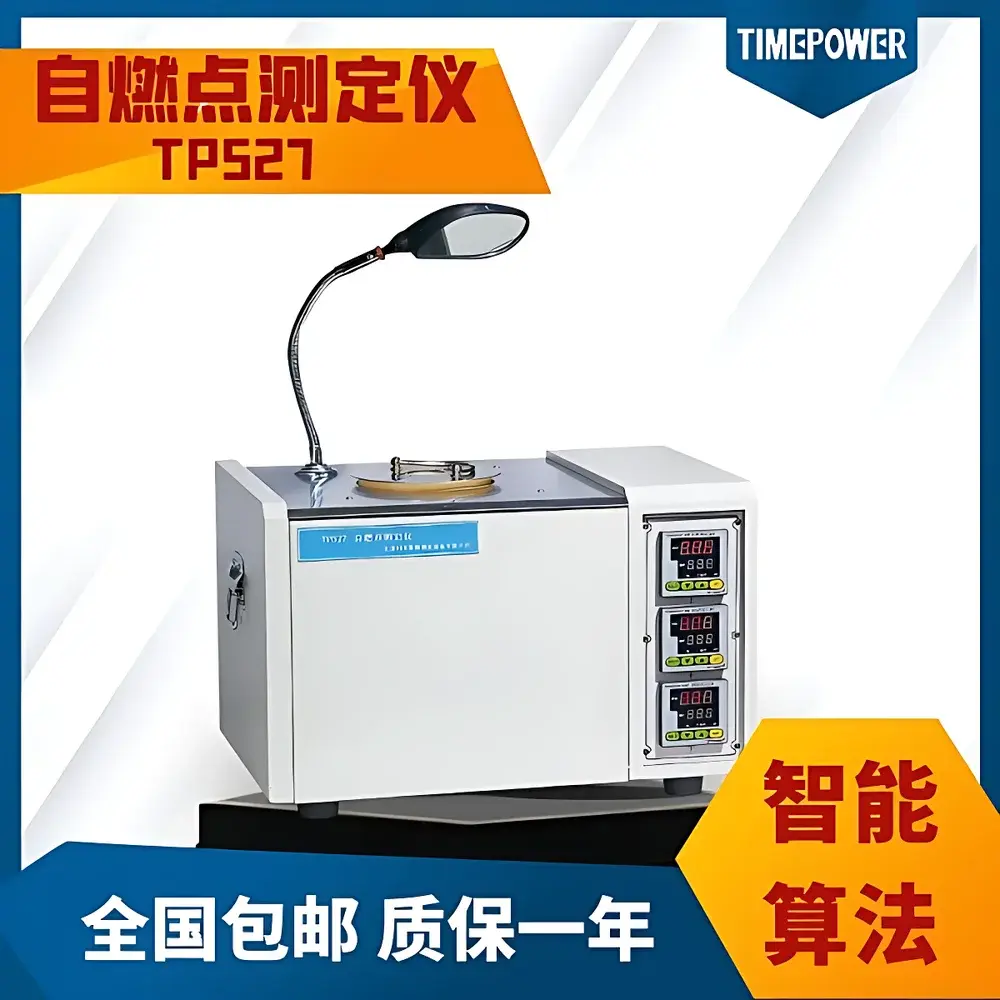
TimePower TP527 Automatic Autoignition Temperature Analyzer
| Brand | TimePower |
|---|---|
| Model | TP527 |
| Origin | Beijing, China |
| Manufacturer Type | Direct Manufacturer |
| Detection Method | Closed-Cup Method |
| Operation Mode | Fully Automatic |
| Applicable Standards | DL/T 706, SH/T 0642, DIN 51794 |
| Repeatability | ≤4 °C |
| Ignition Control | AI-Driven Temperature Regulation Algorithm |
| Temperature Range | 79–400 °C (primary test range), ambient to 400 °C (full heating capability), –25 °C to 200 °C (optional low-temperature configuration) |
| Temperature Uniformity | ≤1 °C across top/middle/bottom of test flask |
| Sensor Type | K-type Thermocouple |
| Display | LED Digital Interface |
| Heating System | Dual Independent Heaters (Primary + Auxiliary) with Auto-Switching Logic |
| Observation | Multi-Axis Adjustable Mirror for Real-Time Flame Detection |
Overview
The TimePower TP527 Automatic Autoignition Temperature Analyzer is a precision-engineered instrument designed for the standardized determination of autoignition temperature (AIT) under controlled closed-cup conditions. It operates on the fundamental principle of thermal stability assessment: a sample is heated incrementally in a sealed, inert-atmosphere flask until spontaneous ignition occurs without external flame or spark initiation. The measured AIT serves as a critical safety parameter for high-temperature industrial fluids—particularly in power generation, petrochemical processing, and thermal energy systems—where inadvertent ignition poses severe operational and regulatory risks. Compliant with DL/T 706 (China’s standard for phosphate ester anti-wear hydraulic oil used in turbine control systems) and SH/T 0642 (Chinese standard for autoignition temperature of petroleum products), the TP527 also aligns with the internationally referenced DIN 51794 methodology. Its design reflects rigorous adherence to thermodynamic equilibrium requirements, ensuring that temperature gradients within the test vessel remain within ±1 °C across vertical measurement zones—a prerequisite for reproducible AIT reporting per ASTM E659 and ISO 25331 harmonized practices.
Key Features
- Fully automated closed-cup testing sequence, eliminating manual intervention during heating, ignition detection, and data capture.
- Dual-zone heating architecture with primary and auxiliary heaters governed by an AI-driven adaptive temperature regulation algorithm—enabling precise ramp control, overshoot suppression, and stable plateau maintenance at target temperatures.
- K-type thermocouple array with three spatially distributed probes (top, middle, bottom of test flask) continuously monitored to verify thermal homogeneity (≤1 °C deviation) prior to and during ignition event detection.
- Multi-axis adjustable optical mirror system enabling unobstructed real-time visual observation of flame onset from multiple angles—critical for operator verification and method validation under GLP-compliant workflows.
- LED digital interface with intuitive menu navigation, real-time temperature logging, and pass/fail status indicators aligned with DL/T 706 pass criteria.
- Robust stainless-steel test chamber with integrated inert gas purge port (N₂-compatible) to maintain oxygen-controlled environment during analysis—essential for mitigating oxidative interference in high-temperature fluid testing.
Sample Compatibility & Compliance
The TP527 is validated for use with phosphate ester-based anti-wear turbine control oils (e.g., Fyrquel, Skydrol), synthetic heat transfer fluids (e.g., Dowtherm J, Therminol VP-1), organic thermal carriers, and other non-volatile, thermally stable liquids requiring AIT certification per utility and insurance mandates. It supports routine compliance verification for ISO 5660-1 fire reaction testing prerequisites and meets the physical test apparatus requirements outlined in IEC 60896-21 for power plant auxiliary system fluid qualification. All hardware and firmware configurations are documented per internal design history file (DHF) protocols, supporting audit readiness for GMP-aligned quality assurance departments and third-party certification bodies.
Software & Data Management
While the TP527 operates as a standalone benchtop analyzer with embedded firmware, its data output conforms to ASCII-delimited text format via RS-232 serial interface—enabling seamless integration into LIMS environments (e.g., LabWare, Thermo Fisher SampleManager) or custom SCADA platforms. Each test record includes timestamp, setpoint ramp rate, actual temperature profile (1 Hz sampling), detected ignition temperature, and operator ID field. Audit trail functionality—though not natively graphical—is supported through external logging servers configured to meet FDA 21 CFR Part 11 requirements when paired with validated electronic signature modules.
Applications
- Autoignition screening of phosphate ester anti-wear hydraulic oils in steam turbine governor systems per DL/T 706.
- Thermal safety evaluation of organic heat transfer fluids prior to commissioning in solar thermal plants or chemical process heaters.
- Periodic AIT verification for aging lubricants in combined-cycle gas turbines where thermal degradation may elevate ignition risk.
- Research-grade characterization of novel bio-based thermal fluids under accelerated aging protocols.
- Supporting hazard classification under UN GHS and CLP Regulation Annex VI for transport and storage documentation.
FAQ
What standards does the TP527 explicitly support?
DL/T 706, SH/T 0642, and DIN 51794. It is not configured for open-cup methods (e.g., ASTM D92) or Cleveland Open Cup (COC) testing.
Is the instrument suitable for volatile solvents like gasoline or acetone?
No. The TP527 is engineered exclusively for high-boiling-point, low-volatility fluids with initial boiling points >250 °C. Volatile samples require alternative flash point analyzers per ASTM D56 or D93.
Can test data be exported to Excel or CSV formats?
Yes—via RS-232 serial output using standard terminal emulation software or custom Python/Node-RED parsers configured for comma- or tab-separated values.
Does the system include calibration traceability documentation?
Each unit ships with a factory calibration certificate referencing NIST-traceable K-type thermocouple standards, valid for 12 months under normal operating conditions.
What maintenance intervals are recommended?
Optical mirror cleaning after every 50 tests; thermocouple verification annually or after impact events; heater performance validation semiannually using certified reference oil (e.g., NIST SRM 2723).
Related Products






