
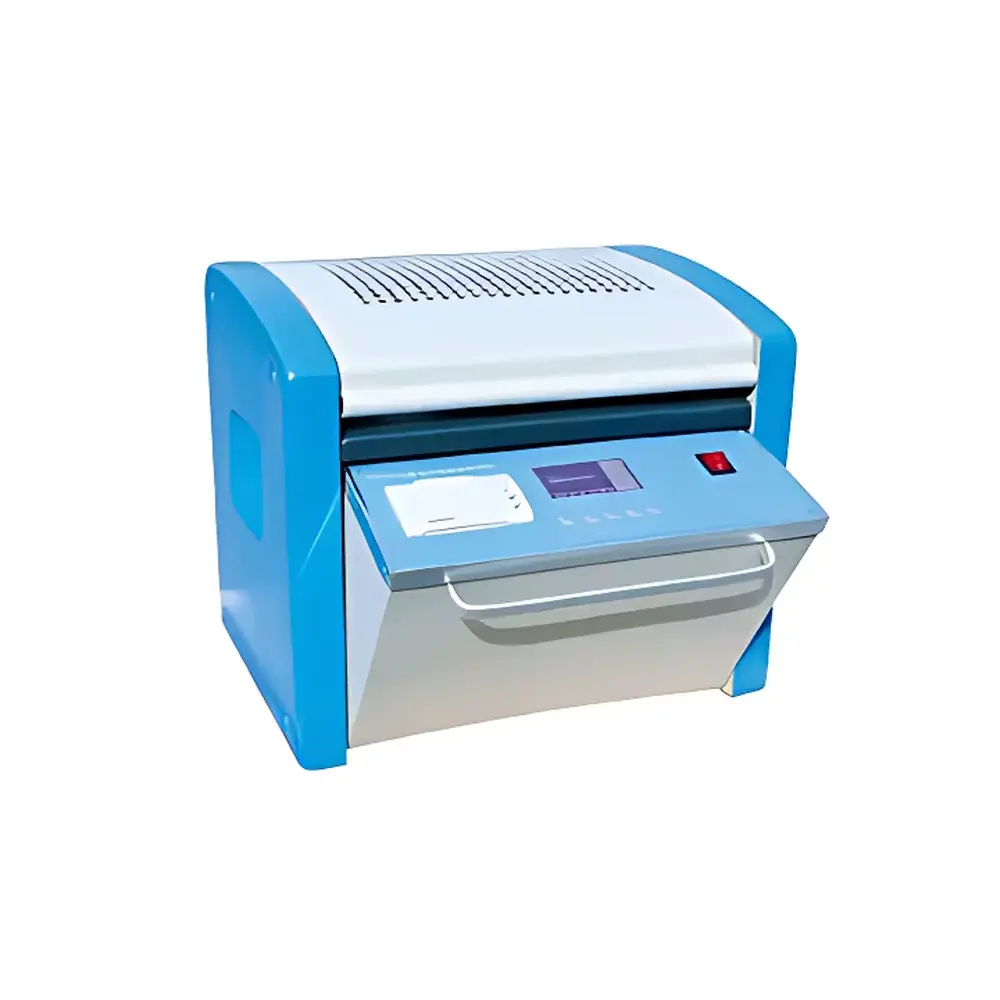
Timepower TP572 Dielectric Strength Tester for Insulating Oil
| Brand | Timepower |
|---|---|
| Model | TP572 |
| Origin | Beijing, China |
| Manufacturer | Timepower (Domestic) |
| Voltage Range | 0–80 kV |
| Resolution | 0.1 kV |
| Rising Rate | 2.0–3.0 kV/s (adjustable, two preset modes: 2 kV/s and 3 kV/s) |
| Test Repetition | 1–9 cycles (default 6) |
| Electrode Gap | Standard (compliant with GB/T 507–1986 and DL 429.9–1991) |
| Stirring Method | Magnetic stirring |
| Standby Time | 0–59 min (default 15 min) |
| Inter-test Interval | 0–9 min (default 3–5 min) |
| Operating Temperature | 5–40 °C |
| Relative Humidity | ≤85% RH |
| Power Supply | AC 220 V ±10%, 50 Hz ±10% |
| Dimensions | 610 × 410 × 425 mm |
| Weight | 45 kg |
| Safety Protections | Overvoltage, overcurrent, automatic zero-return, grounded enclosure |
| Transformer Type | Dry-type, integrated compact design |
| Display | LCD panel |
| Data Handling | Automatic storage, recall, and thermal printing |
| Compliance | GB/T 507–1986, DL 429.9–1991 |
Overview
The Timepower TP572 Dielectric Strength Tester is a fully automated, microprocessor-controlled instrument engineered for precise determination of the dielectric breakdown voltage of insulating oils used in high-voltage electrical equipment. It operates on the principle of controlled AC voltage ramping across standardized electrode geometry immersed in oil—measuring the minimum voltage at which electrical breakdown occurs under defined electro-thermal conditions. This measurement serves as a critical quality indicator for transformer oil, circuit breaker oil, cable oil, capacitor oil, and bushing oil, directly correlating with oxidation stability, moisture content, particulate contamination, and aging-related degradation. Designed to meet the rigorous procedural requirements of GB/T 507–1986 (equivalent to IEC 60156:1995) and DL 429.9–1991 (Chinese power industry standard), the TP572 delivers repeatable, traceable, and auditable test results essential for predictive maintenance, condition-based asset management, and regulatory compliance in utility, industrial, and third-party calibration laboratories.
Key Features
- Dual-CPU architecture ensures synchronized control of voltage ramping, magnetic stirring, timing sequences, data acquisition, and safety interlocks.
- Programmable AC voltage ramp rates of 2.0 kV/s and 3.0 kV/s—both compliant with GB/T 507–1986—with fine adjustment capability (2.0–3.0 kV/s range) for method flexibility and cross-laboratory comparability.
- Integrated dry-type high-voltage transformer module minimizes footprint and weight while maintaining stable sinusoidal waveform output and low internal impedance.
- Automatic sequence execution: oil cup loading → magnetic stirring → 15-minute静置 (configurable 0–59 min) → voltage ramp → breakdown detection → discharge → zero-return → inter-test delay (3–5 min, adjustable 0–9 min).
- Comprehensive hardware safety system including overvoltage cutoff, overcurrent shutdown, automatic return-to-zero upon completion or fault, and mandatory grounding verification prior to test initiation.
- LCD interface with real-time display of applied voltage, elapsed time, cycle count, and pass/fail status; all test records—including date/time stamp, breakdown voltage, and test parameters—are stored internally and exportable via thermal printer.
Sample Compatibility & Compliance
The TP572 is validated for use with mineral-based, synthetic, and bio-derived insulating oils meeting ASTM D877, ASTM D1816, IEC 60156, and GB/T 507 specifications. Its single-oil-cup configuration employs a standard 2.5 mm spherical electrode gap conforming to GB/T 507–1986 and DL 429.9–1991. The instrument supports routine QC testing in accordance with ISO/IEC 17025-accredited laboratories and aligns with operational requirements for IEEE C57.106 and IEC 60422 maintenance guidelines. While not inherently 21 CFR Part 11-compliant, audit trails, parameter locking, and printed reports support GLP/GMP documentation workflows when paired with laboratory SOPs.
Software & Data Management
The TP572 embeds firmware-level data handling without external PC dependency. Each test generates a timestamped record containing breakdown voltage (kV), ramp rate (kV/s), stir duration,静置 time, ambient temperature, and cycle number. Up to 100 test results are retained in non-volatile memory. Thermal printouts include instrument ID (TP572), operator code field, and compliance reference (GB/T 507–1986). For integration into LIMS environments, manual transcription or optional RS-232 output (available upon request) enables structured data ingestion. Firmware updates are performed via USB port using certified Timepower utilities.
Applications
- Routine acceptance testing of new insulating oil batches prior to transformer filling.
- Periodic in-service oil monitoring per IEEE C57.106 recommended intervals (e.g., annually for distribution transformers, semi-annually for power transformers).
- Troubleshooting insulation failures by correlating dielectric strength trends with dissolved gas analysis (DGA) and acidity measurements.
- Verification of oil reclamation effectiveness post-vacuum dehydration or clay filtration.
- Quality assurance in oil manufacturing and blending facilities adhering to GB 2536–2011 or IEC 60296 specifications.
- Training and certification labs requiring reproducible, standards-aligned instruction platforms.
FAQ
What standards does the TP572 comply with?
It conforms to GB/T 507–1986 (identical technical basis to IEC 60156:1995) and DL 429.9–1991, covering electrode geometry, voltage waveform fidelity, ramp rate tolerance, and environmental operating conditions.
Can the TP572 test oils above 80 kV?
The standard unit is rated to 80 kV. Units capable of 100 kV output are available as custom-engineered variants—contact Timepower Engineering for specification review and lead-time confirmation.
Is grounding mandatory before operation?
Yes. The grounding terminal must be securely connected to a verified earth ground before power-on; failure to do so disables the high-voltage generation circuit as a hardwired safety interlock.
How is electrode cleaning and calibration maintained?
Electrodes require periodic cleaning with analytical-grade petroleum ether and lint-free wipes. Calibration verification is performed using certified reference oils traceable to NIM (National Institute of Metrology, China); annual recalibration is recommended.
What maintenance is required for long-term reliability?
Annual inspection of HV transformer insulation resistance, stir motor torque, and oil cup seal integrity is advised. Desiccant in the HV compartment should be replaced every 12 months or when color-indicating silica gel transitions from blue to pink.



