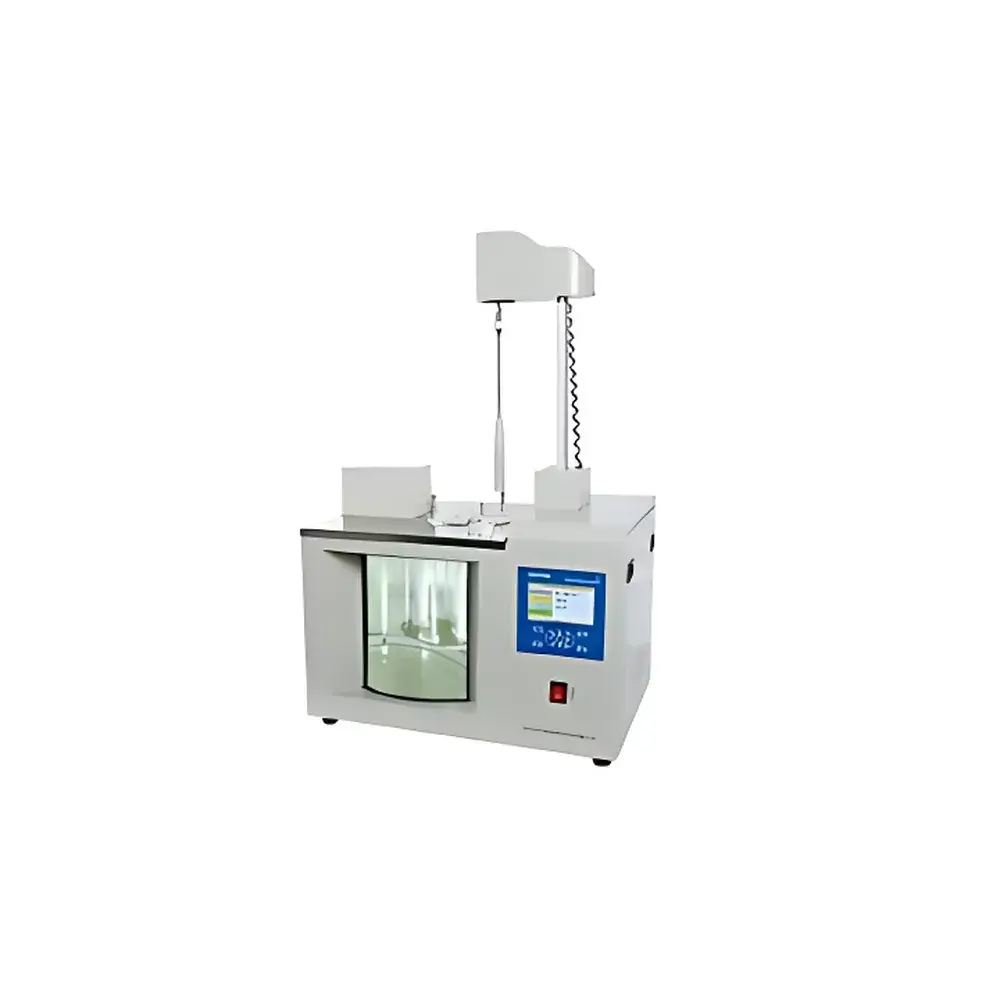
TimePower TP651 Petroleum Demulsibility Tester
| Brand | TimePower |
|---|---|
| Model | TP651 |
| Origin | Beijing, China |
| Manufacturer | TimePower Instrument Co., Ltd. |
| Category | Petroleum Specialized Analytical Instrument |
| Temperature Range | Ambient to 100 °C |
| Temperature Accuracy | ±2 °C |
| Temperature Resolution | 0.1 °C |
| Repeatability | ≤4 °C |
| Stirring Duration | 5 min (fixed) |
| Stirrer Positioning Precision | 6 mm above cylinder bottom |
| Cylinder Capacity | 100 mL |
| Power Supply | AC 220 V ±10%, 50 Hz ±10% |
| Power Consumption | ≤1600 W |
| Dimensions (W×D×H) | 510 mm × 360 mm × 580 mm |
| Weight | 23.5 kg |
| Operating Environment | 5–40 °C, RH ≤85% |
| Compliance | GB/T 7305-2003 |
Overview
The TimePower TP651 Petroleum Demulsibility Tester is a fully automated benchtop instrument engineered for precise determination of the demulsification characteristics of petroleum products and synthetic lubricants according to GB/T 7305–2003 (equivalent to ASTM D1401). It quantifies the ability of oil–water mixtures to separate into distinct phases under standardized thermal and mechanical agitation conditions—a critical performance parameter for turbine oils, hydraulic fluids, transformer oils, and other industrial lubricants where water ingress compromises dielectric strength, oxidation stability, and bearing protection. The instrument operates on the principle of controlled coalescence kinetics: a defined volume (100 mL) of oil–water mixture is heated in a calibrated water bath to either 54 °C ±1 °C (standard test temperature) or 82 °C ±1 °C (for high-viscosity oils), agitated for exactly five minutes by a vertically positioned impeller, then allowed to settle while automatically recording phase separation time. This method reflects real-world operational conditions where emulsion persistence correlates directly with equipment reliability and maintenance intervals.
Key Features
- Fully automated test sequence: integrated microcontroller coordinates water bath temperature stabilization, stirrer descent to 6 mm above cylinder base, 5-minute timed agitation, automatic stirrer retraction, and start/stop of separation timing.
- High-precision thermostatic control: PID-regulated water bath maintains setpoint within ±2 °C across ambient-to-100 °C range, with 0.1 °C digital resolution and ≤4 °C repeatability—ensuring compliance with GB/T 7305 thermometric requirements.
- Electromechanical lift system: brushless linear actuator provides smooth, repeatable vertical movement of the stirring assembly, eliminating manual alignment errors and enhancing operator safety.
- Intuitive human–machine interface: 480×272 pixel color LCD display with full Chinese menu navigation, context-sensitive prompts, and guided input logic—designed for routine use in QC laboratories without specialized programming training.
- Robust mechanical architecture: stainless steel water bath vessel, corrosion-resistant aluminum frame, and precision-machined 100 mL graduated cylinder holder ensure long-term dimensional stability and resistance to chemical exposure.
Sample Compatibility & Compliance
The TP651 is validated for use with mineral-based and synthetic hydrocarbon lubricants, including but not limited to turbine oils (ISO VG 32–68), transformer oils (IEC 60296), hydraulic fluids (ISO 11158 HM/HLP), and compressor oils. It accommodates samples with kinematic viscosities up to 300 mm²/s at 40 °C when tested at the elevated 82 °C condition. All operational parameters—including temperature tolerance, agitation geometry, cylinder dimensions, and timing protocol—are aligned with GB/T 7305–2003, which references the fundamental methodology of ASTM D1401. While the instrument itself does not carry CE or UL certification, its design adheres to IEC 61010-1 safety principles for laboratory electrical equipment. Data output supports traceability in GLP-compliant environments through timestamped test records stored in non-volatile memory.
Software & Data Management
The TP651 employs embedded firmware—not PC-dependent software—to execute all core functions. Test parameters (temperature setpoint, agitation duration, and pass/fail criteria) are stored in EEPROM with battery-backed retention. Each test generates a timestamped record containing start time, final separation time, observed layer volumes (oil/water/emulsion), and operator ID (manually entered via keypad). Up to 200 test logs can be retained onboard; data export is supported via USB port to CSV-formatted files for integration into LIMS or QA documentation systems. Audit trail functionality meets basic GLP requirements: all parameter changes and test initiations are logged with date/time stamps. The system supports 21 CFR Part 11 readiness through optional password-protected user roles (administrator/operator) and immutable log archiving protocols.
Applications
- Quality control of new lubricant batches prior to release—verifying conformity to OEM specifications for demulsibility performance.
- In-service oil analysis programs in power generation facilities, where prolonged emulsion formation in turbine lube systems signals degradation or contamination.
- R&D evaluation of additive packages (e.g., demulsifiers, anti-foam agents) under controlled thermal–mechanical stress.
- Third-party testing for customs clearance and import compliance in petroleum trading, particularly under China’s AQSIQ regulatory framework.
- Academic research on interfacial tension dynamics and coalescence mechanisms in non-Newtonian oil–water dispersions.
FAQ
What standards does the TP651 comply with?
It is designed and validated for GB/T 7305–2003, the Chinese national standard equivalent to ASTM D1401–18a for petroleum product demulsibility testing.
Can the instrument test oils with viscosity above 100 mm²/s at 40 °C?
Yes—by selecting the 82 °C ±1 °C test condition per Clause 6.2 of GB/T 7305, enabling reliable measurement for highly viscous gear oils and heavy-duty hydraulic fluids.
Is external computer software required to operate the device?
No—the TP651 is self-contained with embedded microcontroller logic; no PC connection is needed for routine operation or data acquisition.
How is calibration verified during routine use?
Users perform daily verification using NIST-traceable mercury-in-glass thermometers and certified stopwatch timers; the instrument’s internal temperature sensor is factory-calibrated against reference standards and requires biannual verification.
What safety precautions apply to water bath operation?
Always de-energize before filling; maintain 3–4 cm air gap between water surface and bath rim to prevent overflow during thermal expansion and ensure proper heater ventilation.