
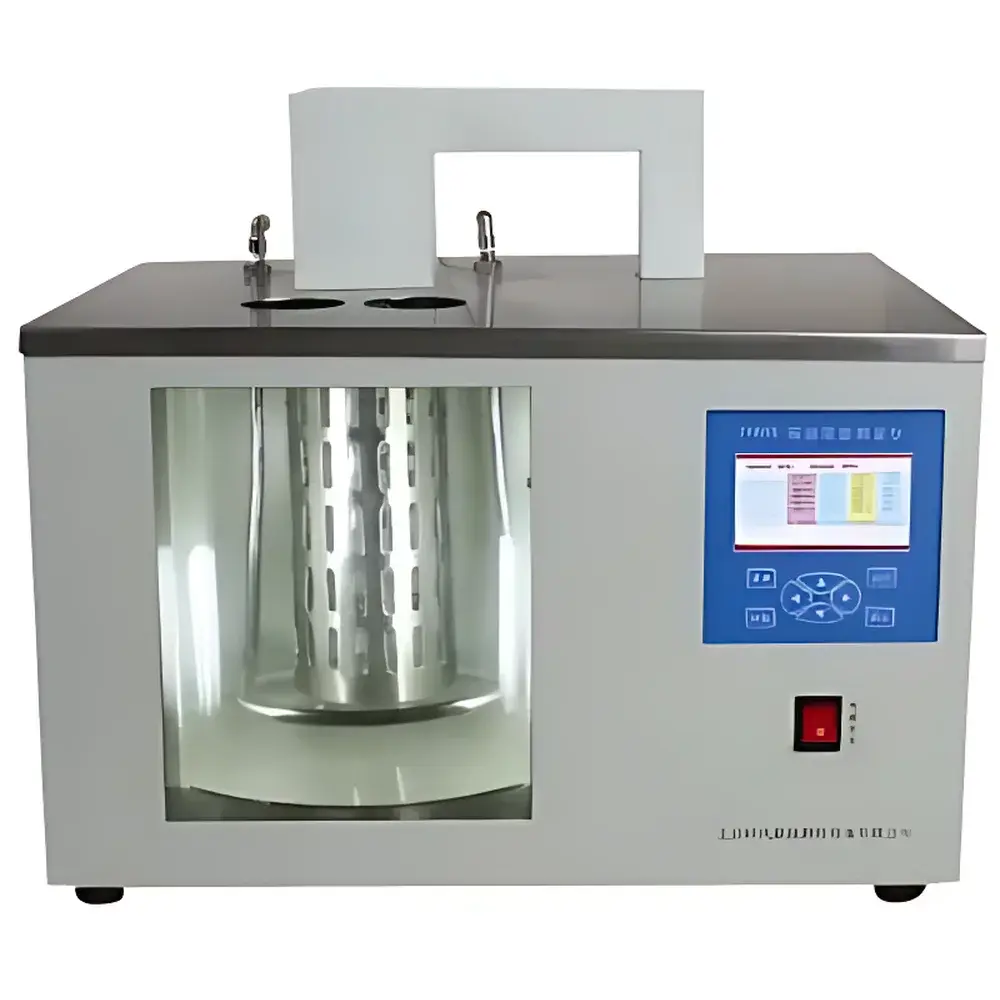
TimePower TP655 Petroleum Density Analyzer
| Brand | TimePower |
|---|---|
| Model | TP655 |
| Application | Petroleum Liquid Density Measurement per GB/T 1884 |
| Temperature Control Range | 0–110 °C |
| Temperature Resolution | ±0.01 °C |
| Temperature Stability | ±0.1 °C |
| Heating Power | ≤1600 W |
| Programmable Stirring Speed | 10-step digital control |
| Sample Capacity | Dual-bath (2 positions) |
| Ambient Operating Conditions | 0–45 °C, ≤85% RH |
| Power Supply | AC 220 V ±10%, 50 Hz |
| Rated Power Consumption | 1800 VA |
| Dimensions (W×D×H) | 515 × 380 × 490 mm |
| Net Weight | 20.2 kg |
Overview
The TimePower TP655 Petroleum Density Analyzer is a precision laboratory instrument engineered for the accurate determination of density of liquid petroleum products at controlled temperatures, in strict accordance with the national standard GB/T 1884—2000 (equivalent to ASTM D1298 and ISO 3675). It implements the hydrometer method—a gravimetric technique wherein the buoyant displacement of a calibrated glass hydrometer in a thermostatically stabilized sample yields density values directly traceable to SI units. The system integrates a dual-bath constant-temperature bath, PID-driven thermal regulation, and programmable mechanical agitation to ensure rapid thermal equilibration and minimal convection-induced measurement drift. Designed for routine QC laboratories in refineries, independent testing centers, and R&D facilities, the TP655 delivers high reproducibility (RSD < 0.05% for repeat measurements under standardized conditions) and long-term stability across extended operational cycles.
Key Features
- PID-based temperature control architecture delivering ±0.1 °C stability over the full 0–110 °C operating range, with resolution to ±0.01 °C for precise thermal referencing
- Dual independent sample wells enabling parallel analysis or reference/control comparison without cross-contamination or thermal interference
- 10-step digitally regulated stirring system ensuring uniform temperature distribution and eliminating stratification in viscous or thermally sensitive samples
- Energy-efficient annular tri-color LED illumination providing flicker-free, glare-free, and spectrally neutral backlighting optimized for hydrometer meniscus reading accuracy
- Robust stainless-steel bath construction with insulated housing and low-thermal-mass design to minimize warm-up time and power consumption
- Comprehensive safety circuitry including over-temperature cutoff, dry-run protection, and ground-fault detection compliant with IEC 61010-1
Sample Compatibility & Compliance
The TP655 accommodates a broad range of petroleum-derived liquids—including crude oil fractions, gasoline, diesel, kerosene, lubricating oils, and biodiesel blends—within viscosity limits suitable for standard hydrometer immersion (typically < 1000 mm²/s at test temperature). All operational parameters adhere to the procedural requirements of GB/T 1884, which mandates temperature control accuracy, sample homogeneity, meniscus reading methodology, and calibration traceability to NIM (National Institute of Metrology, China) certified standards. The instrument supports audit-ready documentation practices aligned with GLP and ISO/IEC 17025 frameworks; while it does not include built-in electronic data logging, its thermal and mechanical subsystems are fully compatible with external validation protocols required for FDA 21 CFR Part 11-compliant environments when integrated with validated third-party LIMS or ELN systems.
Software & Data Management
The TP655 operates as a standalone benchtop instrument with no embedded microprocessor or touchscreen interface. Temperature setpoints, stirring speed, and timing functions are managed via front-panel membrane switches and analog dials, ensuring electromagnetic compatibility and operational reliability in electrically noisy industrial labs. All critical thermal parameters—including actual bath temperature, setpoint deviation, and stabilization status—are displayed on a dual-line LED readout. While the device does not feature native USB or Ethernet connectivity, its analog temperature output (0–10 V or 4–20 mA optional upon request) enables integration with PLC-based monitoring systems or data acquisition hardware for continuous thermal profiling and SPC charting. Calibration records, maintenance logs, and operator verification entries must be maintained manually per ISO/IEC 17025 Section 7.7 requirements.
Applications
- Density determination of finished fuel products prior to custody transfer or regulatory reporting (e.g., API gravity conversion)
- Quality assurance of blending components in refinery process streams
- Stability assessment of emulsified fuels and biofuel blends during storage
- Supporting distillation curve interpretation (ASTM D86) through correlated density-temperature relationships
- Verification of additive package homogeneity in lubricant formulations
- Research-grade characterization of novel hydrocarbon solvents and synthetic base stocks
FAQ
Does the TP655 comply with international standards beyond GB/T 1884?
Yes—the hydrometer method implemented by the TP655 is technically equivalent to ASTM D1298 and ISO 3675. Its thermal performance specifications meet or exceed the temperature control tolerances cited in these standards.
Can the instrument measure densities below 0 °C ambient?
Yes—the integrated refrigeration-assisted cooling module (optional configuration) allows operation down to 0 °C bath temperature even in ambient environments up to 45 °C.
Is calibration certificate included with shipment?
A factory calibration report traceable to NIM standards is provided; users are responsible for periodic recalibration using certified reference oils per GB/T 1884 Annex B.
What hydrometers are compatible with the TP655 bath geometry?
Standard ASTM 151, 152, and 153 hydrometers (100–150 mm length, 12–14 mm diameter stem) fit precisely within the dual-well chamber without contact interference.
Is preventive maintenance training available?
TimePower offers on-site or remote technical workshops covering bath fluid management, PID tuning verification, stirrer motor inspection, and optical alignment procedures—all documented in the English-language Operation & Maintenance Manual (Rev. 3.1).



