
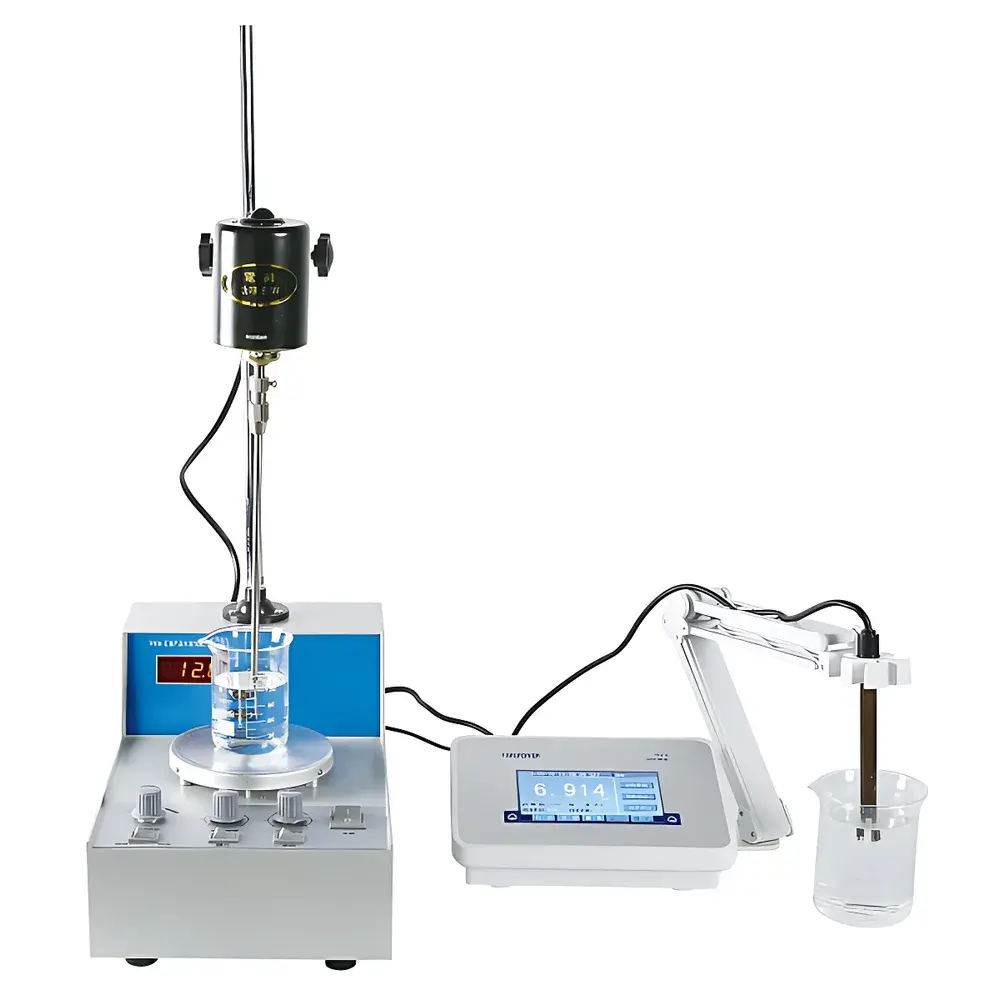
Timepower TP656 Water-Soluble Acid and Alkali Analyzer
| Brand | Timepower |
|---|---|
| Model | TP656 |
| Origin | Beijing, China |
| Manufacturer | Timepower Instrument Co., Ltd. |
| Measurement Principle | Potentiometric pH analysis of aqueous extract |
| pH Range | 0.00–14.00 |
| pH Accuracy | ±0.02 pH |
| pH Resolution | 0.01 pH |
| pH Repeatability | ≤1% |
| pH Stability | ±1% F.S./4 h |
| Response Time (T90) | <1 min at 25 °C |
| Temperature Control Range | Ambient to 100 °C |
| Temperature Control Accuracy | ≤±1 °C |
| Magnetic Stirring Speed | 0–2400 rpm |
| Mechanical Stirring Speed | 0–3000 rpm |
| Heating Power | 200 W |
| Stirring Motor Power | 3 W (magnetic), 30 W (mechanical) |
| Total Power Consumption | ≤1200 W |
| Input Voltage | AC 220 V ±10%, 50 Hz ±10% |
| Sample Temp. Range | 5–60 °C |
| Ambient Operating Temp. | 5–40 °C |
| Relative Humidity | ≤85% RH |
Overview
The Timepower TP656 Water-Soluble Acid and Alkali Analyzer is a dedicated electrochemical instrument engineered for standardized determination of water-soluble acidic and alkaline components in petroleum products and related hydrocarbon-based materials. It operates in strict accordance with GB/T 259–1988, the Chinese national standard equivalent to ASTM D974 (titration-based acid/alkali number) and aligned with ISO 6618 and IP 177 methodologies for extractive pH assessment. Unlike general-purpose pH meters, the TP656 integrates sample preparation, thermal conditioning, and potentiometric measurement into a single controlled workflow. The system extracts soluble ionic species—primarily low-molecular-weight organic acids (e.g., naphthenic acids), inorganic salts (e.g., sodium hydroxide residues), or degradation byproducts—into distilled water under defined temperature and agitation conditions. The resulting aqueous phase is then measured using a calibrated glass pH electrode, enabling quantitative classification of acidity or alkalinity per standardized pass/fail thresholds or semi-quantitative reporting in pH units.
Key Features
- Integrated dual-mode stirring platform combining magnetic stirring (0–2400 rpm) and mechanical overhead stirring (0–3000 rpm), both independently controllable and operable simultaneously with heating—eliminating manual agitation and ensuring reproducible extraction kinetics.
- Programmable thermostatic control (ambient to 100 °C) with ±1 °C accuracy, supporting standardized heating protocols for viscous samples (e.g., lubricating greases, waxes) as specified in GB/T 259–1988 Section 5.3.
- 24-bit high-resolution A/D conversion circuitry delivering stable, low-noise pH signal acquisition with ≤0.02 pH absolute error and 0.01 pH resolution—critical for detecting marginal shifts near neutrality (pH 6.5–7.5) where corrosivity risk is most ambiguous.
- Dedicated firmware with Chinese-language menu navigation optimized for laboratory technicians in power generation, refinery QC, and petrochemical R&D environments—no external PC required for routine operation.
- Robust industrial-grade architecture compliant with IEC 61000-4 electromagnetic immunity standards and designed for continuous duty in analytical labs with variable ambient humidity (≤85% RH) and temperature (5–40 °C).
Sample Compatibility & Compliance
The TP656 accommodates a broad spectrum of petroleum-derived matrices per GB/T 259–1988 scope: light distillates (gasoline, naphtha), middle distillates (diesel, kerosene), residual fuels, lubricating oils, greases, paraffin waxes, and spent catalyst slurries. Specialized handling protocols are embedded for high-viscosity samples: pre-dilution with solvent (e.g., 50 mL gasoline), controlled water-phase equilibration at 50–60 °C, and gravity filtration through qualitative filter paper to remove suspended particulates prior to pH measurement. All operational parameters—including temperature ramp profiles, stir speed sequences, and electrode calibration intervals—are traceable and configurable to support GLP-compliant documentation. While the instrument itself does not generate CFR Part 11–compliant audit trails, its analog output and RS-232 interface enable integration with validated LIMS or ELN systems for regulated environments.
Software & Data Management
The TP656 operates via an embedded real-time operating system with non-volatile memory storing up to 200 test records, each timestamped and annotated with sample ID, operator code, temperature setpoint, stir mode, and final pH reading. Data export is supported via USB flash drive (FAT32 format) in CSV format for post-processing in Excel or statistical software (e.g., JMP, Minitab). Electrode calibration follows a two-point NIST-traceable buffer protocol (pH 4.01 and 7.00 at 25 °C); slope and offset values are logged automatically. No proprietary software installation is required—raw data files are human-readable and interoperable with third-party QA/QC dashboards. Firmware updates are delivered via signed binary packages verified against SHA-256 checksums to ensure integrity.
Applications
- Corrosion risk screening of transformer oils and turbine lubricants in power plants—detecting early-stage oxidation byproducts before acid number (TAN) exceeds ASTM D974 limits (e.g., >0.15 mg KOH/g).
- Refinery process monitoring: verification of caustic wash efficiency in naphtha desulfurization units by quantifying residual NaOH in product streams.
- Quality release testing of commercial solvents and cutting fluids—ensuring absence of alkaline contaminants that could interfere with metalworking emulsion stability.
- Research on biodiesel stability: tracking formation of free fatty acids during accelerated oxidation per EN 14112, using aqueous extract pH as a rapid proxy for TAN progression.
- Regulatory compliance for customs inspection labs: verifying conformity of imported fuel batches with GB 17930 (gasoline) or GB 19147 (diesel) water-soluble alkali limits (pH ≤ 7.0).
FAQ
Does the TP656 comply with international standards beyond GB/T 259–1988?
Yes—it implements core procedural elements consistent with ASTM D974 (acid/alkali number), ISO 6618 (petroleum product pH determination), and IP 177 (water-soluble acidity/alkalinity), though final reporting remains in pH units rather than titrimetric equivalents.
Can the instrument measure samples with viscosity >75 mm²/s without modification?
No—per GB/T 259–1988, such samples must be pre-diluted with 50 mL gasoline and extracted with preheated distilled water (50–60 °C); the TP656 supports this protocol via independent temperature and dual-stir control.
Is electrode calibration traceable to NIST standards?
Yes—calibration uses certified reference materials (CRM) traceable to NIST SRM 186, with slope verification within 95–105% and asymmetry potential ≤±30 mV.
What maintenance is required for long-term accuracy?
Monthly verification using fresh pH 4.01 and 7.00 buffers; annual replacement of the Ag/AgCl reference electrolyte (3 mol/L KCl) and periodic cleaning of the magnetic stir bar housing to prevent residue buildup.
Can data be exported directly to LIMS?
Yes—via RS-232 serial output (Modbus RTU protocol) or USB mass storage mode; custom driver development is supported through Timepower’s SDK documentation package.




