
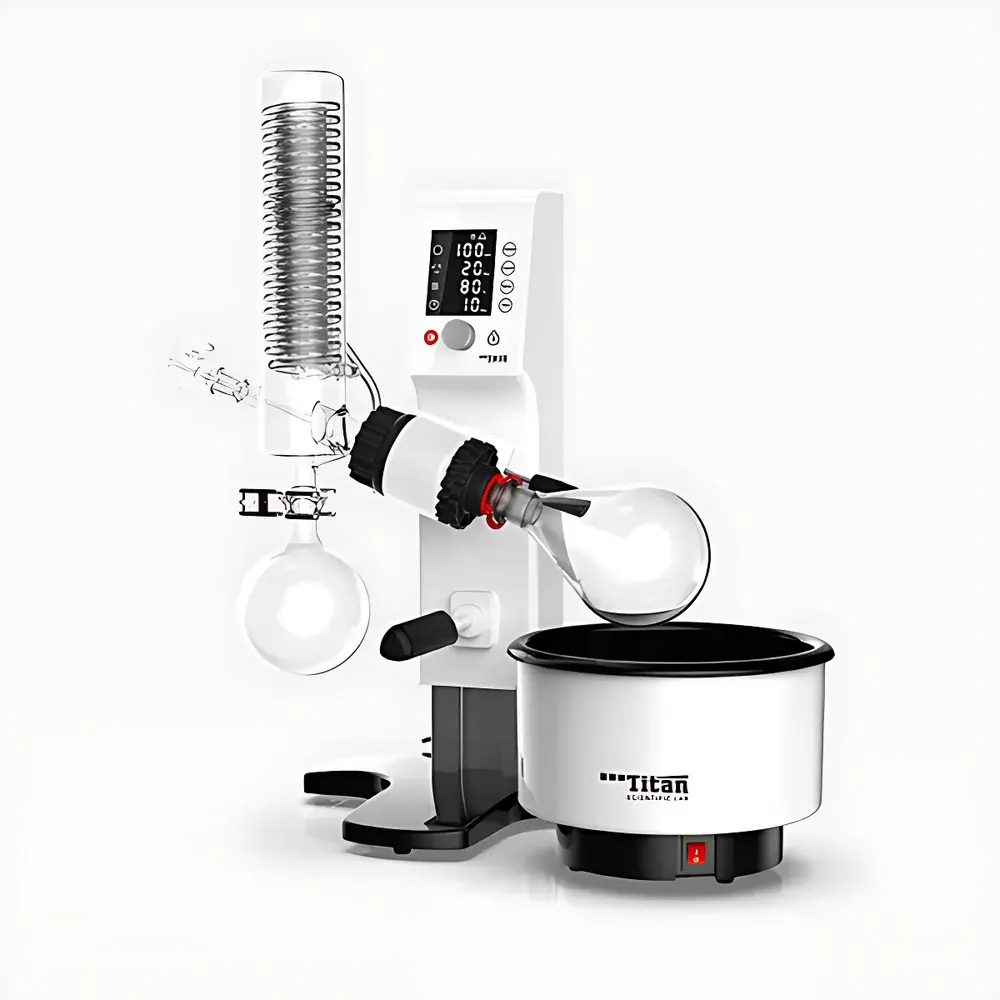
Titan TR-3L Rotary Evaporator
| Brand | Titan |
|---|---|
| Origin | Shanghai, China |
| Manufacturer Type | Direct Manufacturer |
| Product Origin | Domestic (China) |
| Model | TR-3L |
| Capacity | 3 L |
| Ultimate Vacuum | 4 mbar |
| Rotation Speed | 20–320 rpm |
| Temperature Control Range | Ambient +5 °C to 180 °C |
| Temperature Accuracy | ±1.5 °C (water bath), ±3 °C (oil bath) |
| Condenser Cooling Surface Area | 1500 cm² |
Overview
The Titan TR-3L Rotary Evaporator is a benchtop solvent removal system engineered for precision, repeatability, and operational safety in synthetic chemistry, natural product isolation, and analytical sample preparation laboratories. It operates on the fundamental principle of reduced-pressure distillation: by rotating a flask under controlled vacuum and regulated thermal input, the effective surface area of the liquid film increases while its boiling point decreases—enabling rapid, gentle, and selective evaporation of volatile solvents without thermal degradation of heat-sensitive compounds. Designed for consistent performance across diverse organic and aqueous systems, the TR-3L integrates a robust glass-on-glass sealing architecture, balanced motor-driven rotation, and dual-mode heating (water or oil bath) to accommodate both low- and high-boiling-point applications.
Key Features
- 3-liter evaporation capacity with standardized ISO-KF 25/35 ground-glass joints for secure, leak-tight connections to condensers, receiving flasks, and vacuum manifolds.
- Adjustable rotation speed from 20 to 320 rpm via digital stepper motor control—optimized for film stability across varying viscosities and solvent volatilities.
- Vacuum compatibility down to 4 mbar (3 mmHg), supporting efficient removal of solvents with boiling points up to ~180 °C at atmospheric pressure—including chloroform, ethyl acetate, toluene, and DMF.
- Dual heating mode: water bath (max 99 °C) and oil bath (max 180 °C), each with independent PID temperature regulation and real-time digital display.
- High-efficiency vertical condenser with 1500 cm² active cooling surface area, optimized for counter-current vapor flow and high condensate recovery rates (>95% typical for common solvents).
- Integrated safety features including overtemperature cutoff, motor overload protection, and automatic lift-off mechanism triggered by vacuum loss or power interruption.
Sample Compatibility & Compliance
The TR-3L accommodates standard round-bottom flasks (1 L, 2 L, and 3 L), pear-shaped flasks, and short-path distillation adapters. It supports a broad range of solvents—including polar protic (methanol, ethanol), polar aprotic (acetone, THF, acetonitrile), and nonpolar (hexane, dichloromethane)—and is routinely employed in workflows aligned with ASTM D129, ISO 661, and USP residual solvent analysis protocols. While not certified for GMP production environments, its design facilitates GLP-compliant documentation when paired with external data loggers and audit-trail-enabled vacuum controllers. All wetted parts are borosilicate 3.3 glass (DIN/ISO 3585), ensuring chemical resistance to strong acids, bases, and halogenated solvents under standard operating conditions.
Software & Data Management
The TR-3L operates as a stand-alone instrument with analog-digital hybrid controls: temperature and rotation are set and monitored via front-panel LED displays and rotary encoders. For laboratories requiring electronic recordkeeping, optional RS-485 or USB-to-serial interfaces enable integration with third-party lab information management systems (LIMS) or custom SCADA platforms. When used with compliant vacuum pumps and temperature data loggers, the system supports 21 CFR Part 11–aligned workflows—including user authentication, electronic signatures, and immutable event logs—provided such functionality is implemented at the peripheral controller level.
Applications
- Concentration of reaction mixtures post-synthesis in medicinal chemistry and process R&D.
- Removal of extraction solvents (e.g., petroleum ether, ethyl acetate) during phytochemical isolation and essential oil purification.
- Preparative-scale solvent exchange (e.g., DCM → toluene) prior to crystallization or chromatography.
- Lyophilization pre-concentration steps where thermal sensitivity prohibits freeze-drying of dilute solutions.
- Environmental sample preparation, including EPA Method 3510C (separation of extractable petroleum hydrocarbons) and related solvent-based cleanup procedures.
FAQ
What is the maximum recommended working volume for continuous operation?
For optimal film formation and bumping prevention, the 3 L flask should be filled to no more than 50% capacity (i.e., ≤1.5 L) when rotating at speeds above 120 rpm.
Can the TR-3L be used with corrosive solvents such as concentrated HCl or bromine-containing reagents?
Borosilicate glass components resist mild corrosion; however, prolonged exposure to hot concentrated mineral acids or halogens is not advised. Use PTFE-coated clamps and cold traps for aggressive chemistries.
Is the condenser compatible with dry ice–acetone or liquid nitrogen cooling?
Yes—the vertical condenser accepts standard cryogenic coolant jackets; however, thermal shock must be avoided by gradual cooldown and use of insulated sleeves.
Does Titan provide calibration certificates traceable to NIST or CNAS standards?
Factory calibration reports are supplied with each unit; full metrological certification (e.g., ISO/IEC 17025) is available upon request and subject to third-party verification.
What vacuum pump specifications are recommended for achieving 4 mbar reliably?
A two-stage diaphragm pump with ultimate vacuum ≤1 mbar and pumping speed ≥20 L/min is recommended; for solvent-laden streams, inclusion of a cold trap or chemical scrubber is strongly advised.



