
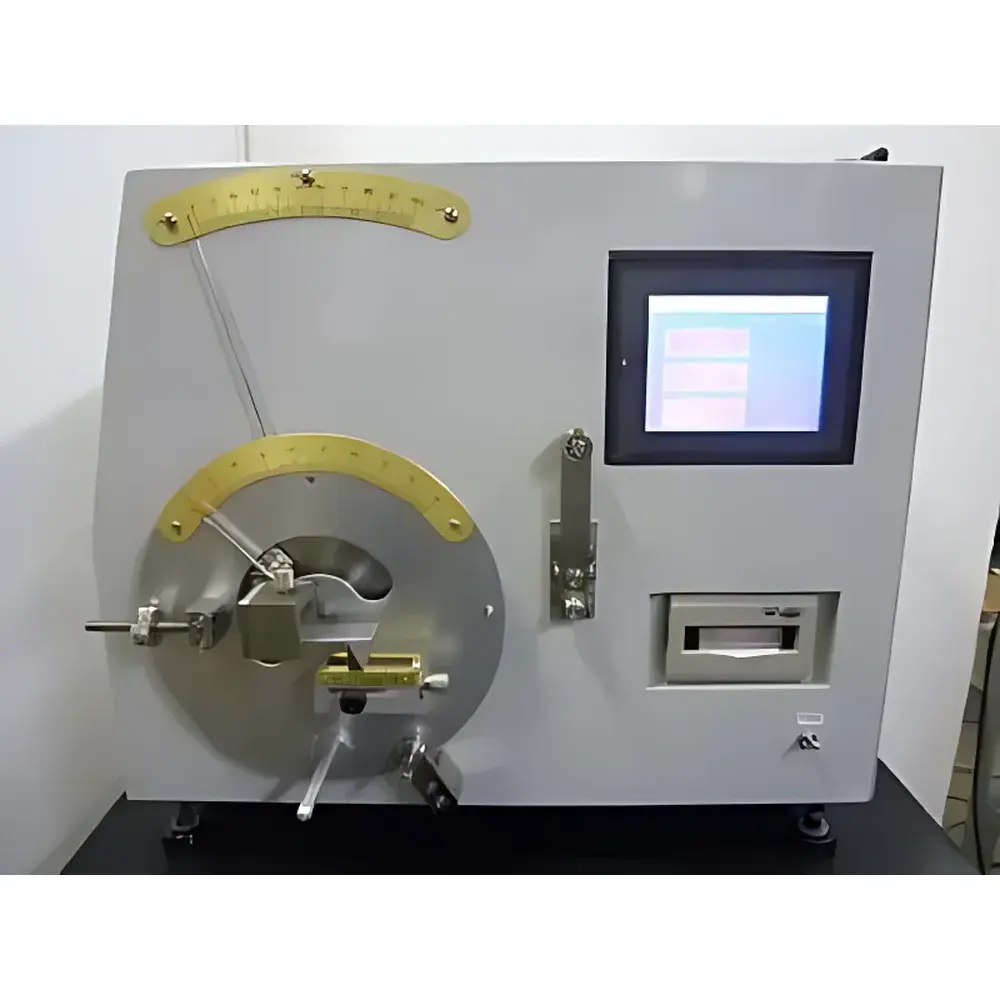
Yasuda No.118-D Digital Olsen-Type Surface Stiffness Tester (Heavy-Load Configuration)
| Brand | Yasuda |
|---|---|
| Origin | Japan |
| Model | No.118-D |
| Compliance Standards | JIS K 7106, ASTM D 747 |
| Display | LCD Controller with Auto-Calculation |
| Output | Integrated Thermal Printer |
| Load Configuration | Heavy-duty torsional loading system |
| Test Principle | Cantilever bending under controlled angular displacement |
Overview
The Yasuda No.118-D Digital Olsen-Type Surface Stiffness Tester is a precision mechanical testing instrument engineered for the quantitative determination of flexural stiffness (surface modulus) in rigid and semi-rigid polymeric materials under cantilever bending conditions. Operating on the fundamental principle of torsional moment equilibrium in a single-end-clamped specimen geometry, the device applies a precisely controlled angular deflection to the free end of a standardized test bar while measuring the resulting reaction torque. This configuration conforms strictly to the kinematic boundary conditions defined in JIS K 7106 and ASTM D 747—both of which specify methods for evaluating the apparent flexural modulus of plastics using the Olsen-type apparatus. Unlike universal testing machines, the No.118-D employs a dedicated mechanical architecture optimized for high-reproducibility stiffness measurements at low-to-moderate strain levels, eliminating compliance artifacts associated with crosshead displacement control or load-cell drift during sustained torque application.
Key Features
- Integrated digital LCD controller with real-time display of angular displacement (°), applied torque (N·mm), and calculated surface stiffness (MPa·mm³)
- Heavy-load mechanical drive system featuring hardened steel torsion shafts and precision-ground bearing supports to maintain dimensional stability under repeated high-torque cycling
- Fixed-clamp specimen holder compatible with standard test bars per JIS K 7106 (e.g., 127 mm × 12.7 mm × 3.2 mm) and ASTM D 747 (63.5 mm × 12.7 mm × 3.2 mm)
- Automated calculation engine implementing the standardized formula: Es = (L³ × M) / (4 × b × h³ × θ), where L = support span, M = applied moment, b and h = specimen width and thickness, and θ = measured angular deflection in radians
- Thermal line printer providing permanent hardcopy output of raw data, calculated modulus values, test date/time stamp, and operator ID field
- Calibration traceability supported via certified reference torque weights and angular encoder verification protocols aligned with ISO/IEC 17025 requirements
Sample Compatibility & Compliance
The No.118-D accommodates thermoplastic and thermosetting sheet, bar, and molded specimens with nominal thicknesses ranging from 1.0 mm to 6.4 mm and widths up to 15 mm. Specimen conditioning follows ISO 291 and ASTM D 618 ambient preconditioning guidelines (23 °C ± 2 °C, 50 % RH ± 5 % RH, ≥40 h). The instrument’s mechanical design ensures full compliance with the fixture geometry, loading rate tolerances (±10 % of nominal 2°/min angular sweep), and measurement uncertainty budgets stipulated in JIS K 7106:2012 and ASTM D 747–22. It is routinely deployed in QC laboratories supporting ISO 9001-certified manufacturing processes and meets baseline mechanical integrity requirements for GLP-compliant polymer characterization workflows.
Software & Data Management
While the No.118-D operates as a standalone electromechanical system without PC connectivity, its embedded firmware supports audit-trail functionality through timestamped thermal printouts that record operator input, calibration status, and environmental monitoring flags (if external hygrothermograph data are manually annotated). All printed reports include unique test sequence identifiers and conform to minimum documentation standards referenced in FDA 21 CFR Part 11 Annex A for non-electronic records. Optional analog voltage outputs (0–5 V DC proportional to torque) enable integration with third-party DAQ systems for long-term trend analysis in predictive maintenance applications.
Applications
- Determination of surface flexural modulus for ABS, polycarbonate, PVC, and phenolic laminates in automotive interior component qualification
- Batch-release testing of rigid packaging substrates (e.g., blister foil laminates) per ASTM D 747-based internal specifications
- Comparative stiffness screening during polymer formulation development, particularly for fiber-reinforced composites where interfacial bonding affects cantilever response
- Verification of heat-ageing effects on thermoset rigidity by tracking modulus decay across accelerated thermal exposure cycles
- Education and training in polymer mechanics laboratories where visual, hands-on demonstration of bending moment–deflection relationships is pedagogically essential
FAQ
Does the No.118-D comply with ISO 178 for flexural testing?
No—it implements the Olsen cantilever method per JIS K 7106 and ASTM D 747, which differ fundamentally from the three-point bending geometry specified in ISO 178.
Can test data be exported digitally?
Not natively; data output is exclusively via thermal printer. Analog signal outputs may be interfaced with external DAQ hardware for digitization.
What is the maximum specimen length supported?
The standard clamp configuration accepts specimens up to 150 mm in total length, with effective cantilever spans of 63.5 mm (ASTM) or 127 mm (JIS) maintained via fixed-position support anvils.
Is periodic recalibration required?
Yes—annual verification against NIST-traceable torque standards and angular encoders is recommended to maintain measurement uncertainty within ±2.5 % of reading, consistent with JIS Z 8401 guidance.
How is operator error minimized during specimen mounting?
The clamping mechanism incorporates tactile feedback detents and engraved alignment marks to ensure repeatable axial positioning and eliminate eccentric loading-induced torsional coupling errors.



