
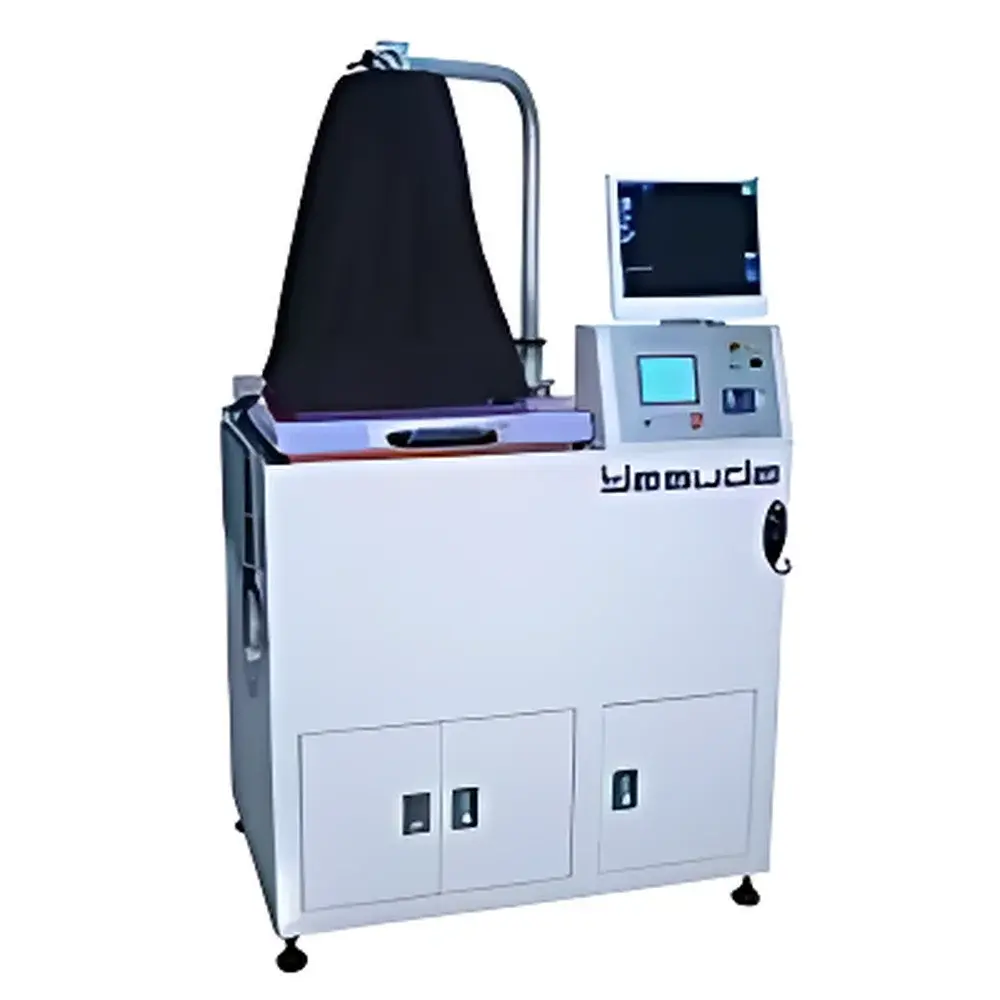
Yasuda No.119-LVR De Mattia Flex-Cracking and Crack Growth Tester with Low-Temperature Chamber
| Brand | Yasuda |
|---|---|
| Origin | Japan |
| Model | No.119-LVR |
| Standards Compliance | JIS K6260, ASTM D813, BS 903 Part A24, ISO 132 |
| Temperature Range | −70 °C to +100 °C (low-temperature chamber) |
| High-Speed Imaging | Up to 1000 fps with real-time crack detection algorithm |
| Test Mode | Continuous cyclic flexing with automated crack initiation and propagation monitoring |
| Drive Mechanism | Electromechanical servo-controlled cam system |
| Sample Holder | Dual-clamp, adjustable stroke (10–50 mm), frequency range 0.1–5 Hz |
Overview
The Yasuda No.119-LVR De Mattia Flex-Cracking and Crack Growth Tester with Low-Temperature Chamber is an electromechanical fatigue testing system engineered for the quantitative evaluation of crack initiation and propagation behavior in elastomeric materials under controlled thermal and dynamic mechanical stress conditions. Based on the classical De Mattia principle—where a rectangular test specimen is subjected to repeated bending over a cylindrical mandrel—the instrument applies precisely regulated cyclic flexure while maintaining stable low-temperature environments down to −70 °C. This enables accelerated simulation of service-induced degradation mechanisms observed in automotive seals, aerospace O-rings, industrial hoses, and cold-weather rubber components. Unlike conventional stop-start flex testers, the No.119-LVR integrates synchronized high-speed imaging (up to 1000 frames per second) with real-time edge-detection algorithms to capture sub-millimeter crack formation without interrupting test continuity—a capability critical for generating time-resolved crack growth kinetics data compliant with ISO 132 and ASTM D813.
Key Features
- Integrated low-temperature chamber with PID-controlled refrigeration system, achieving stable operation from −70 °C to +100 °C; chamber volume optimized for uniform thermal distribution across dual test stations.
- Electromechanical servo-driven cam mechanism delivering repeatable stroke amplitudes (10–50 mm) and frequencies (0.1–5 Hz) with < ±0.2% deviation over 10⁶ cycles.
- Dual independent test stations allow parallel evaluation of reference and conditioned specimens under identical thermal–mechanical profiles.
- High-resolution monochrome CMOS camera (1280 × 1024 px) mounted on rigid optical rail with telecentric lens; calibrated pixel-to-length mapping supports automated crack length measurement per ISO 132 Annex B.
- Real-time image processing firmware detects crack tip advancement with ≥98.7% sensitivity at ≥50 µm resolution; timestamped event logs synchronize mechanical actuation, thermal setpoint, and crack metrics.
- Modular control interface compatible with third-party DAQ systems via Ethernet/IP and analog I/O (0–10 V, ±10 V), supporting integration into centralized lab automation platforms.
Sample Compatibility & Compliance
The No.119-LVR accommodates standard dumbbell-shaped specimens per JIS K6260 (Type A, 25 × 6 × 2 mm) and ASTM D813 (Type I, 127 × 12.7 × 3.2 mm), as well as custom geometries up to 150 mm length and 20 mm width. Clamping force is pneumatically regulated (0.5–2.0 MPa) to prevent slippage without inducing localized strain concentrations. All mechanical and thermal subsystems are validated against traceable NIST-traceable calibration protocols. The system meets essential requirements of ISO/IEC 17025 for testing laboratories, including documented uncertainty budgets for stroke amplitude (±0.05 mm), frequency stability (±0.01 Hz), and temperature uniformity (±0.8 °C within working zone). Full compliance documentation—including factory acceptance test reports and metrological traceability certificates—is provided with each unit.
Software & Data Management
Yasuda FlexView™ v3.2 software provides unified control, acquisition, and analysis workflows. It records synchronized time-series data for cycle count, displacement, chamber temperature, and crack length (in mm), exporting ASCII-delimited files compatible with MATLAB, Python (Pandas), and statistical process control (SPC) packages. Audit trails meet FDA 21 CFR Part 11 requirements: electronic signatures, role-based access control, immutable raw data archives, and version-locked analysis scripts. Optional GLP/GMP modules enable automatic generation of IQ/OQ/PQ validation protocols and electronic batch records aligned with pharmaceutical elastomer qualification frameworks (e.g., USP , EP 3.2.9).
Applications
- Quantifying low-temperature flex-cracking resistance of silicone, EPDM, and fluoroelastomers used in cryogenic sealing applications.
- Comparative assessment of antioxidant package efficacy by tracking crack growth rate (mm/cycle) under accelerated aging protocols.
- Supporting material substitution studies for automotive NVH components where dynamic fatigue life correlates with road noise performance.
- Generating input parameters for finite element models simulating crack nucleation in viscoelastic polymers under multiaxial strain states.
- Validating lot-to-lot consistency of compounded rubber batches per ASTM D3182 and ISO 27207.
FAQ
What standards does the No.119-LVR directly support?
It is fully configured to execute JIS K6260, ASTM D813, BS 903 Part A24, and ISO 132 test methods—including mandatory specimen dimensions, mandrel diameters, flexing frequencies, and pass/fail criteria.
Can the system operate unattended for extended duration tests?
Yes. With integrated thermal safety interlocks, automatic power-fail recovery, and 72-hour continuous logging capacity, it supports overnight and weekend testing cycles without manual intervention.
Is high-speed imaging data exportable for third-party fracture mechanics analysis?
All raw image sequences (AVI, TIFF stack) and processed crack coordinate files (CSV) are exportable with full metadata—including timestamps, thermal setpoints, and mechanical actuation profiles—for use in fracture energy modeling or machine learning–based defect classification pipelines.



