
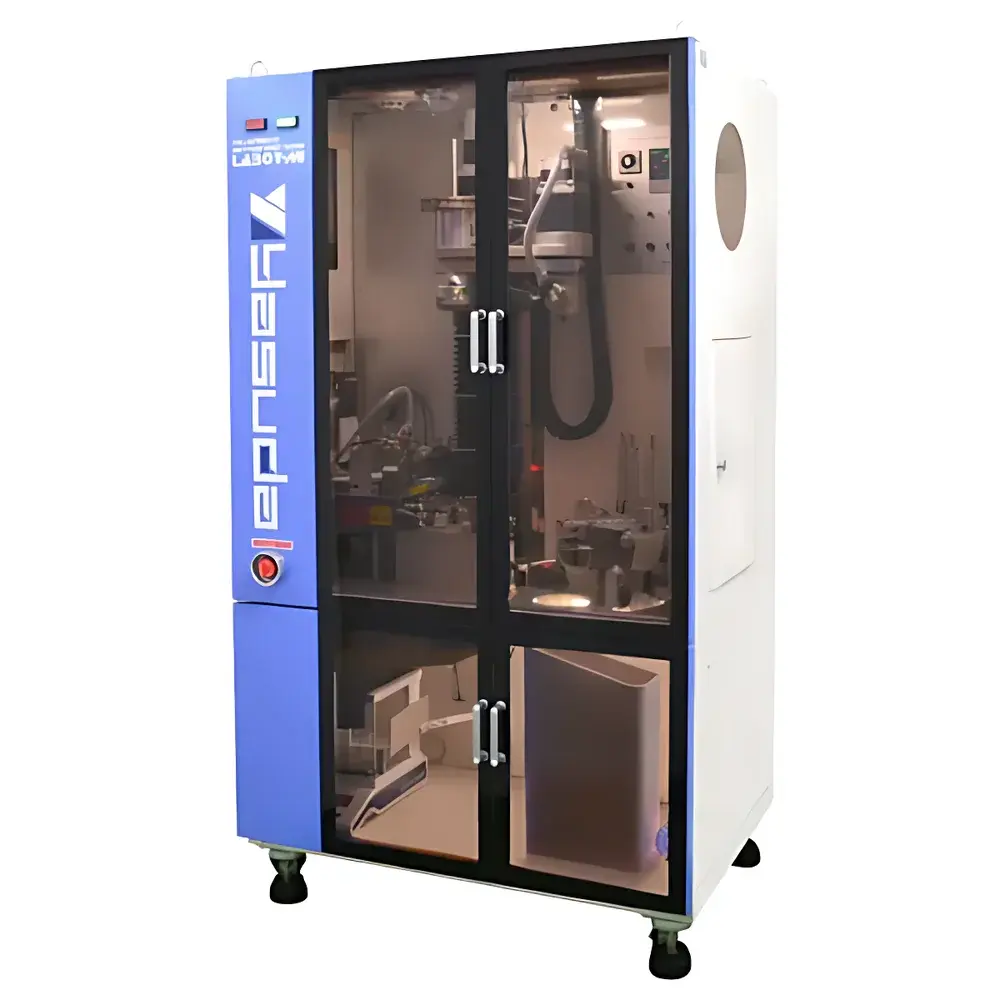
Yasuda No.120-LABOT-MI Intelligent Multi-Station Melt Flow Indexer (12/24/50-Position Configurable)
| Brand | Yasuda |
|---|---|
| Origin | Japan |
| Model | No.120-LABOT-MI |
| Temperature Range | Up to 300 °C (optional 400 °C) |
| Die Dimensions | φ2.095 ± 0.005 mm × 8.000 ± 0.025 mm |
| Piston Diameter | φ9.474 ± 0.007 mm |
| Cylinder Inner Diameter | φ9.550 ± 0.007 mm |
| Standard Test Loads | 0.325, 1.20, 2.16, 3.80, 5.00, 10.00, 21.60 kgf |
| Compliance | ASTM D1238, ISO 1133, GB/T 1031–2016, JIS K7210 |
| Automation Level | Fully Automated (A-Method MFR & B-Method MVR), Including Auto-Feeding, Auto-Loading, Auto-Cutting, Auto-Weighing, Auto-Cleaning (Die/Cylinder/Piston/Nozzle Rod/Lint Removal) |
| Position Configurations | 12-, 24-, or 50-station modular carousel |
| Power Supply | AC 200/220 V, 1φ, 15 A, 50/60 Hz |
| Air Supply | ≥0.5 MPa |
| Dimensions (12/24-station) | ~950 × 680 × 1720 mm |
| Weight | ~350 kg |
| Dimensions (50-station) | ~1100 × 700 × 1750 mm |
| Weight | ~400 kg |
Overview
The Yasuda No.120-LABOT-MI Intelligent Multi-Station Melt Flow Indexer is an engineered solution for high-throughput, traceable, and standards-compliant melt flow rate (MFR) and melt volume rate (MVR) determination of thermoplastic polymers. Based on the fundamental principle of extrusion plastometry—measuring the mass or volume of polymer melt extruded through a standardized capillary die under controlled temperature and specified load—the instrument delivers reproducible rheological data essential for quality control, formulation development, and process validation in rubber and plastic manufacturing. Designed for strict adherence to ASTM D1238 (Condition A for MFR, Condition B for MVR), ISO 1133-1/-2, GB/T 1031–2016, and JIS K7210, the system supports both gravimetric (A-method) and volumetric (B-method) measurement protocols with full metrological traceability. Its modular architecture accommodates 12-, 24-, or 50-position sample carousels, enabling unattended batch testing across diverse resin grades—including PP, PE, PS, ABS, PC, and engineering thermoplastics—without manual intervention between runs.
Key Features
- Multi-position automated carousel (12/24/50 stations) with precision indexing and thermal stability across all positions
- Integrated robotic handling system performing auto-feeding, auto-loading, auto-cutting (via heated blade), auto-weighing (with internal analytical balance), and auto-calculation of MFR/MVR values per ISO 1133-2 Annex C
- Full-cycle automated cleaning: solvent-based cylinder purge, motorized die scrubbing, piston surface wiping, nozzle rod washing, and lint removal using disposable non-woven fabric—minimizing carryover and cross-contamination
- High-accuracy temperature control (±0.2 °C uniformity over 160 mm heating zone) with optional 400 °C configuration for high-temperature resins (e.g., PEEK, PEI)
- Standardized capillary geometry compliant with ISO 1133: die diameter φ2.095 ± 0.005 mm, length 8.000 ± 0.025 mm; piston diameter φ9.474 ± 0.007 mm; cylinder ID φ9.550 ± 0.007 mm
- Selectable test loads from 0.325 to 21.60 kgf, with certified stainless-steel weights traceable to national standards
- Built-in rotary encoder for high-resolution displacement measurement (0.001 mm resolution) during MVR testing
- Modular expandability: optional feed purification unit, vacuum drying station, compressed air supply module, fume extraction with smoke sensor, and temperature calibration kit
Sample Compatibility & Compliance
The No.120-LABOT-MI accommodates granular, pelletized, and powdered thermoplastics without pre-conditioning—though optional desiccation modules ensure moisture-sensitive materials (e.g., PA6, PET) meet ISO 291 conditioning requirements. All mechanical and thermal subsystems are validated against ISO/IEC 17025 technical competence criteria. The system supports GLP/GMP-aligned audit trails: each test record includes timestamped operator ID, environmental temperature/humidity logs (if external sensors integrated), weight calibration history, temperature ramp profiles, load application verification, and raw encoder/weight data. Full compliance with FDA 21 CFR Part 11 is enabled via optional electronic signature module and encrypted database logging. Test reports export in PDF/A-1b and CSV formats, embedding digital signatures and checksums for long-term archival integrity.
Software & Data Management
Controlled by Windows-compatible LABOT-MI Suite v4.x, the software provides role-based access (Administrator, Technician, Reviewer), real-time monitoring of all 50 stations simultaneously, and dynamic method templates aligned with ASTM D1238 Annexes and ISO 1133-2 Clause 7. Raw data—including cut intervals, piston displacement vs. time, melt density derivation (for MVR→MFR conversion), and statistical summaries (mean, SD, CV%, n)—are stored in an embedded SQL database with automatic backup to network drives. The suite supports custom report generation per internal SOP or regulatory submission requirements (e.g., ICH M4Q, USP ). Audit trail review includes immutable records of parameter changes, user logins, result approvals/rejections, and device calibration events—all timestamped and digitally signed.
Applications
- QC release testing of incoming polymer lots against MFR specifications (e.g., PP homopolymer MFR 12–25 g/10 min @ 230 °C/2.16 kgf)
- Stability studies tracking MFR drift during accelerated aging or UV exposure
- R&D screening of copolymer composition effects on melt viscosity
- Production line support via optional inline variant (LABOT-MI ONLINE) with continuous feed and real-time MVR trending
- Failure analysis of degraded batches exhibiting abnormally high or low flow indices
- Validation of extrusion screw design parameters using reference material interlaboratory comparisons
FAQ
Does the system comply with ISO/IEC 17025 requirements for accredited testing laboratories?
Yes—mechanical dimensions, temperature uniformity, load accuracy, and encoder resolution are verified annually per ISO 1133-1 Annex A and ISO/IEC 17025 Clause 6.4. Calibration certificates include uncertainty budgets.
Can MFR and MVR be measured simultaneously on the same sample?
No—MFR (gravimetric) and MVR (volumetric) require separate test cycles due to differing measurement physics; however, the system allows rapid reconfiguration between methods within the same session.
Is remote diagnostics and firmware update supported?
Yes—via secure TLS-encrypted Ethernet connection; remote support requires prior authorization and adheres to IEC 62443-3-3 security policies.
What maintenance intervals are recommended for the solvent cleaning system?
Solvent reservoir replacement every 200 tests; ceramic nozzle rod brushes replaced after 1,000 cycles; die and cylinder polishing recommended quarterly based on usage frequency and polymer char accumulation.
Are third-party LIMS integrations available?
Yes—through HL7 v2.5 and ASTM E1384-compliant API interface; validated connectors exist for Thermo Fisher SampleManager, LabVantage, and STARLIMS.





