
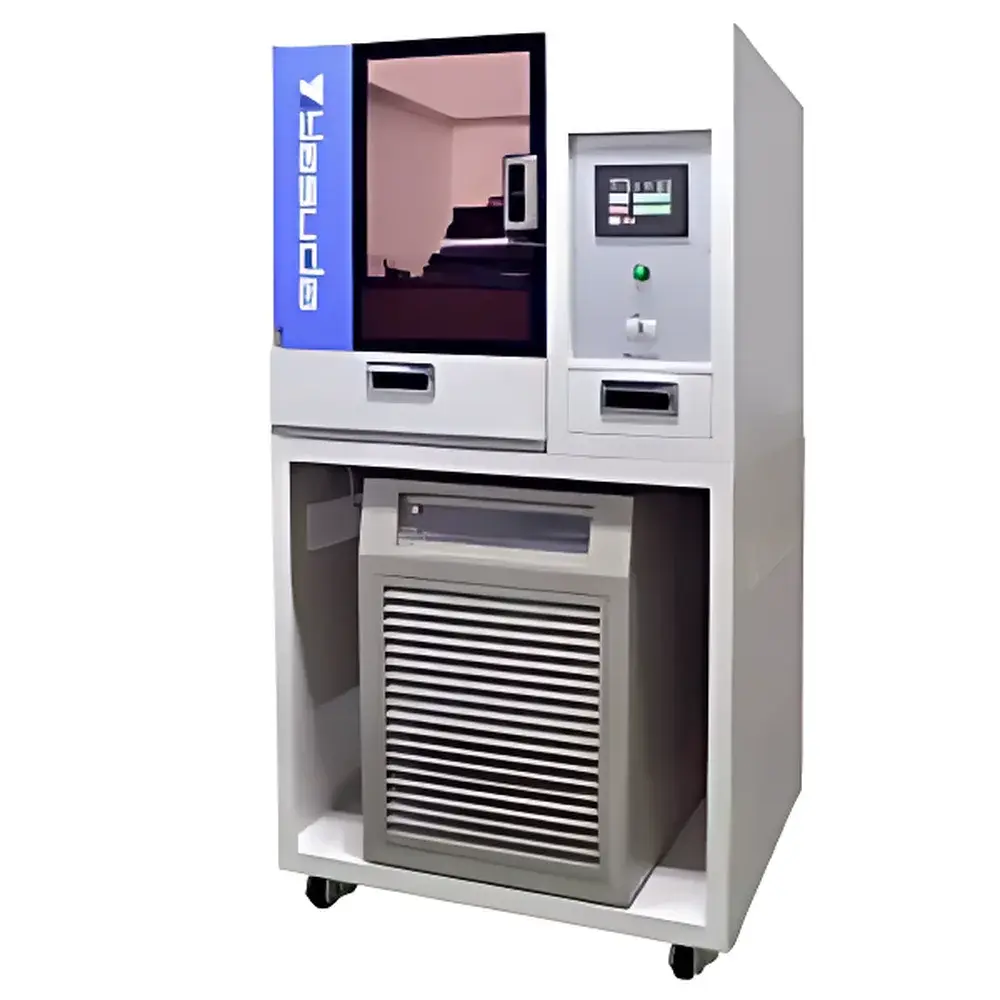
Yasuda No.121-R Brittle Temperature Tester with Integrated Refrigeration Unit
| Brand | Yasuda |
|---|---|
| Origin | Japan |
| Model | No.121-R |
| Low-Temperature Range | –70 °C (optional –100 °C with liquid nitrogen assist) |
| Temperature Stability | ±0.45 °C |
| Specimen Dimensions (Type A) | 38 ±2 mm (L) × 6.0 ±0.4 mm (W) × 2.0 ±0.2 mm (T) |
| Impact Velocity | 2.0 ±0.2 m/s |
| Impact Blade Tip Radius | R1.6 ±0.1 mm |
| Support Span | 6.4 ±0.2 mm |
| Distance from Support to Impact Point | 8.0 ±0.2 mm |
| Specimen Capacity | 5 per fixture (standard), up to 20 with optional multi-fixture kit |
| Heat Transfer Medium Volume | ~15 L |
| Power Supply | AC 200 V, 3-phase, 30 A, 50/60 Hz |
| Dimensions (W×D×H) | 970 × 950 × 1900 mm |
| Weight | ~450 kg |
Overview
The Yasuda No.121-R Brittle Temperature Tester with Integrated Refrigeration Unit is a precision-engineered instrument designed for the standardized determination of the brittle temperature of polymeric materials—including thermoplastics, elastomers, and insulated wires—under controlled low-temperature conditions. It operates on the principle of impact-induced bending fracture, in accordance with internationally recognized test methods including ASTM D746, ISO 812, ISO 974, JIS K6261, JIS K6723, JIS K7216, and JIS C3005. The system subjects standardized Type A specimens (38 mm × 6 mm × 2 mm) to a single-point impact at a precisely regulated velocity (2.0 ± 0.2 m/s) while immersed in a thermally stabilized cryogenic bath. The brittle temperature is defined as the lowest temperature at which 50% of tested specimens exhibit brittle fracture upon impact—or alternatively, the critical transition temperature below which catastrophic failure becomes statistically dominant. Unlike ambient or dry-ice-cooled alternatives, the No.121-R integrates a dedicated mechanical refrigeration unit capable of maintaining stable operation down to –70 °C; optional liquid nitrogen integration extends operational capability to –100 °C for high-performance polymer characterization.
Key Features
- Integrated dual-stage refrigeration system enabling stable, long-duration testing at –70 °C (–100 °C with LN2 assist), eliminating reliance on consumable dry ice
- High-precision mechanical impact mechanism with calibrated blade geometry (R1.6 ± 0.1 mm tip radius) and fixed support span (6.4 ± 0.2 mm)
- Thermal stability of ±0.45 °C across the entire test chamber volume, verified per ASTM E2202 and ISO/IEC 17025 traceable protocols
- Modular specimen fixture accommodating five Type A specimens per cycle; optional 4-fixture kits support parallel evaluation of up to 20 samples
- Full compliance with specimen dimensional tolerances specified in ASTM D746 and ISO 812: length 38 ± 2 mm, width 6.0 ± 0.4 mm, thickness 2.0 ± 0.2 mm
- Robust stainless-steel cryobath housing filled with ~15 L of thermally conductive silicone-based heat transfer medium
- Industrial-grade 3-phase power interface (AC 200 V, 30 A) ensuring consistent compressor and actuator performance under continuous thermal load
Sample Compatibility & Compliance
The No.121-R is validated for use with rigid and semi-crystalline thermoplastics (e.g., PVC, ABS, polycarbonate), vulcanized rubber compounds (NR, SBR, EPDM), and insulated electrical cables meeting IEC 60811 and UL 1581 requirements. Specimen preparation follows strict dimensional controls to ensure inter-laboratory reproducibility. Test reports generated using this system satisfy regulatory submission requirements under FDA 21 CFR Part 11 when paired with compliant data logging software (see Software & Data Management). The instrument’s mechanical design and thermal control architecture conform to ISO/IEC 17025 calibration traceability standards, and its operational envelope supports full alignment with GLP and GMP environmental testing workflows.
Software & Data Management
While the base No.121-R operates via manual temperature setpoint control and visual fracture assessment, it is fully compatible with third-party compliant data acquisition systems supporting ASTM E2202-compliant thermal profiling and impact event timestamping. Optional digital interfaces enable connection to PC-based platforms running validated software for automated temperature ramping, pass/fail classification per specimen, statistical analysis of brittle point distribution (probit analysis), and audit-trail generation. All electronic records comply with ALCOA+ principles (Attributable, Legible, Contemporaneous, Original, Accurate, Complete, Consistent, Enduring, Available) and support 21 CFR Part 11 electronic signature implementation when deployed within validated laboratory information management systems (LIMS).
Applications
- Determination of ductile-to-brittle transition temperature (DBTT) for automotive polymer components exposed to winter climates
- Quality assurance of cable insulation integrity for aerospace and marine applications operating below –40 °C
- Material screening during polymer formulation development, especially for low-temperature sealants and elastomeric gaskets
- Conformance testing of medical device tubing (e.g., PVC, TPE) per ISO 10993-1 biocompatibility environmental stress protocols
- Supporting failure analysis investigations where low-temperature embrittlement is suspected in field returns
- Research into crystallinity effects on cold-impact resistance in polyolefin blends and copolymers
FAQ
What standards does the No.121-R directly support?
It is mechanically and thermally configured to meet all dimensional, kinematic, and environmental requirements of ASTM D746, ISO 812, ISO 974, JIS K6261, JIS K6723, JIS K7216, and JIS C3005.
Can the system operate continuously at –70 °C?
Yes—the integrated refrigeration unit is rated for sustained operation at –70 °C with thermal stability maintained within ±0.45 °C over 24-hour cycles under standard ambient conditions (25 °C, 50% RH).
Is liquid nitrogen required to reach –100 °C?
The –100 °C option requires auxiliary liquid nitrogen injection into the primary cryobath; the base refrigeration system alone achieves –70 °C.
How is specimen fracture assessed?
Fracture is determined visually per standard criteria: complete separation into two or more pieces, or cracking extending ≥50% through the specimen thickness measured perpendicular to the impact axis.
Does Yasuda provide calibration documentation?
Yes—each unit ships with a factory calibration certificate traceable to NMIJ (National Metrology Institute of Japan) for temperature sensors and impact velocity verification, valid for 12 months under normal use conditions.



