
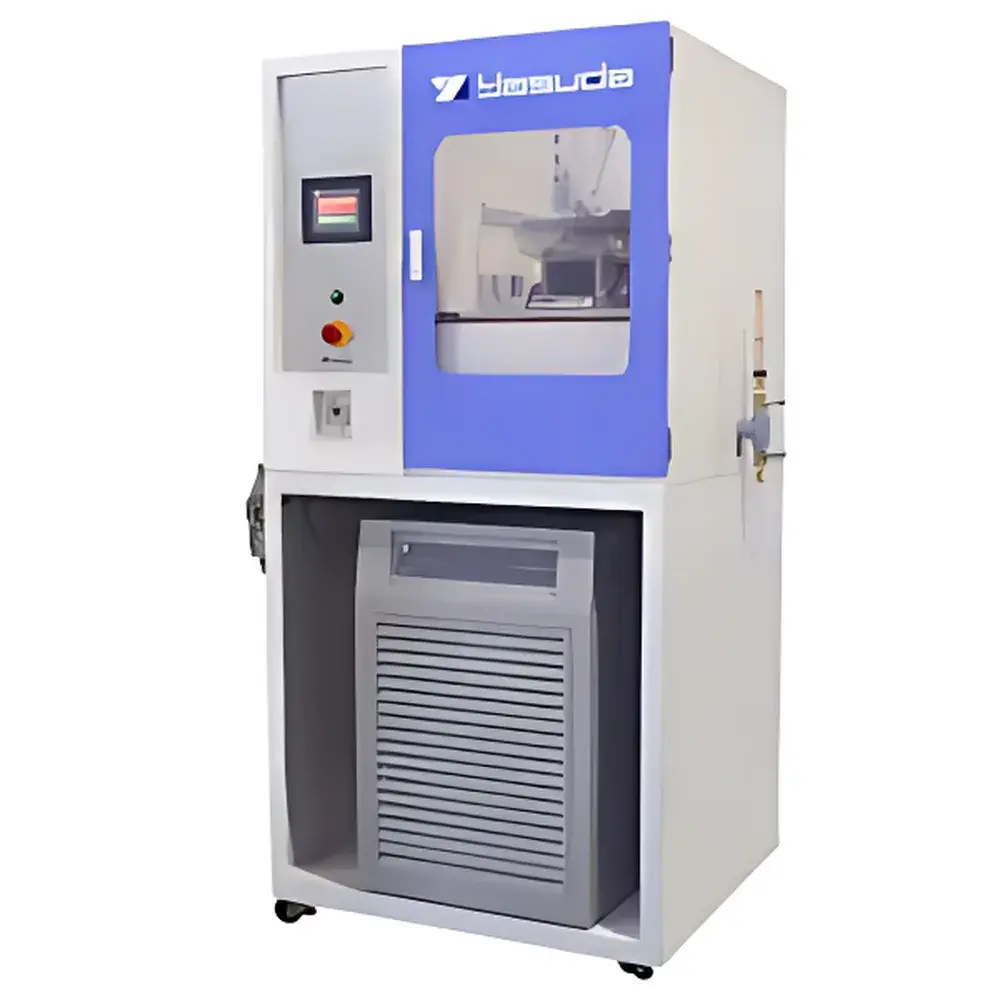
Yasuda No.121-RA Rotary Holder Type Brittleness Temperature Tester for Plastics and Elastomers
| Brand | Yasuda |
|---|---|
| Origin | Japan |
| Model | No.121-RA |
| Low-Temperature Range | −70 °C (extendable to −100 °C with optional liquid nitrogen cooling) |
| Specimen Dimensions (Type A) | 6.0 ± 0.4 mm width × 38 ± 2 mm length × 2.0 ± 0.2 mm thickness |
| Impact Velocity | 2.0 ± 0.2 m/s |
| Anvil-to-Striker Distance | 8.0 ± 0.2 mm |
| Clamp Span | 6.4 ± 0.2 mm |
| Striker Tip Radius | R1.6 ± 0.1 mm |
| Specimen Capacity | 20 positions (5 specimens × 4 rotary holders) |
| Heat Transfer Medium Volume | ~15 L |
| Power Supply | AC 200 V, 3-phase, 30 A, 50/60 Hz |
| Air Supply Requirement | ≥0.5 MPa |
| Dimensions (W×D×H) | 970 × 950 × 1900 mm |
| Weight | ~450 kg |
Overview
The Yasuda No.121-RA Rotary Holder Type Brittleness Temperature Tester is a precision-engineered instrument designed to determine the brittle temperature of polymeric materials—including thermoplastics, elastomers, vulcanized rubber, and flexible composites—under standardized low-temperature conditions. It operates on the principle of dynamic impact testing: a pendulum-mounted striker delivers a controlled mechanical impulse to a specimen clamped between two supports, while the entire test chamber maintains a thermally stabilized environment from ambient down to −70 °C (with optional liquid nitrogen integration enabling operation at −100 °C). Compliance with internationally recognized test methods—including JIS K6261, JIS K6723, JIS K7216, JIS C3005, ASTM D746, ISO 812, and ISO 974—ensures data interoperability across global R&D, quality control, and regulatory submission workflows. Unlike static bend or tensile-based low-temperature assessments, this system evaluates material failure under rapid, localized stress at sub-zero temperatures—a critical parameter for automotive sealing systems, cryogenic cable jackets, medical tubing, and aerospace gasketing.
Key Features
- Rotary holder mechanism enabling sequential, unattended testing of up to 20 specimens (5 per holder × 4 holders), significantly improving throughput and inter-test consistency.
- Touchscreen HMI interface with intuitive parameter configuration—test temperature, dwell time, and cycle count—supporting repeatable thermal conditioning prior to impact.
- High-fidelity impact train calibrated to deliver 2.0 ± 0.2 m/s striker velocity, with traceable geometry: R1.6 ± 0.1 mm tip radius, 6.4 ± 0.2 mm clamp span, and 8.0 ± 0.2 mm anvil-to-impact-point offset per ASTM D746 and ISO 812 specifications.
- Cryogenic chamber architecture utilizing refrigerant-circulating heat transfer medium (~15 L volume), compatible with either compressor-based cooling (standard −70 °C minimum) or liquid nitrogen auxiliary chilling (extended range to −100 °C).
- Robust mechanical construction: heavy-duty steel frame (450 kg total mass) minimizes vibration-induced measurement noise; pneumatic clamping (≥0.5 MPa supply) ensures uniform specimen fixation across thermal gradients.
- Integrated safety interlocks—including door position sensing, overpressure relief, and thermal runaway monitoring—aligned with IEC 61000-6-2/6-4 and CE machinery directive requirements.
Sample Compatibility & Compliance
The No.121-RA accepts standard Type A specimens per ASTM D746 and ISO 812 (6.0 ± 0.4 mm × 38 ± 2 mm × 2.0 ± 0.2 mm), with optional B-type holder configurations available upon request. Specimen preparation tools—including precision cutting die, torque-controlled fastening rods, and alignment jigs—are supplied as standard accessories. The system is validated for use in GLP-compliant laboratories and supports audit-ready documentation when paired with external data loggers. Test reports generated using this instrument meet evidentiary requirements for ISO/IEC 17025 accreditation, particularly in mechanical property verification for automotive OEM Tier-1 suppliers (e.g., IATF 16949 clause 8.5.1.4) and medical device polymer qualification (ISO 10993-12).
Software & Data Management
While the No.121-RA operates via embedded firmware without proprietary PC software, its digital I/O ports (RS-485, analog voltage outputs) enable integration into centralized laboratory information management systems (LIMS) or SCADA platforms. Temperature profiles, cycle timestamps, and pass/fail outcomes per specimen are logged internally with UTC-synchronized timestamps and exportable via USB memory. For regulated environments, optional 21 CFR Part 11–compliant electronic record modules (including user authentication, audit trails, and electronic signatures) can be deployed through third-party validation partners—facilitating FDA submissions and EU MDR technical file compilation.
Applications
- Determination of brittle point in PVC, EPDM, silicone, TPU, and fluoropolymer compounds used in outdoor wiring harnesses and cryogenic fluid handling.
- Quality assurance screening of recycled polymer blends where thermal aging may reduce low-temperature ductility.
- Development of cold-resistant sealants and adhesives for polar-region infrastructure projects.
- Validation of elastomeric components in battery thermal management systems operating below −40 °C.
- Comparative evaluation of plasticizer efficiency in rigid PVC formulations intended for winter-grade construction profiles.
FAQ
What standards does the No.121-RA directly support?
It is mechanically and thermally configured to execute JIS K6261, JIS K6723, JIS K7216, JIS C3005, ASTM D746, ISO 812, and ISO 974 without hardware modification.
Can the system operate continuously at −100 °C?
Yes—with optional liquid nitrogen cooling integration and appropriate thermal insulation upgrades; continuous operation requires external LN₂ supply management and dewar-level monitoring.
Is specimen preparation automated?
No; manual cutting and dimensioning are required per standard specifications, but included tooling ensures dimensional compliance within stated tolerances.
Does the unit include calibration certification?
Factory calibration certificates for temperature uniformity (±1.0 °C across working volume) and impact velocity (traceable to NMIJ/JNLA) are provided with shipment.
What maintenance intervals are recommended?
Compressor oil and refrigerant levels require inspection every 500 operational hours; striker tip geometry and clamp surfaces should be verified quarterly using certified gauge blocks and surface roughness testers.



