
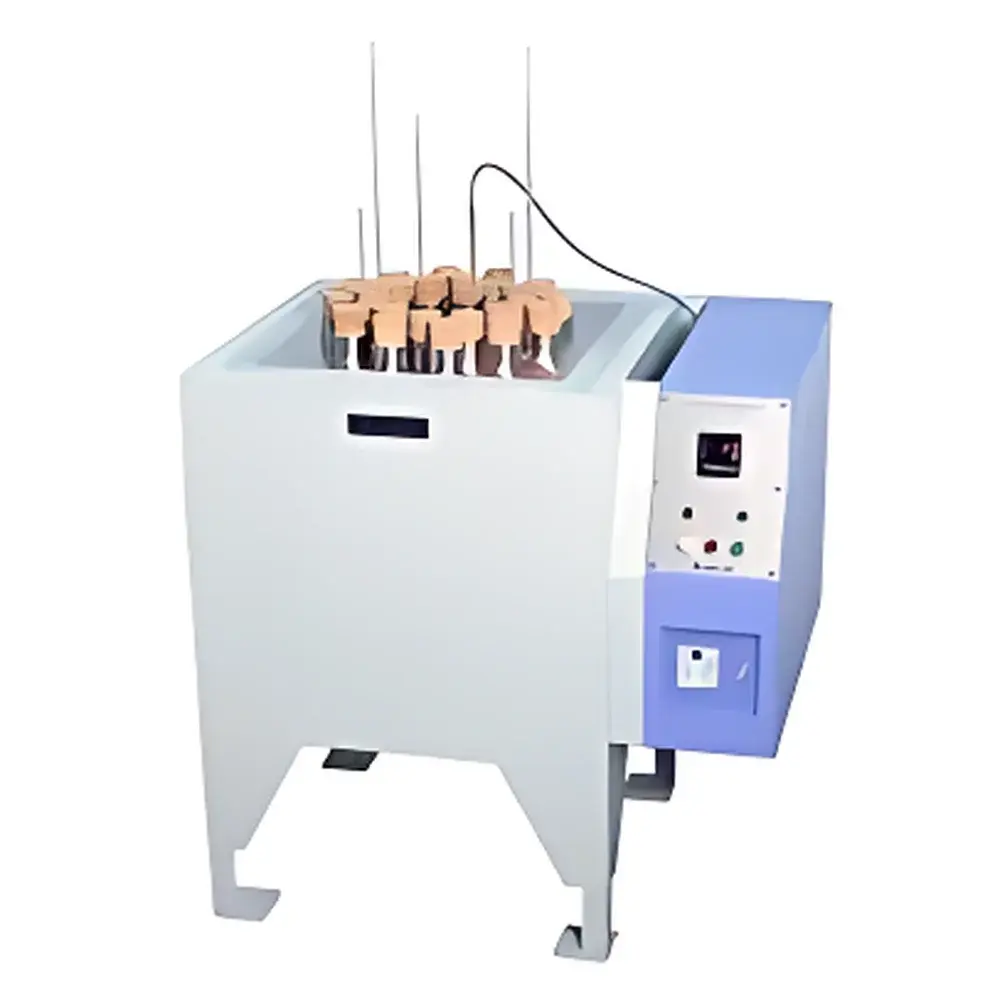
Yasuda No.122 Tube-Type Air-Aging Test Chamber for Vulcanized and Thermoplastic Elastomers
| Brand | Yasuda |
|---|---|
| Origin | Japan |
| Model | No.122 |
| Temperature Range | Up to 300 °C |
| Tube Capacity | 24 tubes (φ38 × 300 mm) |
| Standard Compliance | JIS K6257, ASTM D865, ISO 188 |
| Power Supply | AC 200 V, 1-phase, 20 A, 50/60 Hz |
| Dimensions (W×D×H) | 700 × 560 × 700 mm |
| Weight | ~110 kg |
| Safety Features | Overheat prevention device, earth leakage circuit breaker |
| Accessories Included | 30 aging tubes, 96 air inlet/outlet tubes (48 × φ9 × 375 mm + 48 × φ9 × 405 mm), 30 cork stoppers, 30 metal sample hangers, 24 sleeve pins, 150 washers, mercury thermometer |
Overview
The Yasuda No.122 Tube-Type Air-Aging Test Chamber is a precision-engineered environmental test system designed specifically for evaluating the thermal oxidative aging behavior of vulcanized rubber and thermoplastic elastomers under controlled atmospheric conditions. Based on the fundamental principle of accelerated aging via convective air heating in sealed, inert-atmosphere-compatible glass or metal tubes, this instrument enables standardized exposure of test specimens to elevated temperatures—up to 300 °C—with high spatial uniformity and temporal stability. Unlike bulk chamber designs, the tube-based architecture isolates individual samples, minimizing cross-contamination from volatile decomposition products, plasticizer migration, or antioxidant depletion—critical for eliminating confounding variables such as additive blooming or surface oxidation gradients. The system operates in strict accordance with internationally recognized material aging protocols, including JIS K6257 (Rubber—Determination of resistance to heat aging), ASTM D865 (Standard Test Method for Rubber Deterioration—Heat Aging), and ISO 188 (Rubber, vulcanized or thermoplastic—Accelerated ageing and heat resistance tests). Its design supports quantitative pre- and post-aging mechanical evaluation—including tensile strength, elongation at break, tensile stress at specified elongation, and Shore A hardness—to calculate retention ratios and degradation kinetics.
Key Features
- 24-position vertical tube rack with precise thermal zoning—ensuring ±1.5 °C temperature uniformity across all positions at steady state.
- Individual quartz or borosilicate glass aging tubes (φ38 mm × 300 mm L) accommodating up to four standardized dumbbell or rectangular test pieces per tube—enabling replicate testing and statistical robustness per condition.
- Dual-stage airflow management: independent inlet and outlet tubing sets (φ9 mm OD; 48 each of two lengths) allow optional nitrogen purging or ambient air circulation, supporting both oxidative and inert-atmosphere aging studies.
- Integrated overheat protection circuitry and residual-current circuit breaker (RCCB) compliant with IEC 61000-4-5 surge immunity standards—ensuring operational safety during extended high-temperature cycles (e.g., 72–168 h at 100–150 °C).
- Modular accessory kit: includes calibrated mercury thermometer (range –10 to 350 °C), stainless steel hangers with non-reactive coatings, silicone-free cork stoppers, and precision-machined sleeve pins and washers—designed to prevent mechanical stress artifacts during suspension.
- Robust structural frame fabricated from cold-rolled steel with high-emissivity ceramic-coated interior walls—minimizing thermal lag and improving ramp rate reproducibility between cycles.
Sample Compatibility & Compliance
The No.122 chamber accommodates standard ISO 37, ASTM D412, and JIS K6251-compliant test pieces (e.g., Type 1A dumbbells, 2 mm thick; or 25 mm × 10 mm × 2 mm rectangular strips). Specimen mounting utilizes chemically inert, low-outgassing metal hangers that eliminate contact-induced creep or localized oxidation. All accessories are traceable to Japanese Industrial Standards (JIS) metrological guidelines. The system is routinely validated for GLP-compliant laboratories conducting aging studies under ISO/IEC 17025-accredited quality systems. While not intrinsically FDA 21 CFR Part 11–compliant (as it generates analog temperature records), its output is fully compatible with external digital data loggers meeting ALCOA+ principles—supporting audit-ready documentation for regulatory submissions related to medical device elastomer qualification or automotive sealing material certification.
Software & Data Management
The Yasuda No.122 operates as a standalone hardware platform without embedded microcontroller or proprietary software. This architecture ensures long-term maintainability and eliminates firmware obsolescence risks common in digitally integrated chambers. Users record temperature profiles manually using the supplied mercury thermometer or integrate third-party Class I platinum RTD loggers (e.g., Omega OM-EL-USB-TC or Testo 176 T4) connected to validated PC-based acquisition platforms. All aging parameters—including start time, target temperature, dwell duration, and ambient humidity—are documented in laboratory notebooks or electronic lab notebooks (ELNs) configured for 21 CFR Part 11 compliance. Raw mechanical test data (tensile, hardness) generated post-aging are linked to chamber run IDs via structured metadata fields, enabling full traceability from thermal exposure to final property assessment.
Applications
- Accelerated life prediction modeling for EPDM, NBR, silicone, and fluorocarbon elastomers used in automotive under-hood seals, HVAC gaskets, and aerospace O-rings.
- Formulation screening of antioxidant packages (e.g., hindered phenols, phosphites) and filler systems (carbon black vs. silica) under ISO 188 Condition B (70 °C, 168 h) or ASTM D865 Condition III (125 °C, 72 h).
- Qualification of medical-grade thermoplastic elastomers (TPEs) per ISO 10993-12 extraction protocols requiring controlled thermal aging prior to cytotoxicity testing.
- Root cause analysis of field failures—correlating service temperature history with laboratory-simulated aging outcomes to validate Arrhenius-based activation energy calculations.
- Supporting ISO 22301 business continuity planning by establishing thermal degradation thresholds for critical elastomeric infrastructure components.
FAQ
What standards does the Yasuda No.122 explicitly support?
It is mechanically and operationally aligned with JIS K6257, ASTM D865, and ISO 188—each specifying tube geometry, specimen loading density, airflow requirements, and temperature tolerance limits.
Can the chamber be used for ozone aging or UV exposure testing?
No. It is strictly an air-heating thermal aging system. Ozone and UV require separate exposure apparatuses per ASTM D1149 and ISO 4892-3.
Is nitrogen purging capability built-in?
Yes—via the dual-length air inlet/outlet tube set, users can connect external N₂ supply lines and achieve <10 ppm O₂ residual levels when paired with appropriate flowmeters and pressure regulators.
How is temperature calibration performed?
Using the included mercury thermometer verified against NIST-traceable reference standards; optional PT100 probe insertion through tube caps enables real-time validation during qualification runs.
Are replacement tubes available with different diameters or materials?
Yasuda offers custom-order options including quartz tubes (for >300 °C applications) and stainless-steel variants (for aggressive chemical environments); standard φ38 mm glass tubes are stocked globally via authorized distributors.



