
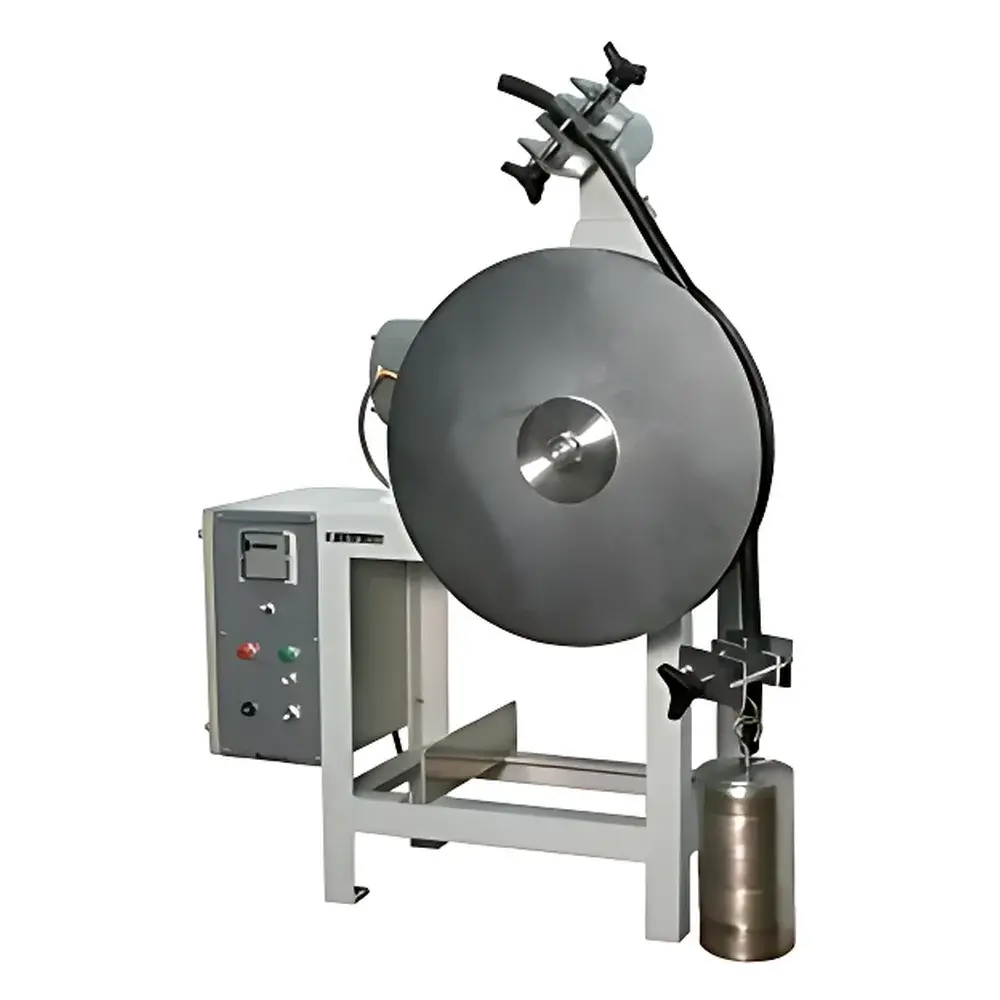
Yasuda No.127 CABTYRE Cable Abrasion Tester
| Brand | Yasuda |
|---|---|
| Origin | Japan |
| Model | No.127 |
| Applicable Standard | JIS C 3005 |
| Test Principle | Rotating abrasive disk with controlled load and vertical suspension geometry |
| Sample Mounting | Fixed at center of rotating disk, free-hanging opposite end with calibrated dead-weight loading |
| Disk Rotation Speed | Adjustable (standard test speed per JIS C 3005) |
| Load Range | Standardized weights for cable tension control (e.g., 500 g, 1000 g, 2000 g) |
| Vertical Drop Distance | ~300 mm from disk center to clamping point |
| Compliance | Designed for JIS C 3005 conformance |
Overview
The Yasuda No.127 CABTYRE Cable Abrasion Tester is a precision-engineered tribological testing instrument specifically designed to evaluate the abrasion resistance of rubber- and plastic-insulated flexible cables under standardized mechanical stress conditions. It operates on a well-established mechanical wear principle: a vertically suspended cable specimen is clamped at its midpoint above a rotating abrasive disk, while its free end bears a calibrated dead weight. As the disk rotates at a defined speed, the cable undergoes repetitive lateral contact and frictional sliding against the abrasive surface—mimicking real-world mechanical wear encountered during installation, routing, or service in industrial, automotive, and building wiring applications. This method directly assesses the durability of outer jackets—particularly critical for low-voltage, multi-core, and portable power cables where jacket integrity prevents conductor exposure, short circuits, and safety hazards. The tester is fully aligned with JIS C 3005 (“Test Methods for Rubber- or Plastic-Insulated Wires and Cables”), which specifies the geometric configuration, loading protocol, rotational parameters, and pass/fail criteria based on complete jacket removal.
Key Features
- Engineered mechanical architecture ensuring consistent vertical alignment and minimal lateral deviation during rotation—critical for reproducible wear track formation.
- Precision-machined aluminum abrasive disk mounting platform with adjustable rotational speed control (typically 40–60 rpm range per JIS C 3005 guidance).
- Dual-point clamping system: upper fixed clamp positioned precisely 300 mm above disk center; lower termination secured via standardized weight hanger with traceable calibration masses (500 g, 1000 g, 2000 g options).
- Modular sample holder compatible with round-section cables ranging from Ø2.0 mm to Ø12.0 mm diameter, accommodating both single- and multi-conductor configurations with insulated sheaths.
- Stainless steel frame and corrosion-resistant components ensure long-term dimensional stability and resistance to environmental degradation in lab or production floor environments.
- No electronic sensors or data logging built-in—designed as a deterministic, operator-observed pass/fail apparatus per JIS-defined visual inspection endpoints.
Sample Compatibility & Compliance
The No.127 is validated for use with thermoplastic (e.g., PVC, PE, TPE) and thermoset (e.g., EPDM, CR, silicone) insulated cables meeting JIS C 3005 scope—including but not limited to CABTYRE, CVV, H05VV-F, and H07RN-F type designations. Specimens must be straight, untwisted, and free of kinks or prior mechanical damage. The test procedure mandates pre-conditioning at 20 ± 5 °C for ≥2 hours prior to mounting. Results are assessed visually after prescribed rotation cycles (e.g., 1000–5000 revolutions depending on cable class), with failure defined as full removal of the outer jacket exposing underlying insulation or conductor. While JIS C 3005 is the primary compliance reference, the mechanical configuration may be adapted—under documented SOPs—for internal quality audits aligned with ISO/IEC 17025 requirements or customer-specific durability protocols.
Software & Data Management
The Yasuda No.127 is a purely electromechanical, non-digital instrument. It does not incorporate embedded firmware, microcontrollers, or digital interfaces. All operational parameters—including disk speed, weight selection, and cycle count—are set manually and verified using external calibrated tools (e.g., tachometer, analytical balance). Test records must be maintained manually or entered into laboratory information management systems (LIMS) per GLP/GMP documentation standards. For regulated environments requiring audit trails, users are advised to pair the tester with a dedicated test logbook or electronic batch record system that captures operator ID, date/time, sample ID, applied load, rotation count, and pass/fail determination with signature verification—fully compliant with FDA 21 CFR Part 11 when implemented with appropriate validation and access controls.
Applications
- Quality assurance screening of incoming cable batches in wire & cable manufacturing facilities.
- Process validation for extrusion line parameter optimization (e.g., compound formulation, cooling rate, crosslink density).
- Comparative wear performance assessment across alternative jacket materials (e.g., halogen-free vs. conventional PVC).
- Technical support for UL, PSE, or JIS certification submissions requiring documented abrasion resistance evidence.
- R&D evaluation of novel elastomeric blends intended for high-flex, robotic-arm, or continuous-flex cable applications.
FAQ
Does the No.127 comply with international standards beyond JIS C 3005?
It is purpose-built for JIS C 3005. While its geometry shares conceptual similarity with IEC 60811-504 (abrasion test for insulating compounds), direct equivalency requires method validation and correlation studies.
Can it test flat or shaped-profile cables?
No—it is mechanically optimized for round-section cables only. Non-circular geometries introduce inconsistent contact pressure and invalidate JIS C 3005 conformance.
Is calibration certification included with shipment?
Yasuda provides factory verification of mechanical dimensions and rotational consistency; user-performed periodic verification of weight mass and disk runout is required per ISO/IEC 17025 Clause 6.5.
What maintenance is recommended for long-term accuracy?
Monthly inspection of clamp jaw integrity, disk surface wear uniformity, and bearing smoothness; annual replacement of abrasive disk surface if visible grooving or material transfer occurs.
Is technical support available outside Japan?
Yes—authorized global distributors provide local mechanical support, spare parts logistics, and JIS-compliant operation training upon request.



