
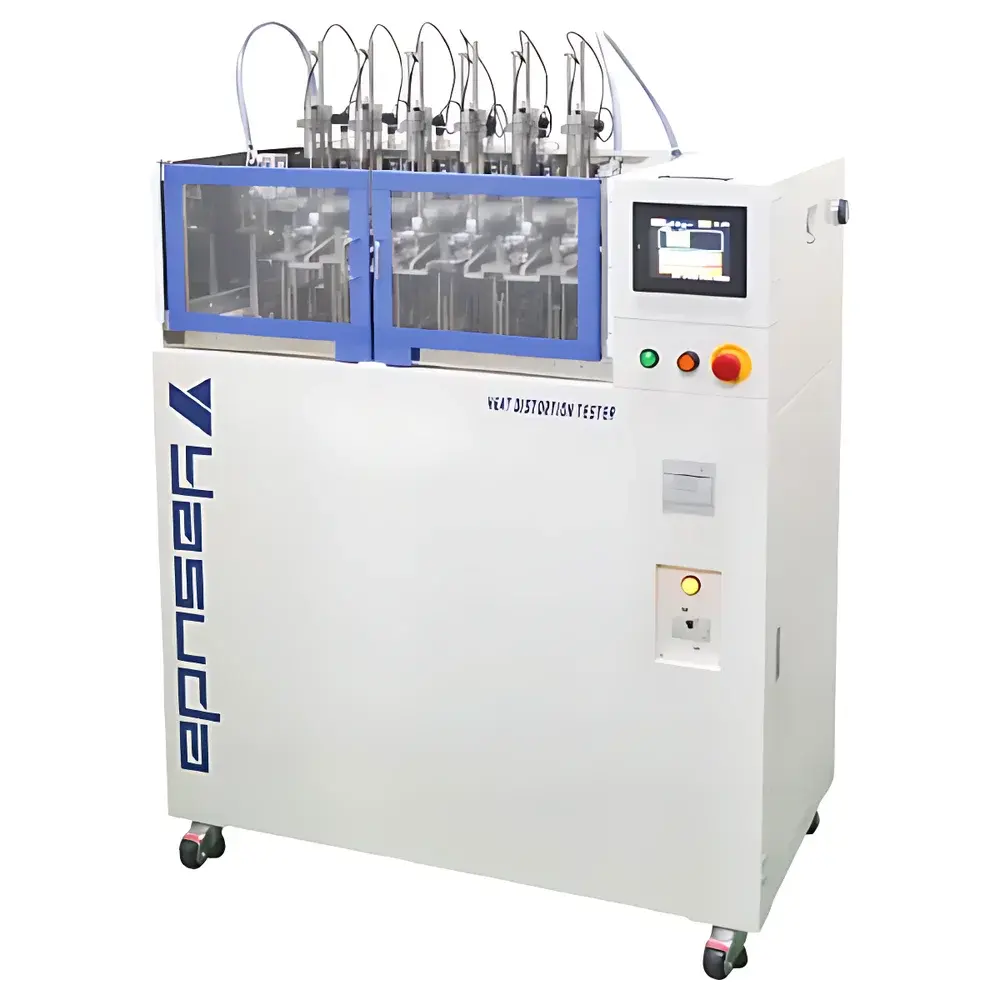
Yasuda No.148-HD-PC Heat Deflection Temperature and Vicat Softening Point Tester
| Brand | Yasuda |
|---|---|
| Origin | Japan |
| Model | No.148-HD-PC |
| Standards Compliance | ASTM D648, D1525 |
| Heating Rate (HDT/Vicat) | 120 ± 10 °C/hr |
| Bending Stress Options | 0.45 MPa (ISO B / ASTM), 1.80 MPa (ISO A / ASTM), 8.00 MPa (ISO C) |
| Load Force Options | DTUL: 76.5–3210 gf |
| Vicat | 10 ± 0.2 N or 50 ± 1 N |
| Ball Pressure | 19.6–20 N |
| Penetrator Geometry | DTUL: R3.0 ± 0.2 mm |
| Vicat | 1.000 ± 0.015 mm² flat-ended needle |
| Ball Pressure | 5 mm diameter spherical tip |
| Span Length | 64 ± 1 mm or 100 ± 1 mm (standard) |
| Displacement Resolution | 0.001 mm (LVDT-based, 4 mm stroke) |
| Max Temp | 300 °C (silicone oil bath) |
| Oil Volume | ~10 L (3-station), ~12 L (4-station), ~17 L (6-station) |
| Cooling | Optional integrated refrigerated chiller (HDA series) |
| Software | Windows 10–compatible proprietary control & analysis suite |
| Power Supply | Single-phase 200/220 V, 20 A (3/4 stations) or 30 A (6 stations) |
| Dimensions (Floor-standing) | W1100 × D700 × H1500 mm |
| Weight | 180–300 kg |
| Dimensions (Bench-top) | W1100 × D700 × H1000 mm |
| Weight | 155–185 kg |
Overview
The Yasuda No.148-HD-PC is a dual-function thermal performance tester engineered for precise determination of Heat Deflection Temperature (HDT) and Vicat Softening Temperature (VST) in thermoplastic and thermosetting polymers. It operates on the fundamental principles of controlled thermal loading under standardized mechanical constraints—specifically, ASTM D648/D1525, ISO 75-1/306, JIS K7191-1/K7206, and IEC 60335-1. The instrument subjects rectangular test specimens to constant flexural stress while ramping temperature at defined rates (120 ± 10 °C/hr for standard HDT/VST, or 50 ± 5 °C/hr for low-rate Vicat testing). Temperature at which specimen deflection reaches prescribed thresholds—0.34 mm for HDT (per ISO/JIS) or 1 mm penetration for VST—is recorded as the material’s thermal resistance index. Its modular design accommodates three distinct test modes: HDT (bending under load), Vicat (needle penetration under static load), and Ball Pressure (spherical indentation for electrical insulation materials per IEC 60335-1). All measurements are traceable to national metrological standards and support GLP-compliant documentation workflows.
Key Features
- Triple-test capability: Simultaneous configuration for HDT, Vicat Softening Point, and Ball Pressure tests via interchangeable penetrators and support fixtures.
- Precision displacement sensing: High-stability linear variable differential transformer (LVDT) with 1 µm resolution and 4 mm full-scale stroke ensures accurate detection of minute deformation onset.
- Thermally uniform silicone oil bath: Temperature-controlled immersion medium (up to 300 °C) with triple or quadruple impeller-driven circulation (depending on station count) minimizes axial and radial thermal gradients (< ±0.5 °C across sample zone).
- Modular load application system: Digitally selectable bending loads (76.5–3210 gf for HDT), calibrated force options (10 N or 50 N for Vicat), and mechanically stable ball pressure assembly (19.6–20 N) conform to ISO, ASTM, and JIS tolerances.
- Configurable test span geometry: Standard 64 mm or 100 mm support spacing; optional 101.6 mm (ASTM-standard) for direct correlation with international reporting requirements.
- Integrated safety architecture: Electromagnetic door lock, visual warning lamp, liquid-level sensor, and overtemperature cutoff prevent operational hazards during extended high-temperature runs.
Sample Compatibility & Compliance
The No.148-HD-PC accepts standard ISO 75 and ASTM D648 rectangular test bars (typically 80 × 10 × 4 mm or 127 × 13 × 3.2 mm). It supports multi-specimen throughput via 3-, 4-, or 6-position sample holders—each independently monitored for displacement and thermal response. All mechanical components—including penetrator tips (R3.0 mm radius for HDT, 1.000 mm² flat-end for Vicat, 5 mm sphere for ball pressure), support anvils, and LVDT couplers—are manufactured to dimensional tolerances specified in ISO 178 and ASTM E2554. The system meets essential requirements for regulatory submissions under FDA 21 CFR Part 11 when paired with audit-trail-enabled software configurations, and supports IQ/OQ documentation packages for GMP-aligned polymer qualification in medical device and automotive supply chains.
Software & Data Management
The included Windows 10–native application provides real-time temperature ramp monitoring, live displacement plotting, automatic endpoint detection (based on user-defined deflection or penetration thresholds), and export-ready data logging (CSV, PDF, XML). Calibration records, operator ID, environmental conditions (ambient temp/humidity), and instrument metadata are embedded into each report. Audit trail functionality logs all parameter modifications, test starts/stops, and calibration events with timestamp and user attribution—fully compliant with ISO/IEC 17025 and GLP Annex 3 requirements. Data integrity is preserved through encrypted local storage and optional network backup integration.
Applications
- Quality control of injection-molded polypropylene, ABS, PC, PEEK, and other engineering thermoplastics in automotive and electronics manufacturing.
- Material selection screening for high-heat applications such as under-hood components, LED housings, and sterilizable medical devices.
- Regulatory compliance testing for UL 746B, IEC 60695-10-2 (glow-wire), and RoHS-relevant thermal stability verification.
- R&D evaluation of flame-retardant formulations, filled composites, and biopolymer blends where heat resistance directly correlates with service life.
- Third-party certification lab validation per ISO/IEC 17025-accredited test methods for contract testing services.
FAQ
What standards does the No.148-HD-PC fully support out-of-the-box?
ASTM D648 (HDT), ASTM D1525 (Vicat), ISO 75-1 & 306, JIS K7191-1 & K7206, and IEC 60335-1 (ball pressure) — all with hardware and software preconfigured to respective load, geometry, and ramp specifications.
Can the system perform HDT and Vicat tests concurrently?
No — the test mode is selected per run due to differing penetrator geometries, load mechanisms, and displacement thresholds; however, rapid reconfiguration between modes is enabled by tool-less fixture swaps and software profile switching.
Is the chiller unit required for routine operation?
Not for ambient-start tests up to 300 °C; however, the integrated HDA-series refrigerated chiller is mandatory for sub-ambient start temperatures (e.g., 20–23 °C initial condition per ISO 75) and enables faster cooldown cycles between sequential tests.
How is measurement traceability maintained?
All critical subsystems — temperature sensors (Pt100 Class A), LVDTs (NIST-traceable linearity), and load cells (calibrated per ISO 376) — are supplied with factory calibration certificates; annual recalibration services include uncertainty budgets per ISO/IEC 17025.
Does the software support electronic signatures for regulated environments?
Yes — when deployed in validated mode with role-based access control, digital signature capture, and 21 CFR Part 11–compliant audit trails, including immutable record retention and change history.





