
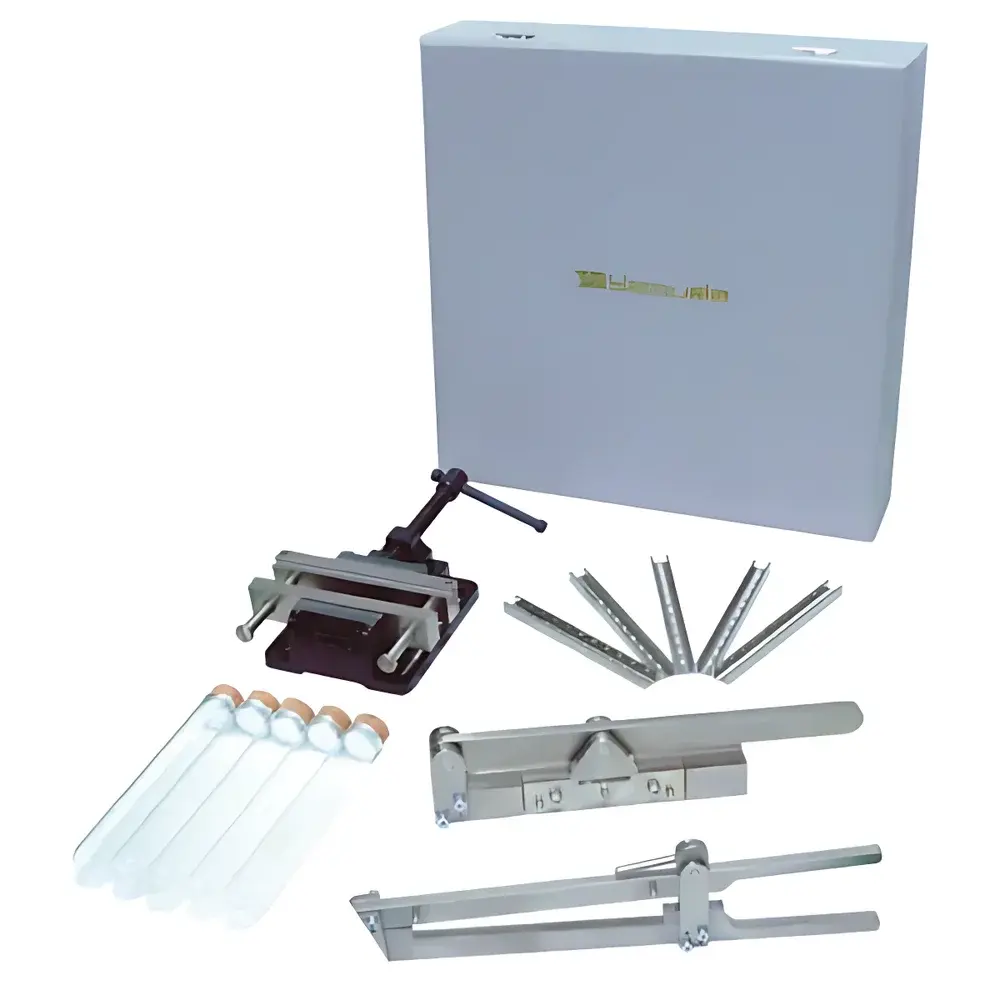
Yasuda No.149 Environmental Stress Cracking Tester
| Brand | Yasuda |
|---|---|
| Origin | Japan |
| Model | No.149 |
| Compliance Standards | JIS K6922-2, JIS Z1703, ASTM D1693, ISO 1872-2 |
| Specimen Dimensions | 13 ± 0.8 mm (w) × 38 ± 2.5 mm (l) × 2 or 3 mm (t) |
| Notch Depth | 0.3 mm or 0.5 mm |
| Notch Length | 19.1 ± 0.1 mm |
| Test Tube | φ30 mm × 200 mm (OD × L), 5 pcs |
| Operating Temperature | 50 °C |
| Accessories | 5 cork stoppers, 5 aluminum foils, 5 specimen holders, 1 bending jig, 1 transfer jig, 1 notch jig |
Overview
The Yasuda No.149 Environmental Stress Cracking Tester is a precision-engineered benchtop instrument designed to evaluate the resistance of thermoplastic materials—particularly polyethylene (PE), polypropylene (PP), and other olefin-based resins—to environmental stress cracking (ESC) under controlled, accelerated conditions. ESC is a time-dependent, brittle failure mechanism that occurs when polymers are simultaneously exposed to tensile stress and aggressive chemical environments (e.g., surfactant solutions, alcohols, or detergents), even at stresses far below their yield strength. This tester implements the standardized constant-strain method defined in JIS K6922-2, ASTM D1693, and ISO 1872-2, wherein notched specimens are elastically deformed using calibrated bending jigs and immersed in a thermostatically maintained test solution at 50 °C. The onset of visible crack initiation—recorded as time-to-failure—is the primary quantitative metric used for comparative material ranking, formulation screening, and quality assurance in polymer manufacturing and R&D laboratories.
Key Features
- Modular mechanical jig system comprising three dedicated components: a precision notch-cutting jig (±0.05 mm depth tolerance), a specimen bending jig for consistent strain application (designed to induce ~1–2% surface strain per ISO 1872-2 geometry), and a specimen transfer jig ensuring reproducible handling without pre-damage;
- Test tube assembly compatible with standard φ30 mm OD × 200 mm L borosilicate glass tubes; includes five certified cork stoppers, aluminum foil seals, and specimen holders to maintain solution integrity and prevent evaporation during extended exposure periods (up to 1000+ hours);
- Robust, corrosion-resistant aluminum alloy frame with machined steel contact surfaces; all jigs feature hardened anodized finishes to ensure dimensional stability and long-term repeatability across thousands of test cycles;
- No external power or control electronics required—purely mechanical operation ensures intrinsic safety in solvent-rich laboratory environments and eliminates calibration drift associated with electromechanical actuators;
- Designed for direct integration into GLP-compliant workflows: each jig bears engraved serial numbers and traceable manufacturing lot codes; documentation packages include jig certification reports aligned with JIS B 7021 metrological requirements.
Sample Compatibility & Compliance
The No.149 supports standardized specimen geometries per ASTM D1693 Type B (13 mm × 38 mm × 2/3 mm) and JIS K6922-2. Notch dimensions (0.3 mm or 0.5 mm depth, 19.1 mm length) are held to ±0.05 mm via precision-ground stainless-steel blades integrated into the notch jig. Specimens must be injection-molded or compression-molded per ISO 293/294 to minimize internal residual stress artifacts. The system is validated for use with common ESC agents including Igepal CO-630 (10% aqueous), ethanol/water mixtures, and sodium lauryl sulfate solutions. Full compliance is documented against JIS Z1703 (packaging film ESC evaluation), ISO 1872-2 (polyolefin classification), and ASTM D1693 Annex A1 (procedure verification). Device-level conformity with JIS B 7101 (mechanical testing equipment accuracy classes) is verified annually by accredited third-party metrology labs in Japan.
Software & Data Management
As a fully mechanical, non-instrumented test platform, the No.149 does not incorporate embedded firmware, data loggers, or proprietary software. All test parameters—including specimen ID, notch depth, bending jig type, solution composition, immersion start time, and first-crack observation timestamp—are recorded manually in laboratory notebooks or electronic lab notebooks (ELNs) compliant with 21 CFR Part 11. Yasuda provides a standardized Excel-based ESC Test Log Template (v2.1), pre-formatted with validation fields, audit trail timestamps, and auto-calculated failure rate statistics (e.g., median failure time, Weibull shape parameter β). This template is routinely accepted during FDA and PMDA pre-submission audits for medical-grade polymer packaging qualification.
Applications
- Comparative assessment of HDPE resin grades for blow-molded pharmaceutical containers;
- QC release testing of PE-RT piping compounds per ISO 22391;
- Accelerated aging studies of multilayer barrier films used in food packaging;
- Root-cause analysis of field failures in automotive fuel system components;
- Supporting ISO 10365-compliant ESC failure mode classification (ductile vs. brittle fracture morphology).
FAQ
Is temperature control built into the No.149 unit?
No—the No.149 is a passive mechanical fixture. Users must supply an externally regulated 50 °C oil bath or water bath with ±0.5 °C stability, per ASTM D1693 Section 7.2.
Can the jig set accommodate specimens thicker than 3 mm?
No—jig geometry is fixed for 2 mm and 3 mm thicknesses only. Thicker specimens require custom jig re-machining, which Yasuda offers under NRE contract with full dimensional certification.
Does Yasuda provide certified reference materials (CRMs) for ESC testing?
Yes—Yasuda supplies NIST-traceable PE homopolymer CRMs (Lot #ESC-RM-2024 series) with documented median failure times in Igepal CO-630, issued with ISO/IEC 17025 test reports.
How often should the notch blade be replaced?
Under typical lab usage (≤20 specimens/day), blade life exceeds 500 cuts. Replacement is recommended when measured notch depth variation exceeds ±0.07 mm across five consecutive specimens.
Is the No.149 suitable for testing elastomers or thermosets?
Not per standard protocols—ESC mechanisms differ fundamentally in crosslinked systems. Yasuda offers separate jig sets (Model No.149-E) validated for EPDM and silicone rubber per ASTM D5300, available on request.
Related Products






